
INTRODUCTION
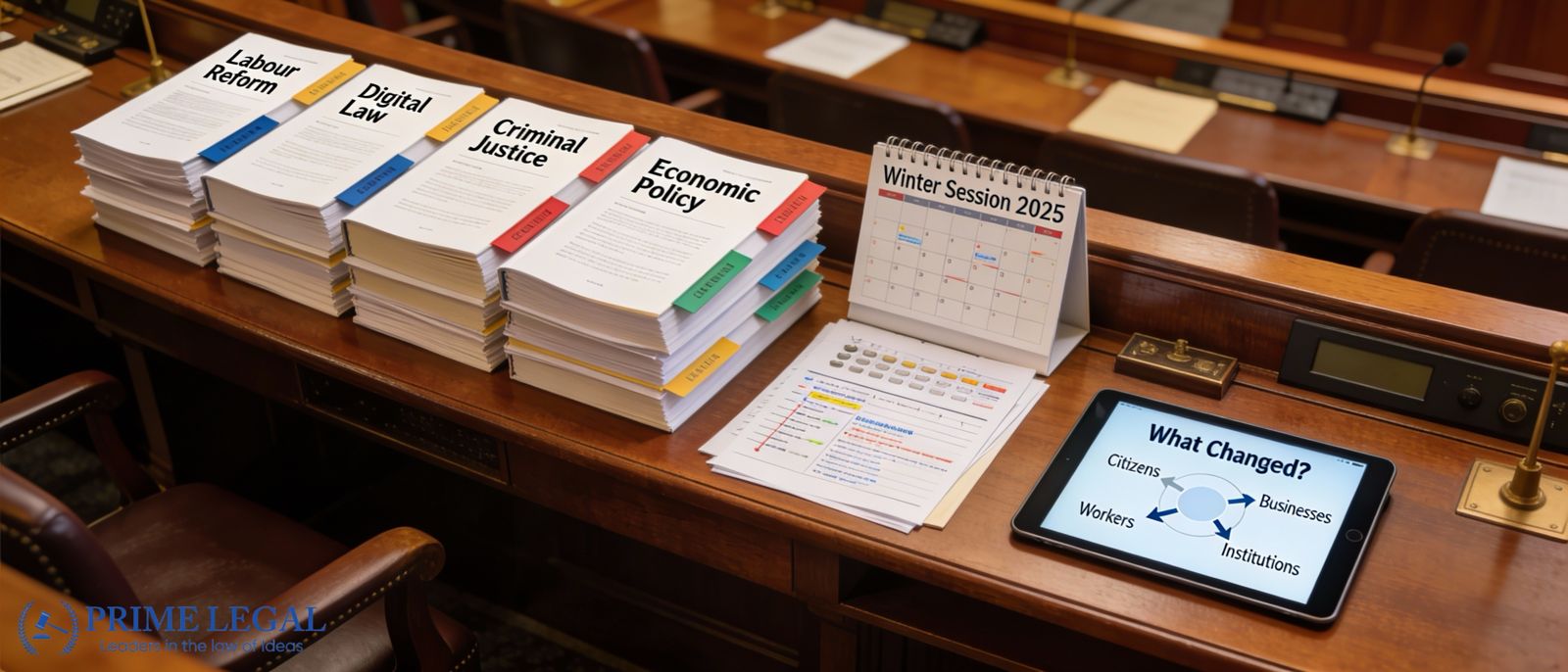
The Winter Session of the Parliament of India, which adjourned on the 19th of December, 2025, will emerge as an undying accolade in the history of the Parliament of the Republic of India. Notching an extraordinary efficiency of 110% in the Lok Sabha and 121% in the Rajya Sabha, the winter session managed to enact 8 Historic Acts, which will completely transform the rural economy, energy, and financial systems of the country. The winter session was mainly conceived on the “Viksit Bharat 2047” Vision.
BACKGROUND
The Winter Session of 2025 took place in the context of India’s dream to achieve the status of a developed country in 2047. The government wanted to remove some rigid bottlenecks in Indian society and structure that included the lack of progress in the rural job market, high capital constraints in the insurance industry, and inhibitive constraints in Indian nuclear energy policy. A major highlight in the country’s politics was actually marking 150 years of the National Song Vande Mataram.
KEY POINTS
- Guarantee for Rozgar and Ajeevika Mission (Gramin) Act
This Act replaces the MGNREGA 2005 (Mahatma Gandhi National Rural Employment Guarantee Act). This increases the statutory work guarantee from 100 days to 125 days per household. It also reduces the burden on the central government by having a shared module of 60% by the centre and 40% by the state on funding of unskilled labour, which was initially completely funded by the state. It also mandates a biometric or Aadhar-based verification module along with geo-tagging of assets to prevent misuse of funds.
2. SHANTI Act 2025
The Sustainable Harnessing and Advancement of Nuclear Energy for Transforming India (SHANTI) Act marks a shift from the Atomic Energy Act of 1962. For the first time, the law allows private and foreign companies to participate in the construction and operation of nuclear power plants (up to 49%), which were previously exclusively managed by government-owned entities. By granting a complete statutory status to the Atomic Energy Regulatory Board (AERB), it is now an independent safety regulator.
3. Sabka Bima Sabka Raksha Act
This Act aims to achieve insurance for every citizen by 2047. It has increased the FDI (Foreign Direct Investment) limit from 74% to 100%. The act to ensure National security also requires a mandate that at least one top executive (Chairman/CEO/MD) must be an Indian citizen.
RECENT DEVELOPMENTS
The session not only passed various Acts but also set several motions. The Viksit Bharat Shiksha Adhishthan Bill was introduced to replace the UGC, AICTE, and NCTE as a single, unified regulator. However, following an intense debate, it has now been referred to a Joint Parliamentary Committee for its enactment. The session also passed the Repealing and Amending Act, 2025. It removed 71 obsolete laws from the statute books to simplify the legal environment for investors.
CONCLUSION
The Winter Session 2025 has thereby dramatically reformed the “social contract” and “economic engine” of the nation. Although the VB-G RAM G Act marks the beginning of an era of increased rigor and asset creation-based social welfare policies, the SHANTI Reform Package, as well as the Insurance Reforms, provide an opportunity for the injection of unprecedented foreign investment into the country. This marks an aggressive shift towards embracing an economy that is technology-driven with market-orientation, although what this session may leave in its wake would include the fierce politics surrounding the repeal of MGNREGA-style social collateral introduced earlier
“PRIME LEGAL is a full-service law firm that has won a National Award and has more than 20 years of experience in an array of sectors and practice areas. Prime legal falls into the category of best law firm, best lawyer, best family lawyer, best divorce lawyer, best divorce law firm, best criminal lawyer, best criminal law firm, best consumer lawyer, best civil lawyer.”
WRITTEN BY: Sharanya M

