
INTRODUCTION
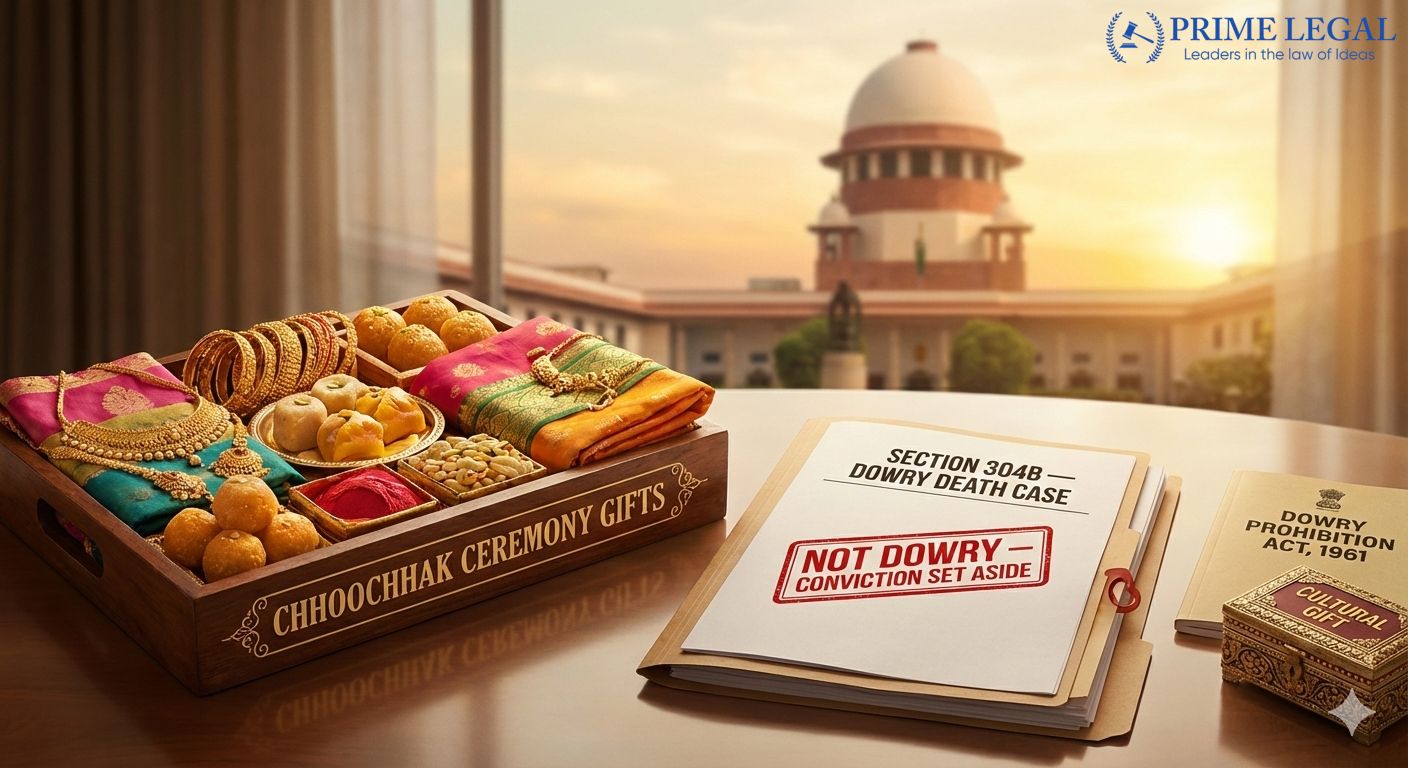
In a significant ruling by the Supreme Court of India, it held that gold gifted during the traditional chhoochhak ceremony, where the bride’s maternal family presents gifts after childbirth, cannot be treated as dowry under the Dowry Prohibition Act. The Court concluded that such customary gifts, given voluntarily and without demand, do not amount to dowry.. Consequently, the conviction of the accused under Section 304B of the Indian Penal Code, which deals with dowry death, was set aside.
BACKGROUND
The case arose from a conviction by the trial court, later upheld by the High Court, where the prosecution argued that gold ornaments received during the chhoochhak ceremony constituted dowry and formed part of the alleged harassment leading to the victim’s death. The defence argued that the gold was a traditional, voluntary gift and not part of any dowry demand. A Bench of the Supreme Court examined whether customary offerings connected with familial ceremonies can amount to dowry under Section 2 of the Dowry Prohibition Act. The Court revisited earlier precedents emphasising that dowry must involve a demand made by the husband or his relatives in connection with marriage, and voluntary gifts given out of affection or custom does not fall within this scope.
KEY POINTS
The court pointed out that when the family asked for gold during the “Chhoochhak” ceremony—basically a traditional celebration right after a baby is born—it’s just a longstanding family custom, not some demand linked to the marriage itself.
Since it had nothing to do with marriage, it didn’t qualify as “dowry” under the law.
Without dowry in the picture, the court couldn’t apply that special rule presuming a “dowry death.”
On top of that, prosecutors failed to prove the woman had been harassed or mistreated cruelly in the days leading up to her death—which the law demands for a guilty verdict.
With those key elements missing, the Supreme Court tossed out the conviction and fully acquitted the accused.
The Supreme Court’s call wasn’t just some legal technicality; it handed a man his life back. Without those key pieces of evidence, they had to scrap the conviction and fully clear him. For him and his family, it meant the nightmare was finally over—a brutal ordeal drawing to a close.
RECENT DEVELOPMENTS
Legal pros hail it as a much-needed reality check, putting up guardrails to stop the heartbreaking abuse of dowry laws that were meant to help..The case highlighted a common clash: when deep-rooted, cultural family customs—like the traditional blessing of “Chhoochhak”—are misinterpreted in the heat of a marital breakdown and wrongly presented as illegal “demands.” Such moments can turn family nuance into criminal evidence.. Women’s groups nod in agreement that it helps shield against false accusations, but they emphasize the importance of rock-solid evidence to prove genuine harassment.
CONCLUSION
This ruling smartly separates true family traditions from actual dowry demands. It drives home the point that convictions only happen when all the legal boxes are fully checked.
“PRIME LEGAL is a full-service law firm that has won a National Award and has more than 20 years of experience in an array of sectors and practice areas. Prime legal falls into the category of best law firm, best lawyer, best family lawyer, best divorce lawyer, best divorce law firm, best criminal lawyer, best criminal law firm, best consumer lawyer, best civil lawyer.”
WRITTEN BY: ARCHITHA MANIKANTAN

