
CASE NAME: Akola Municipal Corporation and Anr. versus Zishan Hussain, Azhar Hussain and Anr.
CASE NUMBER: Civil Appeal Nos. 12488–12489 of 2024
Court: Supreme Court of India
Date: December 08, 2025
QUORUM: Hon’ble Mr. Justice Vikram Nath and Hon’ble Mr. Justice Sandeep Mehta
FACTS
The present suit arises from a judgment dated October 9, 2019, of the Bombay High Court, dismissing the rise in tax levied by the municipal corporation of Akola, which had remained unchanged since 2001. The case was heard under a PIL filed by Dr. Zishan Hussain, a corporator of the Akola Municipal Corporation, stating the revision to be arbitrary and procedurally defective. The High Court thus gave the judgment favouring the petitioner. Subsequently, the corporation had also sought a review petition, but it was rejected on January 24, 2020. Therefore, the corporation had appealed the matter in the Supreme Court.
ISSUES
- Whether a Public Interest Litigation filed by a corporator challenging the property tax revision is maintainable?
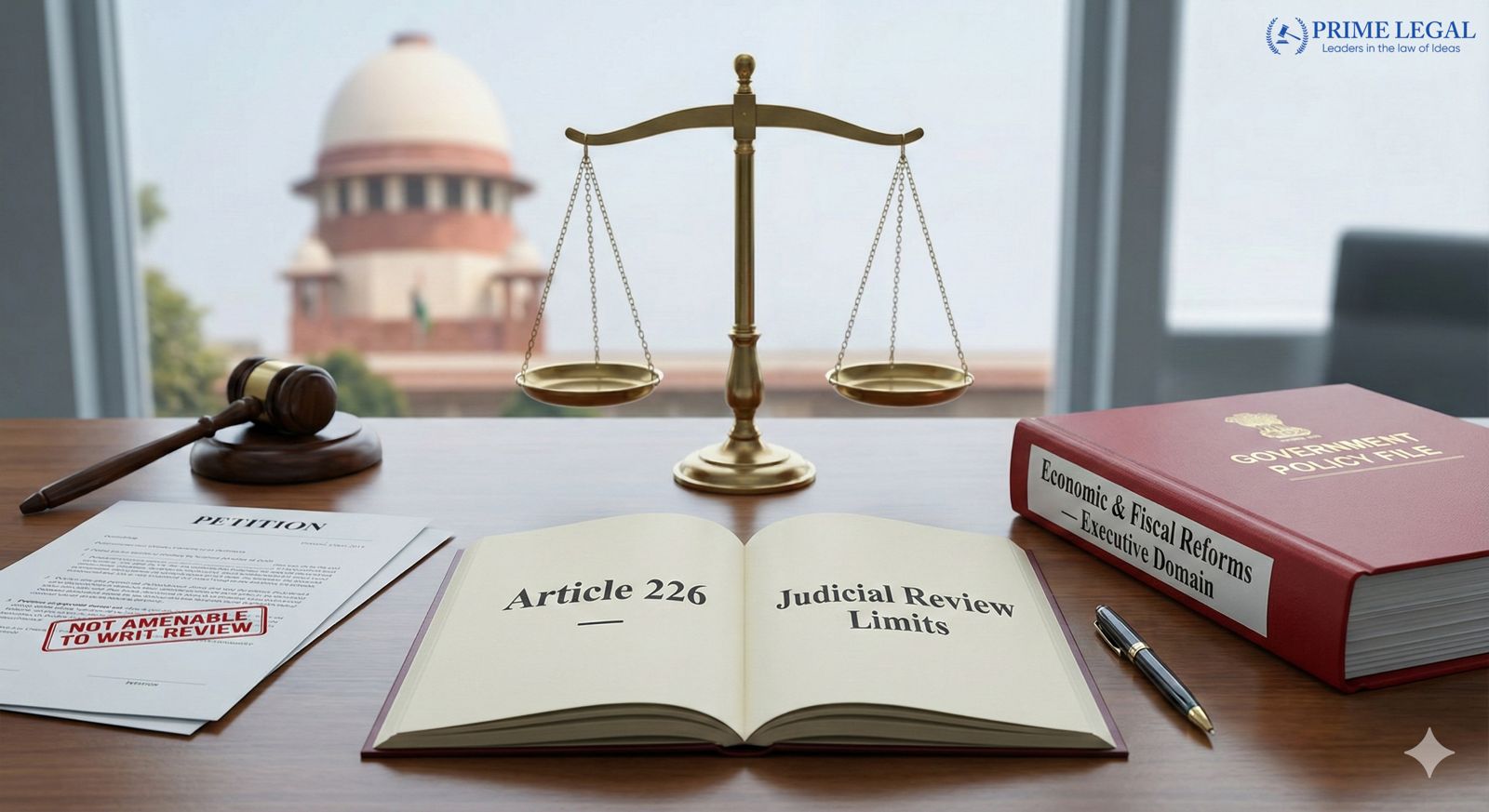
- Whether the High Court exceeded the scope of judicial review by interfering with the municipal corporation’s economic policy?
LEGAL PROVISIONS
- Maharashtra Municipal Corporations Act, 1949 – Provision for statutory remedies against municipal decisions, including tax revision.
- Article 226 of the Constitution of India – Writ jurisdiction of High Courts to enforce fundamental rights and for other purposes.
- Doctrine of Judicial Review and Judicial Restraint – Principles limiting courts from substituting policy decisions unless there is a clear violation of constitutional or statutory provisions.
ARGUMENTS:
APPELLANTS:
The municipal corporation stated that the main source of its income was the tax, which is paid by individuals. As it was unchanged since 2001, the corporation could not carry on its activities like sanitation, urban planning, etc. The corporation also contested the role of the judiciary in the present suit. It stated the court had exceeded its limit by looking into the economic policy of the corporation rather than limiting itself to the laws and procedures involved. Further, it also pointed out the misuse of the PIL, as the Maharashtra Municipal Corporations Act, 1949, itself has a statutory appeal mechanism under section 406 of the act if the parties are aggrieved by the decisions of the corporation. Therefore, it prayed for the cancellation of the judgment of the Bombay High Court.
RESPONDENTS:
The respondent challenged the property tax revision as he contended it was illegal, arbitrary, and procedurally flawed. He alleged that the corporation did not follow due process of law and that the burden laid was excessive. The respondent thus argued that the maintainability of the judgment delivered by the High Court.
ANALYSIS
The Supreme Court highlighted the usage of the PIL by the respondent. It stated that the respondent could not use the PIL as a disguise when there is already a statutory provision to address the issue at hand. It emphasized that a corporator with knowledge of municipal functioning should have sought alternative remedies rather than invoking PIL. It also stated that the court is competent to examine only the legality, procedural compliance, and constitutional violations of the municipality and not the merits or wisdom of policy choices. It also noted the revision of tax to be necessary for the proper functioning of the body and thus set aside the High Court’s judgment and upheld the validity of the actions of the municipal corporation.
JUDGEMENT
The Supreme Court thus allowed the appeals by the corporation and set aside the High Court’s judgment, and it restored the property tax revision resolutions of the Akola Municipal Corporation.
CONCLUSION
The judgment highlighted the principle of judicial restraint in economic policy matters. It also stated the limits of the use of PILs to contest fiscal and economic decisions, reinforcing that courts should intervene only on the constitutionality of the decisions of the corporation rather than the merits of the decision.
“PRIME LEGAL is a full-service law firm that has won a National Award and has more than 20 years of experience in an array of sectors and practice areas. Prime legal falls into the category of best law firm, best lawyer, best family lawyer, best divorce lawyer, best divorce law firm, best criminal lawyer, best criminal law firm, best consumer lawyer, best civil lawyer.”
WRITTEN BY: SHARANYA M

