
INTRODUCTION
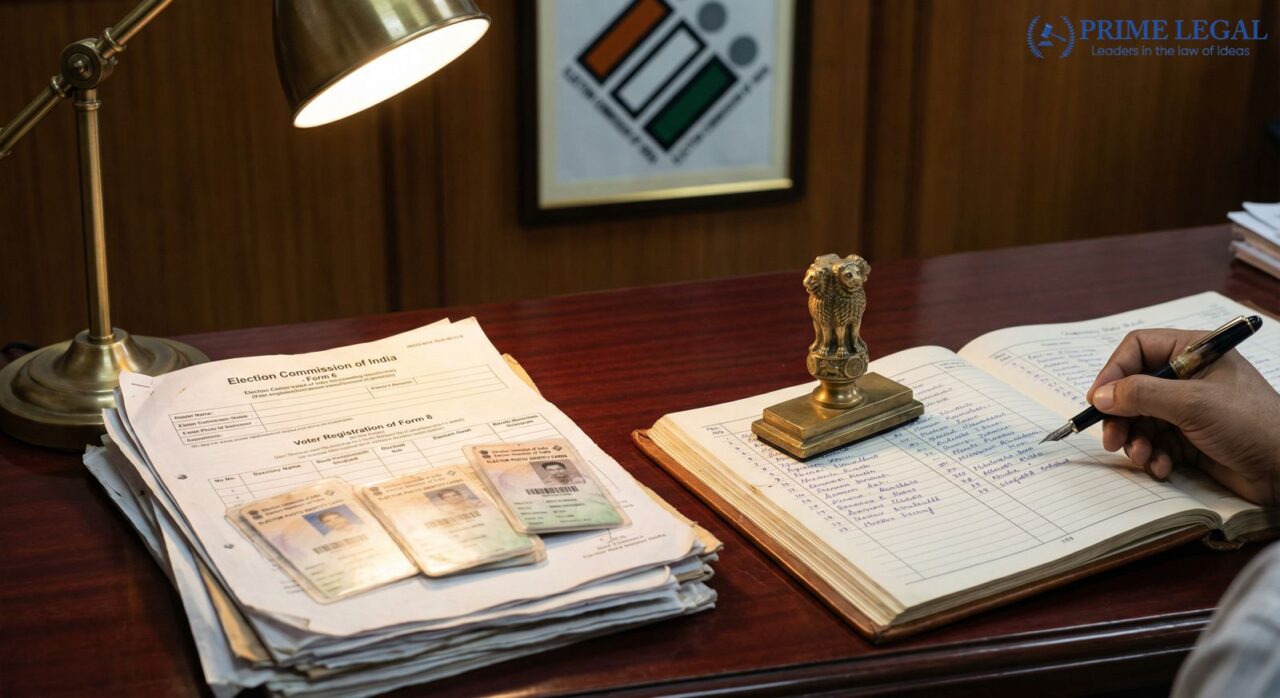
In a hearing which took place on 6th January 2026, the Supreme Court Of India examined the contentious Special Intensive Revision (SIR) of electoral roles being conducted across multiple states including UP and Bihar. A two-Judge bench consisting of Hon’ble Chief Justice of India Surya Kant and Justice Joymalya Bagchi heard extensive arguments from Election Commission Of India and petitioners challenging the constitutionality of the process of SIR. The counsel representing the petitioners, Senior Advocate Rakesh Dwivedi argued that the constitution is fundamentally citizen-centric and that the fundamental duty of the ECI is to prevent any foreign nationals from intervening in electoral rolls. The court noted the tensions which occur while balancing electoral integrity and protecting democratic rights of eligible voters as approximately 6.5 crore names from electoral rolls across 12 states and union territories have been deleted which led to widespread concerns about mass disenfranchisement.
BACKGROUND
The SIR of electoral rolls originated in Bihar during July 2025 as a verification exercise to address inaccuracies, duplications and fraudulent entries in voter rolls which had not gone through intensive revision for nearly two decades. The election commission justified this exercise citing rapid urbanization, demographic changes and concerns regarding voters appearing on multiple electoral rolls across several states. The process was subsequently extended to nine additional States and three Union Territories in October 2025, including major states, such as Uttar Pradesh, West Bengal, Kerala and Tamil Nadu. The first phase of SIR concluded in December 2025, the publication of draft electoral rules being done on 16th December 2025. The amount of deletion received a staggering response, wherein, Uttar Pradesh underwent deletion of 2.89 crore names, which is approximately 18.7% of all registered voters, while Bihar experienced deletion of 68.5 lakh votes. These deletions gave rise to several petitions from political parties, civil society organizations and state governments challenging the constitutionality of SIR and the procedure fairness it employed.
KEY POINTS
The Supreme Court’s January 6 hearing revealed fundamental constitutional questions about the ECI’s powers, the state’s duty to protect voting rights, and the balance between electoral integrity and democratic participation.
- Senior Advocate Rakesh Dwivedi submitted to the Apex court that Articles 323, 325 and 326 of the Constitution of India read with section 15, 16, 19 and 21 of the Representation of Peoples Act, 1951 do not prevent the exercise of ECI from conducting electoral roll revision. He argued that the constitution is citizen-centric and requires for the ECI to ensure that only citizens appear on electoral rules and cited Article 103 of the constitution which mandates that vital governmental appointments can only be made to citizens.
- Dwivedi went on to submit that the term “citizens” under article 326 must be inquired by a competent authority and ECI’s constitutional duty includes ensuring that electoral rolls exclude foreigners. He drew distinction between the present SIRND National Register of Citizens, stating that electoral roll preparation and citizenship verification are distinct exercises, wherein, the function of the SIR is to focus specifically on the voter roll accuracy.
- Senior Advocate Kapil Sibal, who is the counsel for petitioners from Kerala, with discrepancies such as one of the spouses in the living people deleted from the rolls while the other remained included. Senior Advocate Siddharth Dave, who is representing the petitioners from Uttar Pradesh highlighted the unprecedented manner in which deletions have occurred from the state of UP, wherein, 2.89 crore voters have raised concerns about their fundamental rights and procedural practices, while pointing out the lack of time for grievance redressal owing to the elections scheduled in the months of March and April 2027.
- The findings of the SIR prompted Trinamool Congress MPs to file a 101-page petition alleging “Whatsapp Commission” irregularities, wherein, communications made exclusively through WhatsApp messages rather than formal channels. The petition alleged centralized back-end deletion by using ERO-net portal which was undertaken without the knowledge of Electoral Registration Officers. Additionally, usage of discrete, algorithms and software for mapping the voters raised questions about transparency and arbitrariness of the Election Commission of India in the exercise of SIR.
RECENT DEVELOPMENTS
Following the arguments made on 6th January 2026, the Supreme Court directed that the argument would continue on 8th January 2026. The election commission announced procedural modifications for West Bengal by permitting family members of flagged voters to represent the voters at hearings and submit documents without requiring voters’ personal presence. An approximate of 92 lakh waters remain flagged as logical discrepancy cases from the state of West Bengal with hearing scheduled to commence from 13th January 2026 before publication of final electoral roll-on 14th February 2026. Political parties, including Trinamool Congress and opposition parties nationwide have shown support in challenging the SIR. The Supreme Court bench has scheduled continued hearings to examine the balance between ECI’s constitutional authority and voting rights of citizens.
CONCLUSION
The examination of SIR by the Apex Court represents an essential step in developments regarding conduction of elections in India, where the court is dutiful to align constitutional provisions which ensure citizen-centric governance with democratic principles for protection of voting rights. The unprecedented scale in which the deletion of 6.5 crore names has occurred across multiple states brings the question of procedural fairness, transparency, and the protection of eligible votes from arbitrary disenfranchisement. The verdict will be given by the Apex Court as to whether constitution permits mass electoral roll purges based on an exercise of citizen verification as an exercise of the ECI’s authority or whether such revisions must operate within stricter procedural safeguards to protect democratic participation
“PRIME LEGAL is a full-service law firm that has won a National Award and has more than 20 years of experience in an array of sectors and practice areas. Prime legal falls into the category of best law firm, best lawyer, best family lawyer, best divorce lawyer, best divorce law firm, best criminal lawyer, best criminal law firm, best consumer lawyer, best civil lawyer.”
WRITTEN BY: KRISHNA KOUSHIK

