
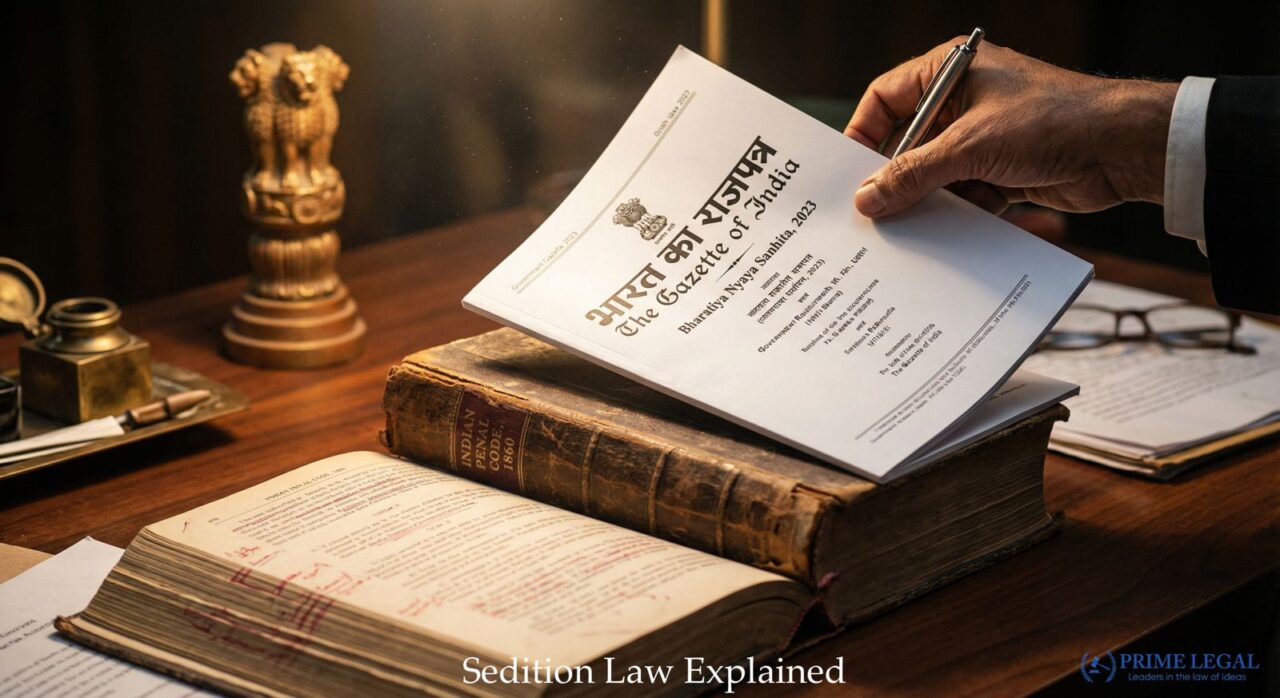
ABSTRACT
Replacing Section 124A of the Indian Penal Code with Section 152 of the Bharatiya Nyaya Sanhita marks a big change in how India handles political speech legally. While this was sold as fixing outdated colonial laws on sedition, looking at key court decisions shows it’s given the government more control—through broader definitions, tougher punishments, and some unclear interpretations. By digging into cases like Kedarnath Singh v. State of Bihar (1962) AIR 955, Tejender Pal Singh @ Timma v. State of Rajasthan (2024) S.B. Cr. Misc. (Pet) No. 5005/2024, and the legal battles such as in the case of Foundation of Independent Journalism and Anr. v. Union of India and Ors. (2025) W.P.(Crl.) No. 316/2025, in which the Senior Advocate representing the magazine stated in her arguments that Section 152 doesn’t weaken sedition laws; it just reshapes them to make enforcement stronger.
KEYWORDS: Sedition, Section 152 BNS, Section 124A IPC, Constitutional Law, Article 19(1)(a), Mens Rea, Sovereignty
INTRODUCTION
On May 11, 2022, the Supreme Court put a hold on Section 124A of the Indian Penal Code, pointing out how it had been abused over the years. From 2010 on, more than 13,000 people faced charges in about 800 cases, with journalists and activists getting hit hardest, even when there wasn’t a real threat to safety. The government’s answer was the Bharatiya Nyaya Sanhita (BNS), which kicked in on July 1, 2024, and swapped out Section 124A for Section 152, supposedly to update the law.
But if you compare them closely, it’s not what you’d expect: instead of cutting back on government power, Section 152 expands it in three main ways. It broadens the definition to include “subversive activities,” ramps up the penalties (up to seven years in jail instead of three, plus mandatory fines), and specifically covers modern stuff like online media and financial backing. This flip—where “reform” means more reach—needs a closer look.
STATUTORY COMPARISON: DEFINITIONAL STRUCTURE
Section 124A IPC went after actions that stirred up hatred or contempt toward the government, or made people feel disaffected. It let prosecutors go after people just for feelings of alienation, without needing to show any real harmful actions.
Section 152 BNS emphasizes on the acts committed “purposely or knowingly” with an aim to spark secession, armed rebellion, subversive activities or separatist feelings which pose a threat to India’s sovereignty, unity or integrity. The penalty can be up to seven years in prison and a required fine.
On the surface, swapping vague “disaffection” for specific offenses seems like an improvement, but leaves space for a lot of ambiguity. “Subversive activities” refers to actions which undermine political systems and authorities,, which include into its definitions the organizing workers who fight for the environment and other activists which causes for the phrase to be perceived to be about endangering sovereignty and basically brings back the old flexibility of Section 124A under new words. So, what looks precise widens the net.
JUDICIAL HISTORY
Kedarnath Singh v. State of Bihar (1962) AIR 955
This five-judge bench verdict laid down for there to be an act of sedition, there needs to be a clear nexus between what someone says and either pushing violence or causing public disorder. Justice B.P. Sinha, who authored the judgement has held that the core of sedition is the intent to cause public disorder using speech and that intense form of criticism was okay under Part III of the Constitution if it didn’t cross that threshold.
Tejender Pal Singh @ Timma v. State of Rajasthan (2024) S.B. Cr. Misc. (Pet) No. 5005/2024
Justice Arun Monga’s ruling was one of the first instances of indulgence into Section 152 of BNS. In a case which involved a Sikh preacher who has been charged for a catena of Facebook posts which indicate sympathy for Amritpal Singh, Justice Monga noted that Section 152 contains its genesis in Section 124A and bears an uncanny resemblance to the offence originally introduced by the British.
Instead of just accepting the new law, this led to a tougher review, wherein, there was an elaboration that only deliberate actions with malintent and the speech limits need to have a direct link to a likely rebellion or secession. The clear and present danger test laid down in the case of Kedarnath Singh v State of Bihar was upheld in this case.
Foundation of Independent Journalism and Anr. v. Union of India and Ors. (2025) W.P.(Crl.) No. 316/2025
When Assam Police issued an arrest warrant for The Wire’s editor over reporting on government stuff, it sparked a major challenge to Section 152. The Supreme Court gave temporary relief on August 12, 2025, bundling several petitions questioning the law’s validity.
The remarks made by Senior Advocate Nitya Ramakrishnan who stated Section 152 of BNS as a practice of repackaged sedition with misuse built in led for the Court to reach a conclusion that arresting of journalists is unnecessary without a proof of direct incitement and imminent threat to public order.
THE ENLARGEMENT OF STATE POWER
Switching from terminology from “disaffection” in Section 124A of the IPC to “subversive activities” in Section 152, BNS leads to a lot of leeway for the state go after challenges to institutions even if they’re not violent or disruptive, even if they are not inherent in nature. The increase of punishment in the form of jail time from three to seven years, in addition to mandatory fines, leads for the government to gain a superior position. Moreover, the inclusion of wording such as electronic communication networks and financial means signals towards the applicability of digital opinions, social media posts and crowdfunding activities being prone to scrutiny.
CRITICAL DISTINCTIONS AND SIGNIFICANT MODIFICATIONS: A DETAILED COMPARISON
The differences between Section 124A IPC and Section 152 BNS show up in six key areas, highlighting both tweaks and a real boost in government authority on sedition.
On the mental side, Section 124A didn’t spell out mens rea, so courts had to figure intent from the situation. That meant charging people solely for their political opinions without having proof of whether they meant harm. Section 152 of BNS, however, requires that acts be done purposely or knowingly, setting a clear mental state. But “purposely” and “knowingly” are different, so prosecutors might claim knowledge even if purpose isn’t clear, especially with shared posts or money transfers.
In its definition, Section 124A imbibes a broad idea of disaffection toward Government and focuses on feelings over actions. Section 152 pinpoints on words such as “secession,” “armed rebellion,” “subversive activities,” and “separatist feelings.” Still, the term “subversive activities” causes for there to be enough ambiguity to include fair dissent for labour rights or environmental upgradation.
Punishments show a big jump in state muscle. Section 124A maxed at three years, with fines optional. Section 152 of BNS increases the jail period to seven years and mandates fines which leads to there being distress to the parties who lack financial resources. On the other hand, Section 124A of vested courts with the power to pronounce terms of imprisonment, fines or both for fairness.
Section 124A emphasized on “words, spoken or written, or by signs, or otherwise,” before the technologically advanced era. Section 152 directly contains terms such as “electronic communication” and “financial means,” creating emphasis for the benefit of judicial bodies. It’s clearer, but that clarity actually broadens the reach to digital speech right away.
Even though it’s not in the text, the law’s history matters. Section 124A came from the 1870 British law to crush nationalists. Section 152 of BNS, while being deemed new in nomenclature, borrows the pre-existing practices and functions from its predecessor. The court in Tejender Pal Singh calling it a descendant of Section 124A has pushed more constitutional checks instead of assuming it’s fixed.
Overall, the changes, while adding formal improvements like mens rea and specific acts, also expand power with wider scope and harsher penalties. It’s not a real weakening of sedition law but a smart tweak that keeps the old ideas while making it stronger. This irony deems which claims to be a reform as expansion accurately defines sedition law post-2023.
ADVANTAGES AND CONCERNS
The mens rea rule should force proof of real intent in a manner wherein, it lists specific offenses is clearer than vague “disaffection” and covers all the necessary modern comms and cuts down on guesswork while the nomenclature which includes “subversive activities” is still too loose, potentially catching fair criticism which leads to the attraction of mandatory fines causing prejudice to the principles of proportional justice. This, coupled with explicit digital rules lead to intensifying of state control which leads prosecutors to treat mens rea as a minor bump rather than a real barrier.
CONCLUSION
Section 152 is more of a recalibration than a true reform of sedition law: narrower on paper with mens rea and listed acts, but broader in practice through wider definitions, tougher punishments, and updated tech. The courts since 2023, like in Tejender Pal Singh with its Kedarnath nod and The Wire’s imminent threat rule, might rein it in. But whether that sticks under pressure will show if India moves toward real democracy or just a slicker version of an old problem. Keeping a constitutional eye on it is crucial as lower courts balance judicial caution with prosecutorial push in Section 152 cases.
“PRIME LEGAL is a full-service law firm that has won a National Award and has more than 20 years of experience in an array of sectors and practice areas. Prime legal falls into the category of best law firm, best lawyer, best family lawyer, best divorce lawyer, best divorce law firm, best criminal lawyer, best criminal law firm, best consumer lawyer, best civil lawyer.”
WRITTEN BY: KRISHNA KOUSHIK

