
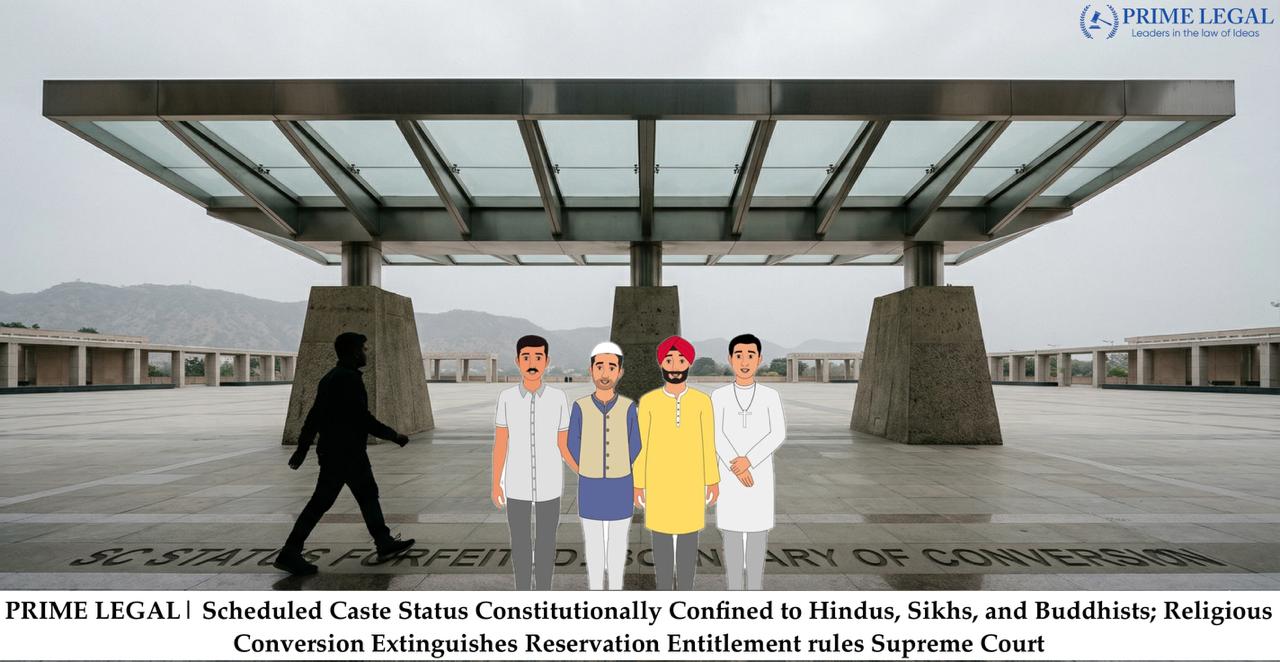
CASE NAME: CHINTHADA ANAND v. STATE OF ANDHRA PRADESH
CASE NO: Criminal Appeal number 1580 of 2026.
COURT: Supreme Court of India.
DATE: 24 March 2026.
QUORUM: Justice Prashant Kumar Mishra and Justice Manmohan.
FACTS:
This case arose from an appeal filed by the petitioner named Chinthada Anand. He was a resident of Guntur district in the state of Andhra Pradesh, who originally belonged to the Madiga community, which is stated as a scheduled caste. Before the occurrence of the incident, he had been working as a Christian pastor and was also conducting regular Sunday prayer meetings in his village. And according to the, in December 2020 he began receiving abusive threats from the local lights and unknown phone calls where he was being threatened by the individuals wherein cast based insults were allegedly used against him due to his religious activities in the village.
The first incident occurred in this case on 3 January 2021. During a prayer meeting at a villager’s house one of the accused allegedly. Called him outside and slapped him, physically assaulted him and used cast bait slurs and warned him not to continue such religious practices in the village or in the religious gatherings because of his caste. His caste and him being a converted Christian pastor was a question in the village, and he was abused based on that, and was told not to practice in any of the village gatherings.
The second serious incident occurred on 24th January 2021 where after finishing a prayer meeting, the appellant was allegedly stopped by the accused and along with a group of others, he was wrongfully restrained, dragged, beaten and abused publicly by the people referring to his caste. He was also allegedly threatened with death and harm to his family members if he continued to profess this.
Troubled by all these accusations and death threats, the appellant he lodged a complaint on 25 January 2021, based on which an FIR was registered on 26th January 2021 under the provisions of SC/ ST (Prevention of Atrocities) Act, 1989, along with certain sections mentioned under IPC, such as 341, 323, 506 read with section 34 of the Code. At the time of the investigation of the case, the statements of several witnesses were being recorded, and the appellant was also being examined medically where it got revealed that the appellant got some minor injuries which are simple in nature. A caste certificate confirmed that he belonged to the Madiga community while the accused belonged to the Reddy community and after completion of investigation a charge sheet was filed.
The appellant in this case approached the High Court under Section 482 of CrPC seeking quashing of the proceedings, primarily on the ground that the appellant had converted to the religion of Christianity and was functioning as a pastor, and therefore could not claim the status of scheduled to cast under the Constitution as he has converted his religion. The High Court has accepted this contention and quashed the proceedings and aggrieved by this order, the appellant, he approached the Supreme Court.
ISSUES:
- Whether a person who has converted to Christianity can claim schedule, cast, status and protection in the SC/ST Act.
- Whether the High Court was justified in quashing the criminal proceedings under Section 482 of CrPC.
- Whether the allegations under the IPC and SCSC Act disclose a prima facie case.
LEGAL PROVISIONS:
- Article 341- Identification of schedule casts.
- Article 342- Identification of Scheduled tribes.
- Clause 3 of the Constitutional (Schedule Castes) Order 1950- States only Hindus, Sikhs, Buddhists have the status of Schedule Caste.
- Section 482 of CrPC (BNSS Section 528) – Inherent powers of the High Court.
- Section 341 of IPC (BNS Section 126 )- Wrongful restraint.
- Section 323 of IPC {BNS section 115(2) }-Voluntarily causing hurt.
- Section 34 of IPC (BNS section 3(5)} -Common intention.
ARGUMENTS:
APPELLANT:
We added in this case argue that the high erred Ink washing the proceedings despite the existence of a primer fussy case, he in this case contended that he was a subject to physical assault, caste based abuse and death threats and criminal intimidation, and that these allegations were supported by the complainant and witness statements. He further argued that he was being discriminated based on his caste and the religion he is professing now. He argued in this case that his cast is being determined by birth, and it does not erase the social stigma Just because he has converted his religion to Christianity. And therefore, he claims that he should still be entitled to protections under SC/ ST Act.
The side of the appellant in this case is relied on the government order issued by the state of Andhra Pradesh, which extended certain benefits to schedule cars converts to Christianity. This indicated recognition of continued social disadvantage even after conversion. With conversion, his social stigma would not be erased, and he would still be entitled to those rights, is what is being stated by the appellant in this case. Further, he contends that the High Court has exceeded its jurisdiction under Section 482 of CRPC by evaluating evidence in detail instead of merely assessing whether a prima facie case existed or not.
RESPONDENT:
The respondent in the case supported the decision by the High Court of quashing the appellant’s appeal. He said the appellant, being a practicing Christian and a pastor for over a decade; he could not claim the rights given under the Schedule caste status considering 3 of the Constitution Order 1950. The respondents strictly argued that he is not entitled to the rights given under schedule castes as he has converted and has been practicing as a pastor for more than a decade in the village.
The Indian law clearly excludes and emphasizes that persons professing religions other than Hinduism, Sikhism and Buddhism from being recognized as Scheduled Castes which states that since he has converted to Christianity and he’s been professing the religion for more than a decade as a pastor, he will not be entitled to the rights given in Scheduled Castes. The respondent argued that the allegations made under the IPC (now replaced by BNS) sections were not supported by reliable evidence or witnesses. No such statements were being supported by the witnesses and therefore continuation of proceedings would amount to abuse of process as the witness statements did not corroborate the appellant’s claims of assault, intimidation in this case.
ANALYSIS:
The Supreme Court in this case analysed all the facts and evidence mentioned and also undertook a detailed analysis of the constitutional framework governing the schedule casts. It has emphasized that the Constitution Schedule casts Order 1950 is Decisive in determining Supreme Court’s status and Clause 3 clearly excludes persons who profess religions other than Hinduism, Sikhism or Buddhism in the country won’t be entitled to enjoy the rights given under scheduled castes. Hereby the Court interprets that the term profits which means declaration or practice of a religion which the appellant was doing from a decade by converting to a Christian pastor, conducting regular Christian prayer meetings in the village and performing religious duties which clearly demonstrated that he has openly professed Christianity and hence should not be entitled to the benefits given under Scheduled Caste and the case should be dismissed as the proceedings would amount to abuse of process.
The court has also analysed the fact that once a person converts to Christianity, he ceases to be recognized as a member of a Scheduled Caste under the law as he has given up his religion in which he was being entitled to such rights since birth. The court also mentions that if the person converts to another religion, the rights he’s been enjoying in the previous religion would not be entertained and he would lose the rights regardless of his birth under the law. Hence, the Court clarifies that the social discrimination may persist in this case, but the legal recognition of Scheduled Caste status is governed strictly by constitutional provisions. And hence the court relied on the discriminatory factor that’s been caused to the appellant and did not entertain the status regarding Scheduled Caste rights. The court observed that the evidence Mentioned in this case and found significant inconsistencies with the witness’s statements. Key witness in this case did not support the appellant’s version of events and there was no clear evidence of assault, wrongful restraint or criminal intimidation against the appellant. The claim mentioned by the appellant that he was being assaulted by a large group of assailants was not corroborated as the medical evidence shows only simple injuries are caused to the appellant. Referring to the case of State of Haryana v. Bhajan Lal AIR 1992 SC 604, the court held that the allegations did not disclose a prima facie case and that the continuation of proceedings would amount to abuse of process and stated that there’s no need to proceed the case further.
JUDGMENT:
Hence, the Supreme Court upheld the decision of the High Court and dismissed the appeal. In this case, it held that the appellant, having converted to Christianity and openly professing that religion, could not be considered a member of Scheduled Caste under the Constitution Order of 1950. Consequently, he was not even entitled to invoke the provisions of SC/ST Act, the court further held that the allegations made under this case by the appellant were not supported by sufficient evidence and therefore the High Court has quashed the proceedings under section 482 of CRPC. And hence the case stays closed.
CONCLUSION:
The Supreme Court held that a person who has converted to a Christianity cannot claim scheduled car status under the Constitution Order 1950 as such status is limited to those who are professing the religion, Hinduism, Sikhism or Buddhism. If the religion is other than the mentioned religions, it wouldn’t be entertained the rights given under schedule castes Since the applet was a practicing Christian pasture, he was not entitled to protection under the SC/ST Act and the court did not find any allegations regarding the criminal intimidation. As there was no sufficient evidence and therefore the court was justified in quashing the decisions and the appeal was dismissed.
“PRIME LEGAL is a National Award-winning law firm with over two decades of experience across diverse legal sectors. We are dedicated to setting the standard for legal excellence in civil, criminal, and family law.”
WRITTEN BY: MEENAKSHI DANGI.
Read the Judgment copy here

