
CASE NAME: RENUKA v. THE STATE OF MAHARASHTRA AND ANOTHER (2026)
CASE NUMBER: CRIMINAL APPEAL NO. OF 2026 (@ SLP (CRL.) NO.7829 OF 2023)
COURT: IN THE SUPREME COURT OF INDIA, CRIMINAL APPELLATE JURISDICTION
DATE: 09 April 2026
CORAM: HON’BLE MR. JUSTICE J.K. MAHESHWARI AND HON’BLE MR. JUSTICE ATUL S. CHANDURKAR
FACTS
The case involves a financial dispute and a matrimonial dispute between Renuka, who is the appellant, and her husband Mr. Ashwin Natwarlal Sheth. The parties involved in the dispute claimed that the other party had illegally transferred shares from two companies, which operated as Sheth Developers and Realtors (India) Limited and Sheth Developers Private Limited.
The two parties reached a settlement agreement on 12th January 2022 to solve their ongoing disputes. The husband made a deal to transfer three floors of the “Natwar Bungalow” property to Renuka in exchange for paying her Rs. 50 crores. Renuka received the payment after she signed the Declaration-cum-Indemnity document, which required her to withdraw all her complaints. The husband used his close associate (the second respondent) as a guarantor to secure the arrangement, which included holding the funds in escrow. He issued a cheque worth Rs. 50 crores to Renuka as part of the agreement. Renuka completed her obligations by signing all necessary documents. She then found out that the shares had been sold because the other party had broken the deal.
The bank dishonored the cheque Renuka presented because it showed that the drawer had stopped payment. She issued a legal notice after she filed a complaint under Section 138 of the Negotiable Instruments Act. The Magistrate found sufficient grounds and issued summons. The Sessions Court and the High Court later dismissed the case because they found no legally enforceable debt. Renuka filed her appeal to the Supreme Court because she was dissatisfied with this outcome.
ISSUES
- Whether the Sessions Court and High Court made the correct decision when they rejected the complaint before the trial because they determined the cheque did not represent a legally binding debt.
- Whether the statutory presumption established by Section 139 of the NI Act cannot be disputed and eliminated before the trial commences.
- Whether the Magistrate issued process (summons) correctly based on the evidence that the complaint presented.
LEGAL PROVISIONS
- Section 138, Negotiable Instruments Act, 1881
- Section 139, Negotiable Instruments Act,
- Article 227, Constitution of India
ARGUMENTS
APPELLANT (RENUKA):
Senior Advocate Mr. Mukul Rohatgi defended the appellant through his legal arguments.
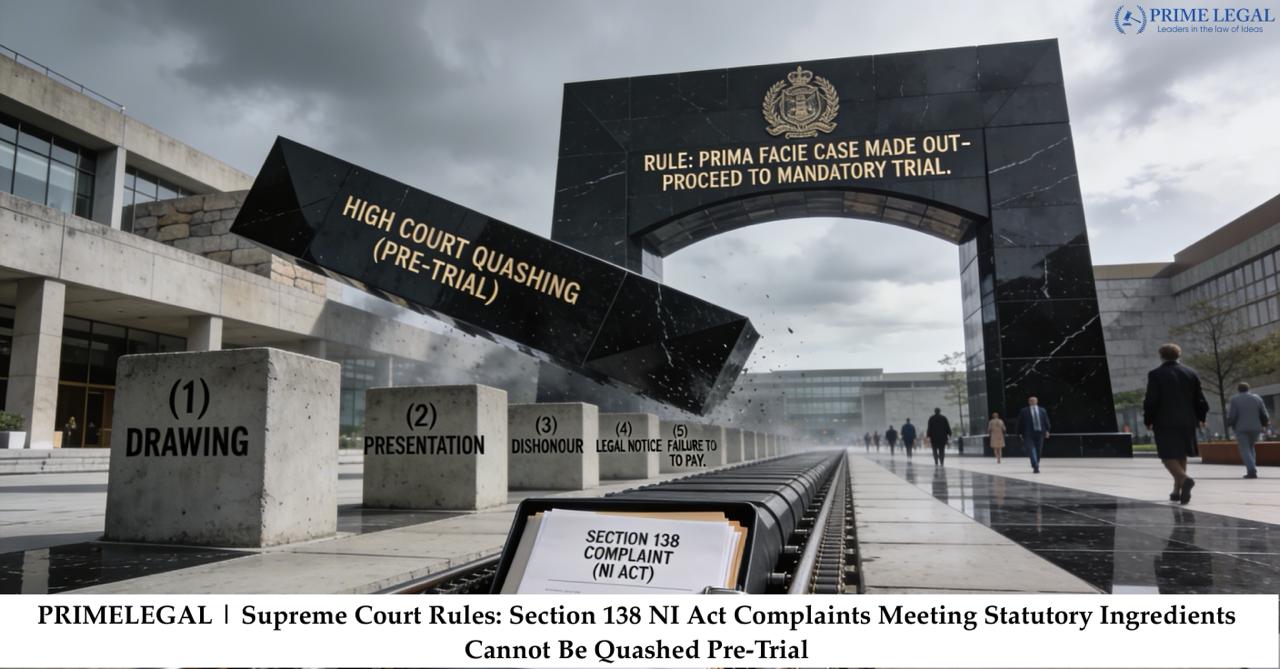
- The Magistrate reached the correct conclusion because all basic elements of Section 138 requirements were fulfilled through the following sequence of events: the cheque issuance, cheque presentation, cheque dishonour, delivery of legal notice, and timely filing of complaint.
- The law establishes a presumption which proves that the cheque represents a valid debt obligation after the basic requirements get fulfilled according to Section 139. The second respondent can only challenge this presumption through evidence which will be presented during the trial.
- The Sessions Court should have proceeded with the case instead of dismissing it before trial. The court must wait until both parties present their proof about the existence of a valid debt.
- The Sessions Court incorrectly interpreted the Supreme Court ruling from Sunil Todi v. State of Gujarat (2021) because the decision actually supports resolving disputed matters through trial proceedings.
RESPONDENT (SECOND RESPONDENT):
Dr. A.M. Singhvi represented the second respondent as his legal advocate.
- The second respondent never signed the settlement agreement which was created on 12th January 2022. Therefore, he was never legally bound by it.
- The second respondent had no legal obligation to pay Rs. 50 crores because the agreement remained unfinished.
- The cheque existed only to serve as a precautionary/escrow measure and not for settling any existing financial obligation.
- The case should not proceed because it would misuse the judicial system which had no legitimate obligations that required enforcement. The ruling in Sunil Todi (supra) provides grounds for dismissal because payment depends on a non-existent event.
ANALYSIS
- The Supreme Court defined its investigation boundaries which it would pursue during summons proceedings. The Magistrate needs to determine now whether the essential elements of Section 138 have been proven according to the rules which govern this initial assessment. The requirements for the case were clearly fulfilled so the Magistrate correctly authorized the legal process to begin.
- The Court then emphasized the importance of the statutory presumption under Section 139. The law establishes that after proving the cheque was issued and subsequently dishonoured the cheque was used to create an enforceable debt. The presumption requires the accused to demonstrate that the debt does not exist which they must prove through evidence during the trial.
- The Court established that the Sessions Court made a major mistake when it assessed debt validity before the pre-trial process began. The court established this because it removed the statutory presumption which needed to be disputed during the trial process. The Supreme Court stated that this method violates the essential function of Section 139.
- The Court found that the respondent did not sign the settlement agreement but he still issued the cheque. The combination of his actions with the dishonoured cheque and legal notice led to the establishment of a legal presumption according to the law. The court needed to investigate whether the cheque represented an actual obligation or functioned as security during the trial through evidence examination.
- The Court based its decision on previous cases which included Rangappa v. Sri Mohan 2010 INSC 289 which established that presumption under Section 139 includes existence of legally enforceable debt and Rajesh Jain v. Ajay Singh 2023 INSC 888 which confirmed that burden shifts to accused after cheque and its dishonour proof.
JUDGMENT
The Supreme Court accepted the appeal and annulled the decisions which the Sessions Court and the Bombay High Court had issued. The Court reinstated Renuka’s complaint and ordered that the case should proceed to trial based on its specific merits. The Court explained that its research findings should only apply to the current procedural stage while remaining separate from the final trial results.
CONCLUSION
According to this ruling, courts must wait until all evidence is presented before they can decide on cheque dishonor cases. The law intentionally places a presumption in favour of the cheque holder to ensure credibility in financial transactions.
“PRIME LEGAL is a National Award-winning law firm with over two decades of experience across diverse legal sectors. We are dedicated to setting the standard for legal excellence in civil, criminal, and family law.”
WRITTEN BY: PRANAVI KOLLU
read the judgement copy here

