
INTRODUCTION
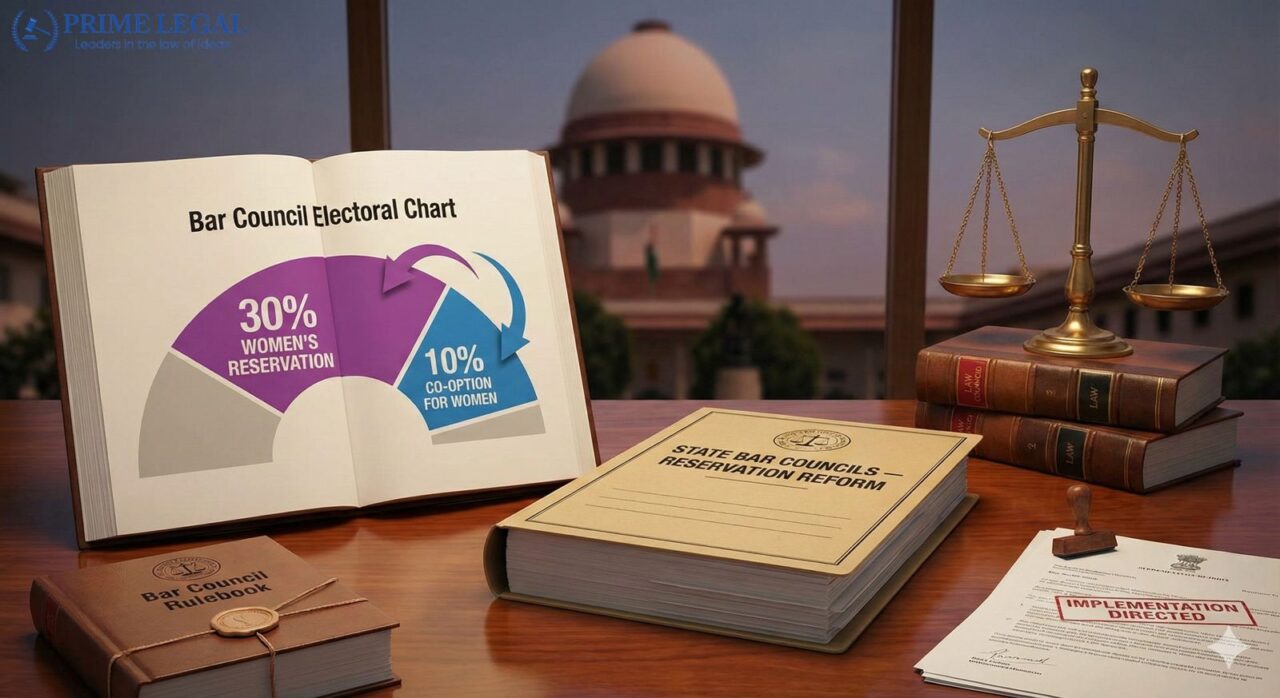
The Supreme Court has delivered a landmark ruling by improving women’s representation in all state bar councils to at least 30% of their elected members. The Court addressed the persisting structural barriers in the system. The Court has allowed Councils to co-opt women members whenever elections do not yield the required number. The ruling seeks to foster balanced decision-making within the legal profession.
BACKGROUND
The ruling came in response to petitions pointing out that women advocates still have very little say in Bar Council bodies. The Court observed that although more women are entering the legal profession, very few reach leadership positions. The Court emphasized that Bar Councils play a significant role in regulating the legal profession, and less number of women in leadership positions indicates huge imbalances and bias. It further held that structural inequalities are to be addressed and that they require targeted measures to ensure equal representation.
KEY POINTS
- The Supreme Court has directed all State Bar Councils to ensure at least 30% women’s representation in their elected bodies, achieved either through the election process or, when necessary, through co-option.
- To ensure that the mandated quota for women is met, co-option has been allowed as an immediate measure when elections fall short in producing enough women members.
- The Court highlighted that gender inclusivity remains as one of the main objectives of the Advocates Act.
- The Bench clarifies that this measure is temporary and holds good until the minimum requirement for women’s representation is met and it aims to eliminate the persisting gender inequality and structural barriers.
- The Court further noted that the existing level of representation for women does not match the constitutional principles such as equality and non-discrimination, which made judicial intervention necessary.
RECENT DEVELOPMENTS
After this particular ruling, many State Bar Councils have begun reviewing their internal structures. Some of them started to alter their rules to comply with the Court’s decision. The Bar Council of India has shown a positive outlook towards the ruling. It has also begun to draft guidelines to ensure it is consistently followed across multiple states.
CONCLUSION
This judgment represents a major milestone in the governance of India’s legal profession. By guaranteeing 30% representation of women, the Court has improved the Constitution’s strength and meaningful participation. Ultimately, it is considered as a huge step in the legal profession as it makes leadership roles reflect on the society’s needs.
“PRIME LEGAL is a full-service law firm that has won a National Award and has more than 20 years of experience in an array of sectors and practice areas. Prime legal falls into the category of best law firm, best lawyer, best family lawyer, best divorce lawyer, best divorce law firm, best criminal lawyer, best criminal law firm, best consumer lawyer, best civil lawyer.”
WRITTEN BY: ARCHITHA MANIKANTAN

