
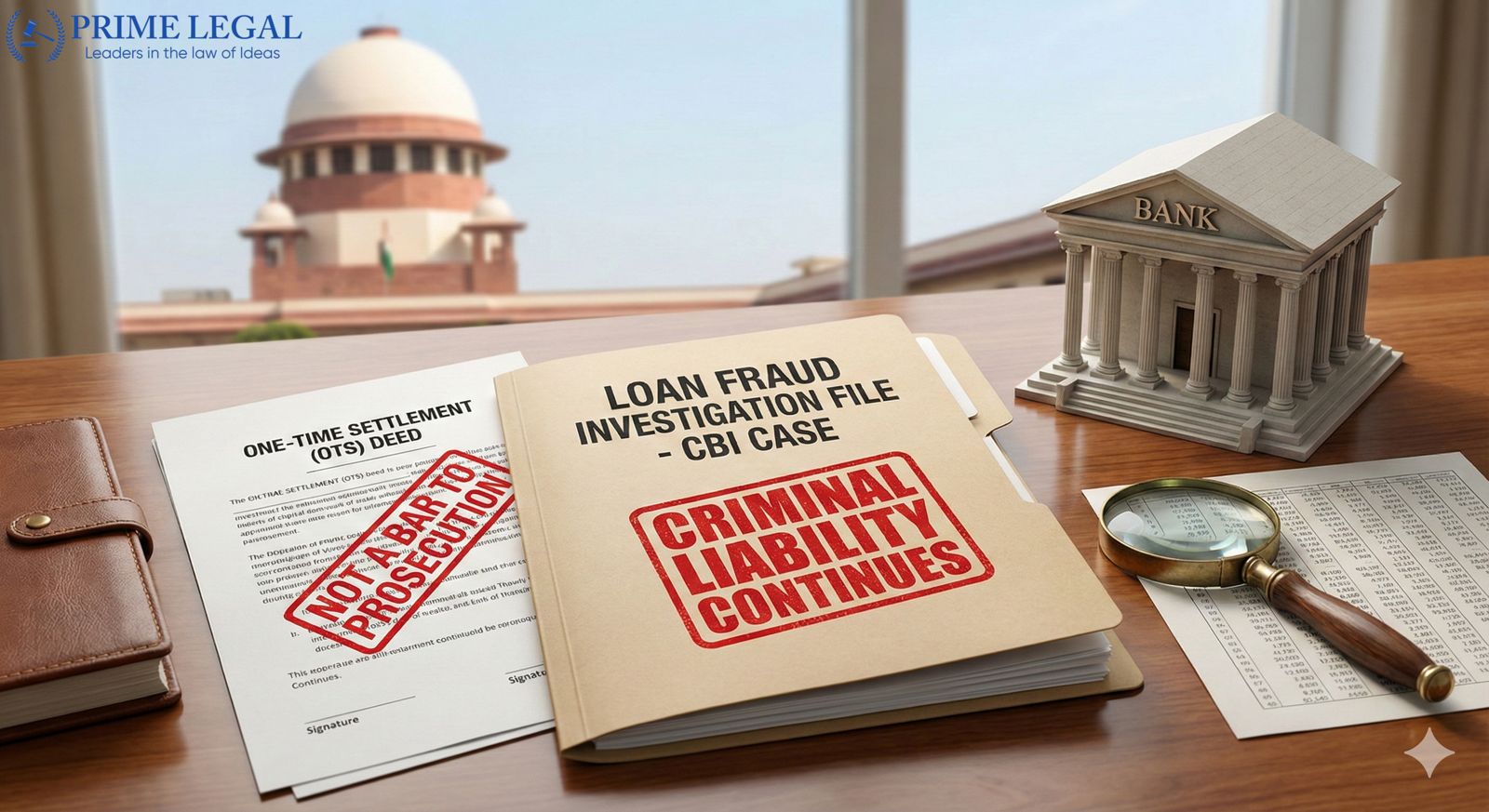
CASE NAME: Central Bureau of Investigation v. M/s Sarvodaya Highways Ltd. & Ors.
CASE NUMBER: Criminal Appeal (Arising out of SLP (Crl.) No. 11108 of 2022)
COURT: Supreme Court of India
DATE: 11 November 2025
QUORUM: Justice Vikram Nath, Justice Sandeep Mehta
FACTS
The case began with an FIR filed by the CBI in 2015, after it came to light that M/s Sarvodaya Highways Ltd. and its Directors had managed to obtain bank credit of ₹50 crore (fund-based) and ₹10 crore (non-fund-based) from the State Bank of Bikaner and Jaipur by relying on fake work orders, inflated stock details, and manipulated revenue records. When the company stopped repaying the loan, the Bank declared the account as an NPA and carried out an internal inquiry. This inquiry revealed a much larger fraud—about ₹52.50 crore—and showed that three of the submitted work orders were completely fabricated, while others were linked to related companies with overlapping Directors. The collateral documents offered to the Bank were also found to be forged.
During its investigation, the CBI concluded that the company’s Directors had acted together with the then Branch Manager, who played a role in enabling the fraud. Sanction was granted to prosecute him as well. Despite these findings, the Punjab & Haryana High Court quashed the FIR and the chargesheet, relying solely on the fact that the company had reached a one-time settlement of ₹41 crore with the Bank.
ISSUES
1.Whether the High Court erred in quashing criminal proceedings solely on the basis of a one-time settlement.
2. Whether economic offences involving fraud on a bank can be treated as civil disputes and closed through compromise.
3. Whether quashing the chargesheet would improperly benefit the Bank Manager against whom valid sanction for prosecution was granted.
4. Whether continuing the proceedings were justified despite loan recovery
ARGUMENTS
APPELLANT
The CBI maintained that the High Court had ignored clear and compelling evidence showing that the company had forged documents, fabricated records, and carried out a planned fraud with the active involvement of the bank manager. The Court emphasized that settling the loan does not erase criminal responsibility, especially when public money has been lost. It added that dropping the case would essentially let the bank manager avoid accountability, defeating the purpose of criminal prosecution. It further pointed out that quashing the case would lead to the manager erasing accountability which would defeat the whole purpose.
RESPONDENTS
The respondents argued that once the Bank accepted the one-time settlement and issued “no dues” letters, there was no real reason to continue with the criminal case. They argued that the matter was basically a civil dispute over loan recovery, and once the dues were settled, there was no reason for the criminal case to continue.
ANALYSIS
The Court emphasized that economic offences of this nature have a larger impact on the financial system and society as a whole, and therefore cannot be brushed aside simply because the borrower has settled some part of the dues.The Court also noted that the precedents cited by the respondents did not apply to the present case. Those earlier cases didn’t involve offences under the Prevention of Corruption Act, proven forgery, or situations where the Bank recovered less than what was actually owed. Given these differences, the Court held that the High Court’s reasoning was legally flawed.
JUDGEMENT
The Supreme Court allowed the appeal, overturned the Punjab and Haryana High Court’s order, and reinstated the criminal proceedings based on the chargesheet dated 30 November 2016. The Court also made it clear that the trial should move forward on its own merits and should not be influenced by anything said in the Supreme Court’s judgment.
CONCLUSION
The judgement noted that crimes like corruption cannot be erased through financial settlements. Even if a bank recovers part of its losses, offences involving forgery, fraud, and collusion with public officials must be prosecuted to protect public interest and maintain integrity in the financial system. The ruling restores the primacy of criminal accountability in cases of bank fraud and prevents misuse of settlement mechanisms to evade prosecution.
“PRIME LEGAL is a full-service law firm that has won a National Award and has more than 20 years of experience in an array of sectors and practice areas. Prime legal falls into the category of best law firm, best lawyer, best family lawyer, best divorce lawyer, best divorce law firm, best criminal lawyer, best criminal law firm, best consumer lawyer, best civil lawyer.”
WRITTEN BY: ARCHITHA MANIKANTAN

