
INTRODUCTION
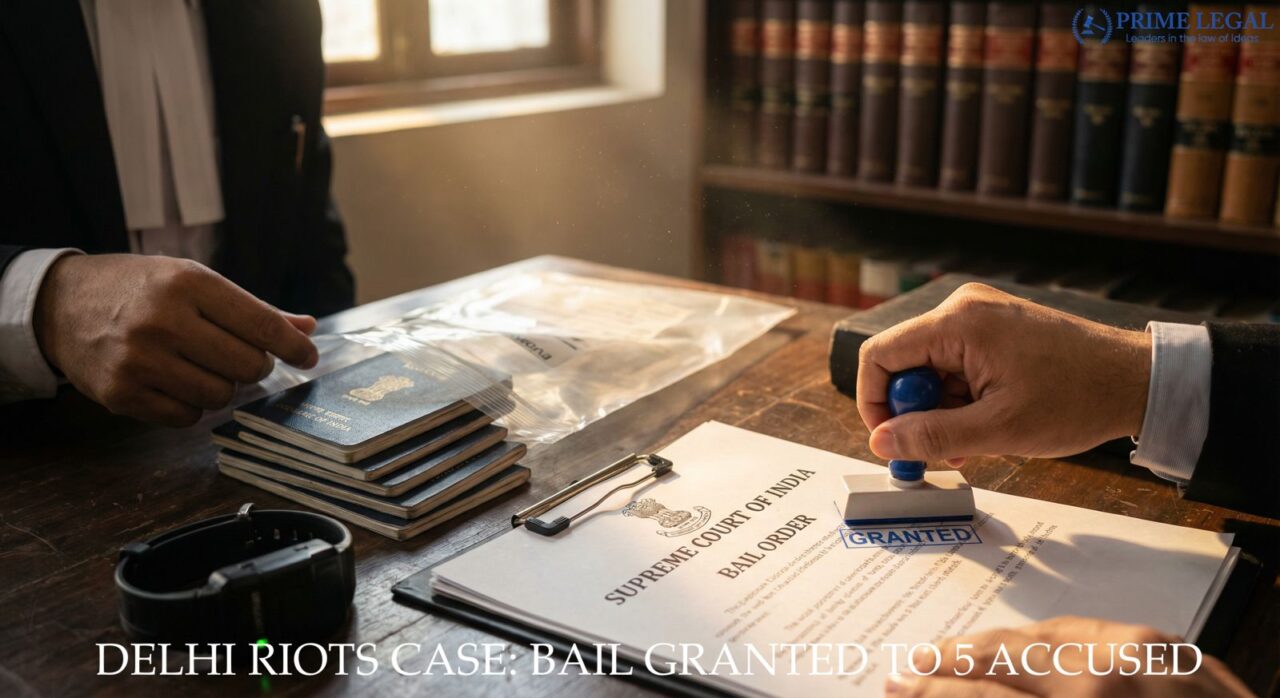
In a landmark ruling involving bail in a case under the Unlawful Activities (Prevention) Act, 1967 (UAPA), five accused in a conspiracy case for the 2020 Delhi riots were allowed bail with certain conditions, while bail applications of Umar Khalid and Sharjeel Imam were rejected, as held by the Supreme Court on 5 January 2026. This ruling is historic, not only for its results-oriented implications, but also for its bail interpretation, and for its impact based on judicial interpretation with regard to a professional assessment of guilt, implications under Article 21 vis-à-vis bail under a statutory Act, UAPA.
BACKGROUND
The February 2020 riots in North-East Delhi resulted in the deaths of 53 persons and heavy property damage. The Delhi Police had also filed several FIRs based on the provisions of the UAPA for the existence of a “larger conspiracy” in the violence that went beyond the protests against the Citizenship (Amendment) Act, 2019 (CAA). The prosecution alleged that the protests grew from organised actions like the blocking of roads, chakka jams, to the disruption of essential supplies, leading to the eruption of violence.
The Delhi High Court refused to grant bail applications filed by some of the accused on September 2, 2024, in which it was held that, prima facie, a united conspiracy existed in this case. This judgment was also challenged before the Supreme Court.
KEY POINTS
A Bench led by Justice Aravind Kumar and Justice N.V. Anjaria released on bail Gulfisha Fatima, Meeran Haider, Shifa-ur-Rehman, Mohd. Saleem Khan and Shadab Ahmad, while refusing bail to Umar Khalid and Sharjeel Imam, on the ground that they were on a “higher footing in the hierarchy of participation.”
The prosecution, led by the Delhi Police, termed the two men, Khalid and Imam, the “intellectual architects” of the conspiracy, as alleged. The Court pointed out that the prosecution’s case against the duo consisted of direct, corroborative, and contemporaneous evidence such as recoveries and communications. The five others are said to play the subsidiary or facilitating role with no independent leverage or influence within the organisational environment.
While giving bail to the five co-accused, the Court imposed the following 11 stringent conditions:
- Execution of a personal bond of ₹2 lakh with two local sureties.
- Not to leave the National Capital Territory of Delhi without permission from the trial court
- Surrender of passports or filing of an affidavit where none exists; immigration authorities are prohibited from allowing foreign travel.
- Furnishing and prior intimation of any change in residential address or contact details.
- To appear before the SHO, Crime Branch, Police Headquarters, New Delhi, twice a week.
- Maintenance of the attendance register with compliance reports to the trial court monthly.
- Not to contact or interfere with any witnesses, or have any associations with organisations connected to the case.
- Bar from publishing or disseminating any kind of information regarding the case in any media.
- Prohibition to attend any public programme, rally, or gathering- physical or virtual.
- Mandatory cooperation with trial proceedings and appearance on all dates of hearing.
- Conditions to maintain peace and good behaviour, coupled with leave to prosecution to move for cancellation of bail on breach.
RECENT DEVELOPMENTS
The Supreme Court acknowledged that long pre-trial detention may violate Article 21 but held that delay is not a “trump card” capable of overriding the UAPA’s strict bail standard under Section 43D (5). While personal liberty remains fundamental, Parliament’s judgment in special statutes to tackle serious offences carries significant weight. Parity with Natasha Narwal, Devangana Kalita, and Asif Iqbal Tanha was refused, as mere formal similarity does not amount to legal parity when the alleged involvement is different.
It also noted that acts like blocking roads, choking supplies, or destabilising civic life can, in certain cases, constitute a “terrorist act” under the UAPA even without traditional violence.
CONCLUSION
The ruling represents a critical moment in UAPA bail jurisprudence. By foregrounding the “hierarchy of participation”, the Supreme Court reaffirmed that bail decisions need to be individualised and not mechanical. On the other hand, the holding that delay cannot overshadow statutory limitations also emphasises the exceptional character of the UAPA bail provisions. The decision, therefore, embodies an orchestrated tension between constitutional freedom guaranteed through Article 21 and collective security anxieties that have been highly significant in their import for future prosecutions in protest events.
“PRIME LEGAL is a full-service law firm that has won a National Award and has more than 20 years of experience in an array of sectors and practice areas. Prime legal falls into the category of best law firm, best lawyer, best family lawyer, best divorce lawyer, best divorce law firm, best criminal lawyer, best criminal law firm, best consumer lawyer, best civil lawyer.”
WRITTEN BY: USIKA K

