
CASE NAME: Central Transmission Utility of India Limited v. Sumit Binani & Ors.
CASE NUMBER: Civil Appeal Nos. 2216–2217 of 2025
COURT: Supreme Court of India, Civil Appellate Jurisdiction
DATE: 23 March, 2026
QUORUM: Hon’ble Justice Sanjay Kumar and Hon’ble Justice K. Vinod Chandran
FACTS
Central Transmission Utility of India Ltd. (CTUIL) is the successor to Power Grid Corporation of India Ltd. (PGCIL) and had a Transmission Service Agreements (TSAs) with KSK Mahanadi Power Company Ltd. (KMPCL). After KMPCL repeatedly defaulted on transmission charges, the Central Electricity Regulatory Commission (CERC) directed KMPCL to either open a Letter of Credit (LoC) or furnish an equivalent Payment Security Mechanism (PSM), leading to a cash deposit of ₹108.44 crore with CTUIL in 2018. However, the National Company Law Tribunal (NCLT) admitted a Corporate Insolvency Resolution Process (CIRP) against KMPCL on the application of a financial creditor and appointed Sumit Binani as the Resolution Professional (RP). CTUIL continued billing after the CIRP, as usual but, in March 2020, unilaterally adjusted the entire PSM deposit of ₹108.44 crore against its unpaid invoices, using about ₹23 crore for post‑CIRP bills and about ₹85 crore for pre‑CIRP dues. The RP applied to NCLT to direct that the PSM can only be used for post‑CIRP charges and that CTUIL’s pre‑CIRP claim should be dealt through the insolvency process. NCLT allowed the application and NCLAT affirmed. CTUIL appealed to the Supreme Court.
ISSUES
- Whether the PSM cash deposit can be apportioned or not against the pre-CIRP dues?
LEGAL PROVISIONS
Insolvency and Bankruptcy Code, 2016:
- Section 14 – Moratorium on recovery
- Section 238 – overriding effect of IBC
Key precedents:
- Bharti Airtel Ltd. v. Aircel Ltd., (2024) 4 SCC 668
- Himadri Chemicals v. Coal Tar Refining Co., (2007) 8 SCC 110
- Standard Chartered Bank v. HEC Ltd., (2020) 13 SCC 574
ARGUMENTS
APPELLANT:
CTUIL argued that the ₹108.44 crore PSM deposit was functionally in lieu of a LoC mandated by TSA and CERC’s 2010 Sharing Regulations. Under the Billing, Collection and Disbursement (BCD) Procedure, a default in monthly transmission charges allowed CTUIL to enforce the PSM/LoC and then require the customer to top it up before the next billing cycle. Relying on Bharti Airtel, CTUIL contended that contractual set‑off remains permissible under IBC, and that on default, beneficial “title” in the PSM amount had effectively shifted away from KMPCL. It portrayed itself as a nodal agency that had already disbursed the appropriated sum to Inter‑State Transmission System (ISTS) licensees, reversing the appropriation, it said, would unjustly enrich the successful resolution applicant and make CTUIL bear others’ losses. It also invoked IBC provisions on security interest and case law on bank guarantees to argue that a LoC‑equivalent security should retain enforceability even after CIRP.
RESPONDENTS:
Respondents contended that the PSM was a simple cash security deposit, not a bank guarantee or third‑party LoC, and therefore remained on KMPCL’s balance sheet as its own asset as on the insolvency commencement date. They submitted that CTUIL had filed its Form B claiming for ₹356.41 crore, without describing the ₹108.44 crore as a separate security interest, and accepted partial admission of its operational debt without challenge. The unilateral appropriation months after moratorium was said to be an attempt to recover pre‑CIRP dues, in direct violation of Section 14 and the pari passu/collective process embodied in the resolution plan, which had since been approved and partly implemented treating the PSM as an asset of the corporate debtor. They argued that Bharti Airtel actually limited set‑off in CIRP to narrow pre‑commencement, mutual‑dealings situations and did not permit post‑CIRP grab of pre‑CIRP claims.
ANALYSIS
The SC analysed the Bharti Airtel and stressed that while contractual set‑off is possible, it is limited to genuine mutual dealings and must be exercised before or at the very start of CIRP and not long afterwards, and there were no such mutual cross‑claims here. The PSM was a one‑way cash security lodged by KMPCL and continued to sit as its asset on the books until lawfully applied. The SC also noted that there was no bank‑issued instrument here, only a cash deposit given for CTUIL’s benefit and that even a true LoC cannot be used post‑CIRP to take value out of the debtor’s estate for old dues without offending Section 14, although the Court accepted the general principle that bank guarantees and LoCs are independent bank–beneficiary contracts. The Court also notes that CTUIL hadn’t invoked the security before CIRP and filed its claims as an ordinary operational creditor, it did not contest the RP’s partial admission and the resolution plan proceeded on treating the deposit to be an asset of the debtor. Against which, the appropriation was seen as an attempt to jump the creditor queue and undermine the pari passu, collective scheme of the IBC.
JUDGMENT
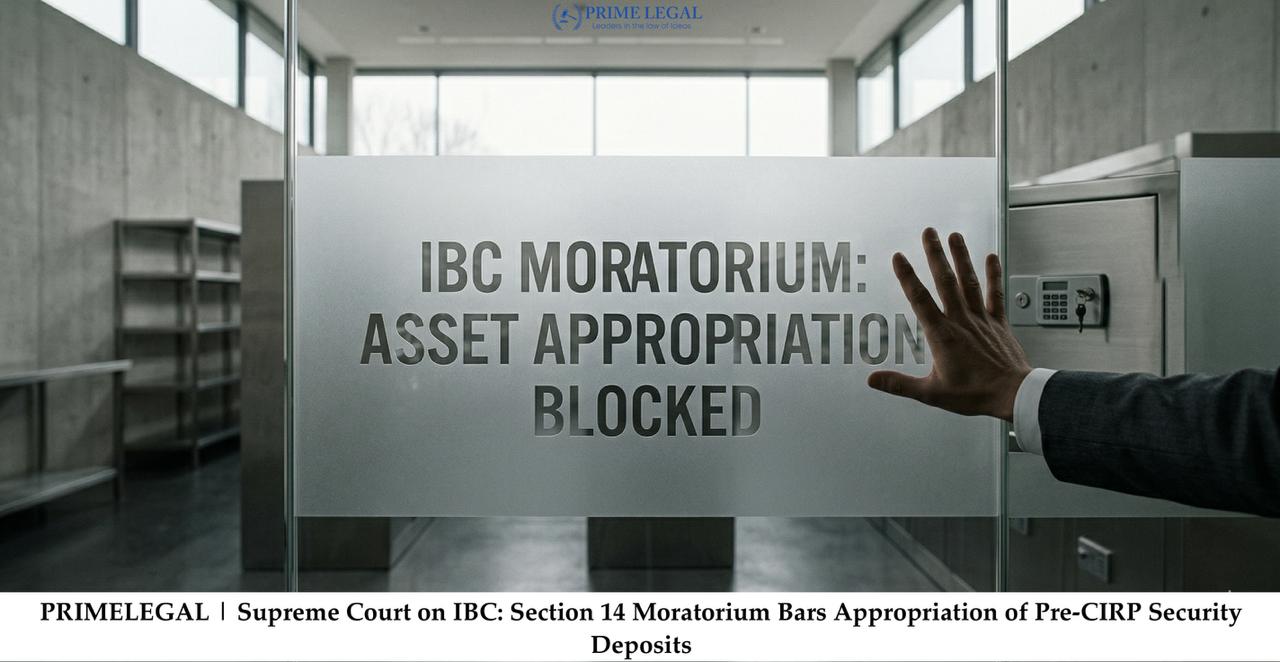
The Supreme Court upheld the order of NCLT and NCLAT, holding that CTUIL’s appropriation of ₹85.13 crore from the PSM towards pre‑CIRP dues was illegal and hit by Section 14. The appeals were dismissed and pending applications disposed of.
CONCLUSION
This ruling sends a clear message to infrastructure and utility creditors: even where sophisticated security mechanisms exist under sectoral regulations, once CIRP begins they must play by the IBC rulebook. Labelling a cash deposit as “in lieu of LoC” or invoking broad notions of set‑off cannot justify dipping into a corporate debtor’s securities for pre‑CIRP dues during moratorium. For resolution professionals and bidders, the judgment also offers welcome clarity: pre‑CIRP security deposits sitting in others’ hands will be treated as part of the debtor’s estate unless lawfully enforced before insolvency, strengthening the predictability and integrity of the resolution process.
“PRIME LEGAL is a National Award-winning law firm with over two decades of experience across diverse legal sectors. We are dedicated to setting the standard for legal excellence in civil, criminal, and family law.”
WRITTEN BY: ABIA MOHAMMED KABEER
read the judgement copy here
Central Transmission Utility of India Limited Versus Sumit Binani & Ors.

