
Introduction
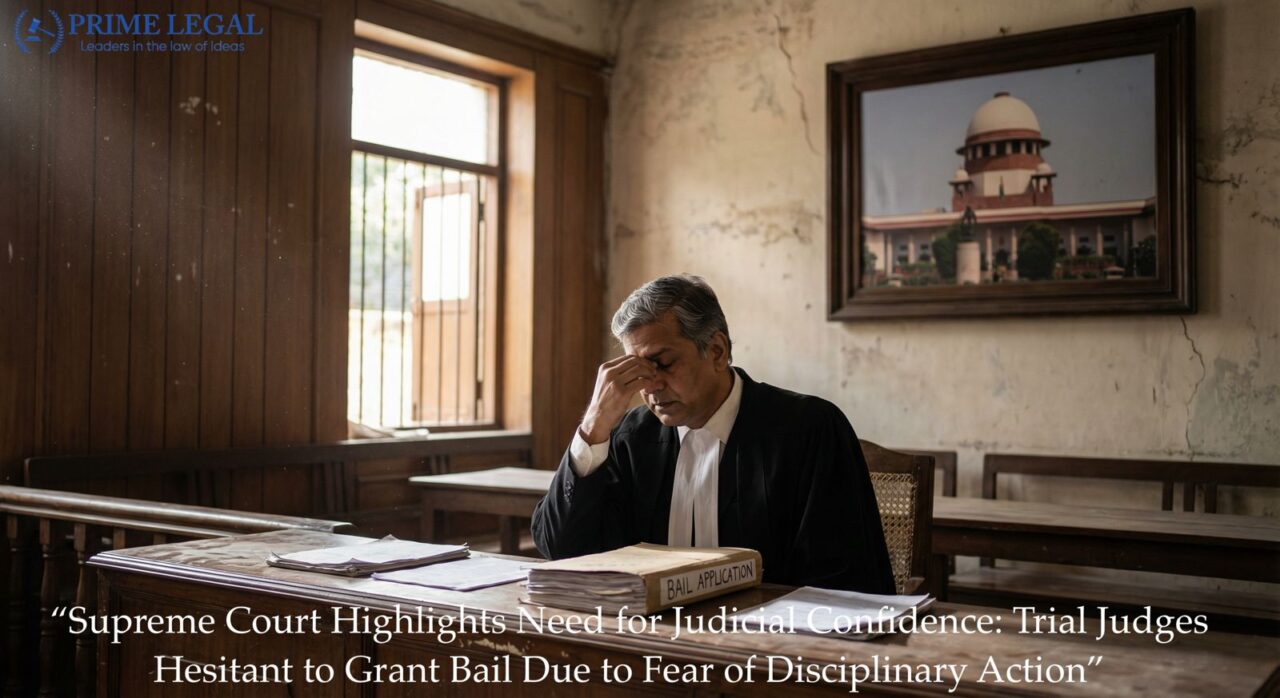
The supreme court of India has drawn sharp attention to an alarming trend in the lower judiciary where the trial court judges are increasingly hesitant to grant bail not for legal reasons but due to the underlying fear of disciplinary action and administrative backlash. The apex court described this phenomenon as a serious threat to judicial independence, nothing that undermines the constitutional right to liberty and overwhelms with avoidable bail petitions. In the landmark judgment the two judges bench led by Justice J.B. Pardiwala and K.V. Vishwanathan Set aside the termination of a Madhya Pradesh judicial officer and laid down robust principles to safeguard judges from punitive Reprisals for Bonafide judicial decisions.
Background
The issue came before the supreme court in the appeal of Nirbhat Singh Suliya,a judicial officer of the Madhya Pradesh higher judicial service who was dismissed from service in 2015 on allegation of corruption and of following double standard while deciding bail matters under the Madhya Pradesh excise act. The disciplinary action against him was primarily based on the finding that he had granted bail in certain cases involving large quantities of seized liquor while refusing bail in others.
The Supreme Court noted that such proceedings based on perceived mistake rather than genuine corruption or malice have created a culture of fear among trial judges, discouraging them from exercising their lawful discretion in granting bail particularly in meritorious cases.
This concern is not new. In 2022 The Chief Justice of India DY Chandrachud had remarked that judges at the grass root are often reluctant to grant bail because they fear being targeted for granting bail in heinous cases Which further contributes to a deluge of applications reaching the High Courts and Supreme Court.
Key Notes
Judicial independence and discipline
The Supreme Court emphasized that a judicial officer cannot be subject to disciplinary proceedings merely because a judicial order was perceived as wrong or an error in judgment. The bench held that initiating inquiry on such grounds compromise judicial autonomy and erodes morale, leading to judges playing it safe rather than applying fearlessly.
Bail hesitancy and backlog
The court observed that this fear of departmental action discouraged District Judges from granting bail even in cases that met well settled legal criteria, thereby flooding High Courts and Supreme Court with routine bail matters. This misallocation of judicial resources contributes directly to the backlog and delays in the justice delivery system.
Supervisory role of High Court
While recognizing the supervisory authority of high courts under Article 227 of the Constitution the Supreme Court directed that care must be taken before initiating departmental proceedings. Only proven misconduct such as corruption or malicious intent should trigger disciplinary action not mere difference in legal interpretation or discretionary exercise
Frivolous complaints and accountability
The apex court also addresses the proliferation of frivolous allegations engineered by disgruntled litigation advocates seeking to intimidate judicial officers. It warned that filing baseless complaints to harass judges would invite contempt proceedings, reference to professional regulatory bodies or other disciplinary steps against those misusing the complaint mechanism.
Restoration of officer and benefits
In Suliya’s case the Supreme Court not only set aside this dismissal but also restored him with full monetary benefit and consequential entitlements underscoring that an unblemished career spanning decades should not be imperiled by procedural lapses or unjust punitive actions.
Recent developments
This judgment came at the time when bail jurisprudence and judicial discretion are highly debatable health issues in Indian courts. Analysts point to a broader issue affecting criminal justice bail hesitancy across courts from trial court to high courts contributing to undertrial overcrowding. In recent years the Supreme Court has repeatedly criticized courts for reluctance in granting bail. Stressing the bail is not a privilege but a constitutional safeguard.
Meanwhile the High Court and Supreme Court have also taken independent steps to streamline the bail processes including direct disposal of pending bail applications within fixed time frames where possible to ensure that custodial detention does not unduly impinge on personal liberty guaranteed under Article 14 and 21 of the Constitution.
Conclusion
The Supreme Court’s latest ruling marks a decisive reaffirmation of judicial independence at the grassroots level. By setting aside a punitive disciplinary action and clarifying that mere judicial error is not misconduct, the Apex Court has taken a strong stance against adjudicative fear and micromanagement in bail matters. The judgment strikes a critical balance – Protecting honest judicial officers from harassment while ensuring accountability for genuine misconduct and aims to curb a culture where judges hesitate to exercise lawful discretion out of fear. Ultimately the decision reinforced the constitutional ethos that justice must be administered without fear or favor and that the bail is an essential liberty interest must be dispensed in accordance with law, not administrative anxieties.
“PRIME LEGAL is a full-service law firm that has won a National Award and has more than 20 years of experience in an array of sectors and practice areas. Prime legal falls into the category of best law firm, best lawyer, best family lawyer, best divorce lawyer, best divorce law firm, best criminal lawyer, best criminal law firm, best consumer lawyer, best civil lawyer.”
WRITTEN BY: NISHTHA JAIN

