
INTRODUCTION
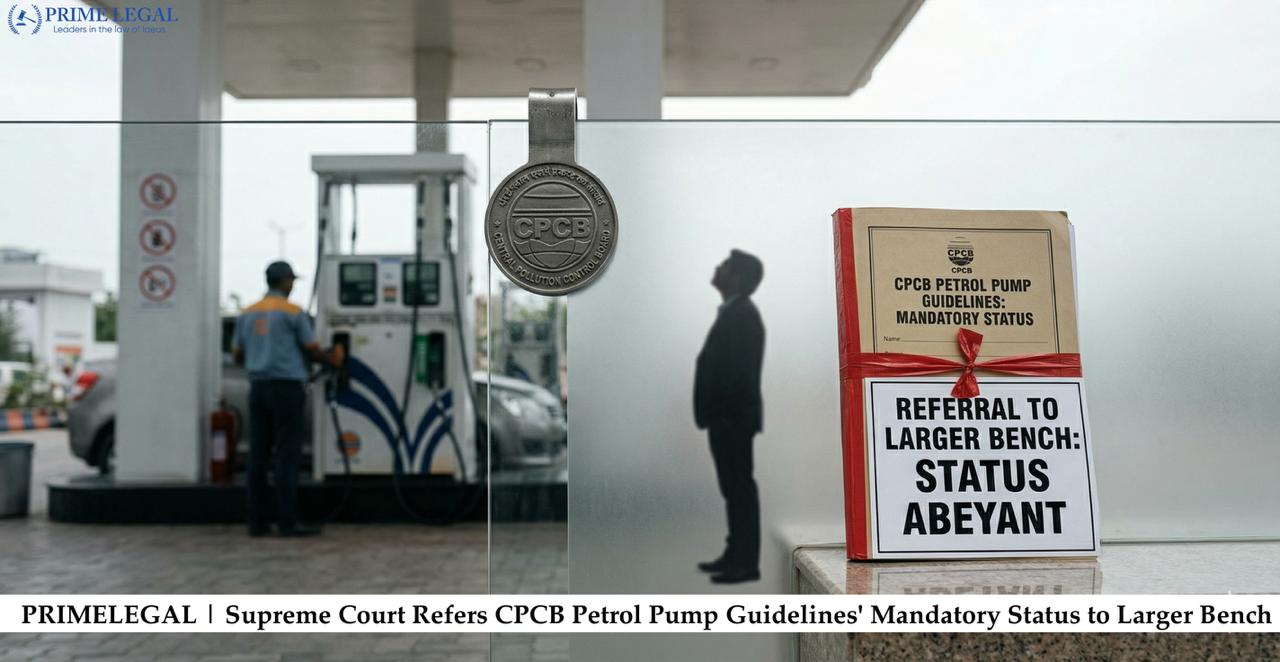
The Supreme Court of India recently referred a significant environmental regulation matter to a larger bench, highlighting tensions between national guidelines and local laws. The case explores whether the Central Pollution Control Board’s 2020 guidelines for petrol pumps which it issued in 2020 are mandatory regulations or advisory recommendations. The case originated from disputes about petrol pump locations in urban areas which include Dehradun because it shows how urban planning and pollution control and zoning authority conflicts with each other throughout the country.
BACKGROUND
On January 7, 2020, CPCB—that is, the Central Pollution Control Board—issued guidelines. It was specifically mentioned that if there is any breach of them, then the State Pollution Control Board has the right to take action according to the law. The guidelines were made for setting up new petrol pumps. The bench of Justice Sanjay Kumar and Justice K. Vinod Chandran was dealing with the appeals about the guidelines issued by CPCB. Here, CPCB issued environmental guidelines regulating petrol pumps, including the minimum distance from schools, residential areas, and hospitals, along with pollution control measures in the location and the safety norms given in the particular guidelines.
A controversy arose over whether these guidelines are binding or advisory in nature. Some said they were binding, and others said they were advisory, which is not mandatory to follow. That is the reason it was referred to the larger bench.
KEY POINTS
- CONFLICT BETWEEN RULE 1 AND RULE 2
In detail, the Supreme Court was facing a legal contradiction between Rule 1 and Rule 2 of CPCB Guidelines 2020, issued by CPCB itself. Rule 1 particularly says that petrol pumps should be 50 metres away from houses, schools, and hospitals, and a minimum of 30 metres in tight situations. All must be followed, with no exceptions. This indicates no one can allow construction of petrol pumps nearby the areas specifically mentioned by CPCB.
Coming to Rule 2 of CPCB Guidelines, it talks about local zoning laws made by local or State authorities. It says petrol pumps can be allowed in residential areas but with approvals.
- FACTUAL MATRIX (DEHRADUN CASE)
In the real situation, a petrol pump in Dehradun was approved under Rule 2 but violated Rule 1 of CPCB. So, which rule has to be followed? That was the particular question.
- NATIONAL GREEN TRIBUNAL’S VIEW
The National Green Tribunal said CPCB guidelines must be followed and even applied retrospectively. This was the decision made by the National Green Tribunal because the environment is considered first, with no excuses.
- SUPREME COURT’S OBSERVATIONS
The Supreme Court, in Indian Oil Corporation Limited vs. VBR Menon MANU/SC/0232/2023, said CPCB guidelines must be followed strictly. The judges found that CPCB failed to evaluate the local zoning regulations which govern this specific situation. The guidelines have zero flexibility, and in reality, cities already allow petrol pumps in residential zones. The enforcement of CPCB guidelines without discretion will result in legal conflicts which may lead to the closure of all operational petrol stations.
- REFERENCE TO LARGER BENCH
The Supreme Court gave a statement: if CPCB rules have no exceptions, calling them mandatory creates chaos in society. That is the reason it was referred to the larger bench, where there is a conflict with past judgments, and the issue affects policy, environment, and urban planning nationwide. That is why the Supreme Court referred it to the larger bench.
CONCLUSION
The referral to a larger bench will determine whether CPCB guidelines must be followed by local zoning regulations. The ruling establishes a framework for petrol pump regulations which will maintain legal order while supporting environmentally sustainable development across India.
“PRIME LEGAL is a National Award-winning law firm with over two decades of experience across diverse legal sectors. We are dedicated to setting the standard for legal excellence in civil, criminal, and family law.”
WRITTEN BY: PRANAVI KOLLU

