
Abstract
The Supreme Court of India issued its ruling on April 10, 2026 which established that voting rights and election contesting rights do not constitute fundamental rights under the Indian Constitution. The rights exist as statutory rights which only exist through legal permission. The case arose from a dispute over bye-laws framed by District Milk Producers’ Cooperative Unions in Rajasthan, which set eligibility conditions for members wishing to contest managing committee elections. The Court invalidated the Rajasthan High Court ruling which had declared these bye-laws unconstitutional, because statutory bodies possess the legal power to control their internal election procedures.
Introduction
The courtroom delivered its landmark judgment through the decision taken by Justices B V Nagarathna and R Mahadevan who established different boundaries between constitutional rights and statutory rights. The dairy cooperative unions in Rajasthan implemented bye-laws that required election candidates to managerial committees to fulfill certain requirements which included minimum milk production and active business status. The Rajasthan High Court received a legal challenge from specific members who succeeded in their case by nullifying the bye-laws. The Supreme Court received the case after the High Court decision was appealed which led to a complete reversal of the lower court ruling.
Key Points
- Electoral Rights Are Statutory, Not Fundamental
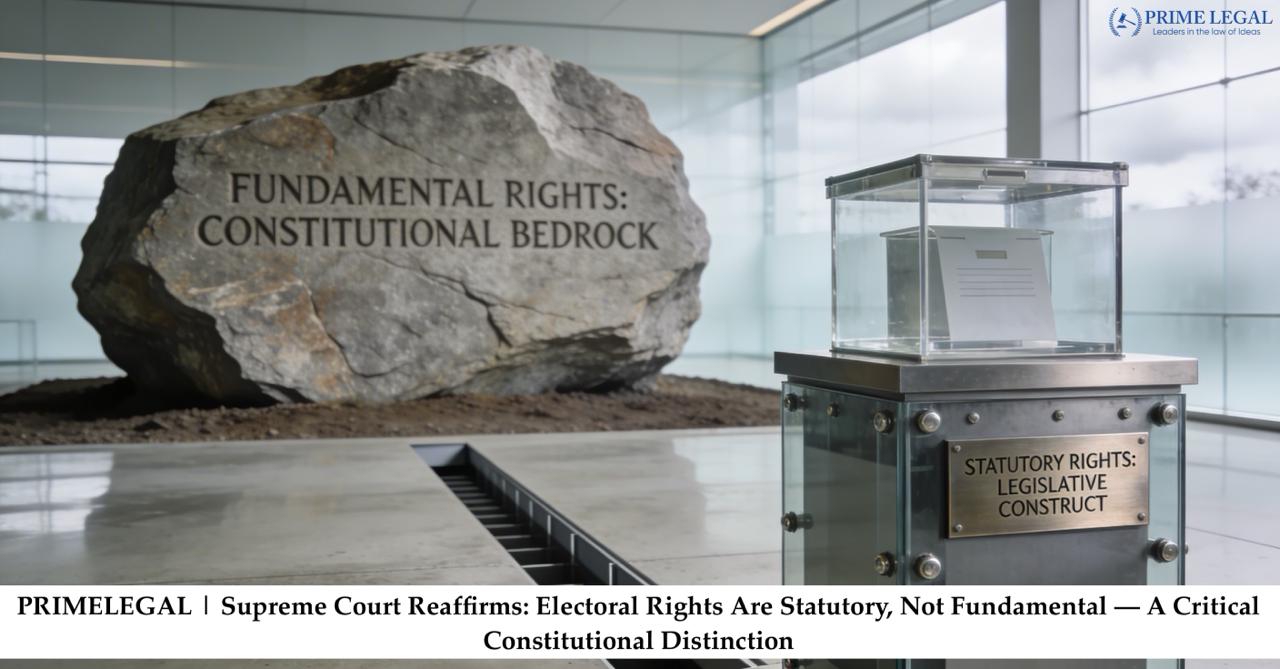
The Supreme Court established that voting rights and election contesting rights do not qualify as fundamental rights. The rights exist because a law established them. The rights which exist as statutory rights can be controlled and restricted or entirely removed through the legal framework which established them without breaching constitutional law.
- Bye-Laws Can Lawfully Set Eligibility Conditions
The eligibility conditions prescribed by the cooperative unions had two requirements which included regular milk supply and operational continuity. The conditions were established through the parent cooperative statute which made the bye-laws valid as delegated legislation. The Court established that those conditions created a logical relationship which served the objectives of the cooperative society.
- Rajasthan High Court’s Approach Was Flawed
The Supreme Court found that the High Court was wrong to exercise its writ jurisdiction in this matter. Cooperative societies do not qualify as “State” entities according to Article 12 of the Constitution because they do not accomplish public duties. Therefore, they are generally not subject to writ jurisdiction which prohibits the High Court from intervening in the cooperative’s internal electoral processes.
- Distinction Between Voting Rights and Contesting Rights
The Court established two distinct legal rights that people possess: the right to vote and the right to contest elections. The constitutional requirements for eligibility to contest elections exist as a recognized legal practice which does not breach any constitutional rights protected under the law.
Conclusion
The Supreme Court’s ruling provides an unambiguous constitutional interpretation of Indian law which states that people can only participate in statutory body elections through legal permission and they do not possess a constitutional right to do so. Cooperative societies maintain complete legal power to establish valid eligibility requirements for their internal elections as long as those requirements originate from the main legal document and do not include nonsensical conditions. The court decision creates an important rule for High Courts which shows that internal matters of non-State organizations must not be addressed through writ jurisdiction. The ruling protects multiple Indian cooperative societies through legal protections while establishing that organizations must meet both accountability and eligibility requirements for their democratic processes.
“PRIME LEGAL is a National Award-winning law firm with over two decades of experience across diverse legal sectors. We are dedicated to setting the standard for legal excellence in civil, criminal, and family law.”
WRITTEN BY: PRANAVI KOLLU

