
ABSTRACT
This article will explore the ways in which the “comfort” of prisoners in 2026 has become a constitutional imperative through the Eighth Amendment. The paper will discuss environmental safety, digital rehabilitation, profit-based incarceration, and global norms in order to show that climate control, technology, and human dignity are all necessary parts of the state’s carceral duty.
KEYWORDS:
Eighth Amendment, carceral bargain, prison conditions, climate justice, digital rehabilitation, human dignity
INTRODUCTION
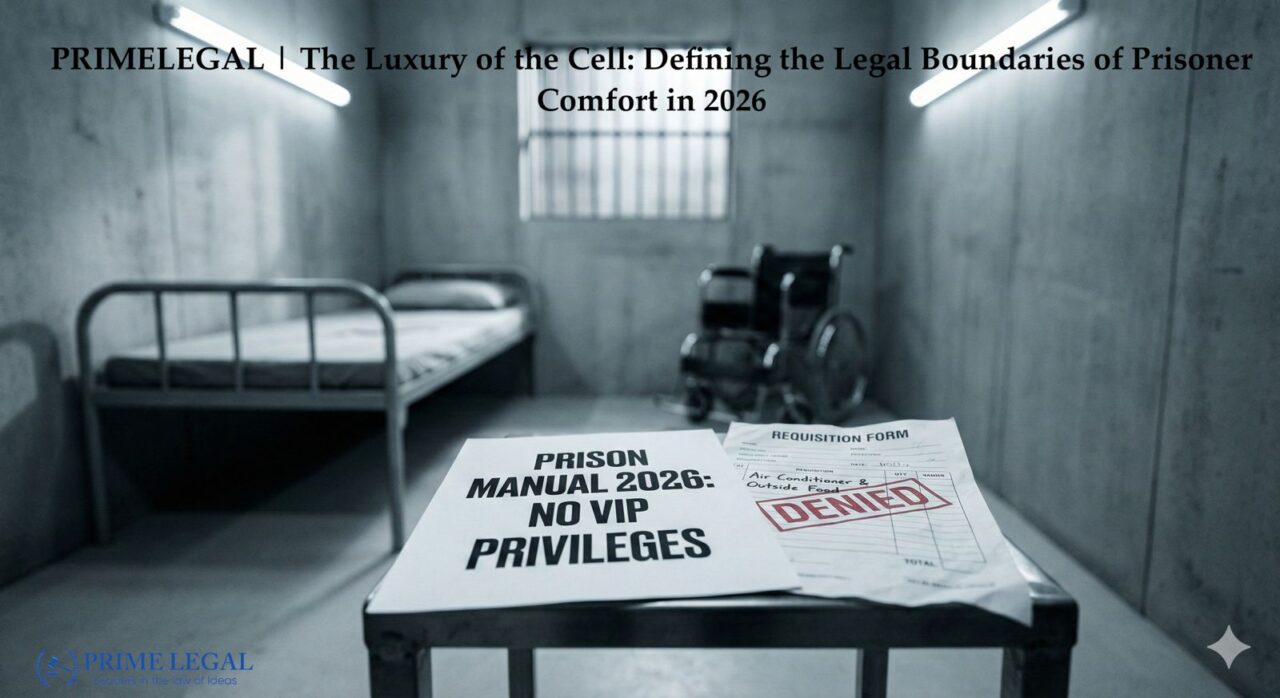
In 2026, the definition of prisoner comfort is no longer a debate over “perks” or “amenities,” but a high-stakes legal battleground centred on the state’s carceral burden: the affirmative obligation to meet the basic human needs of those it has deprived of liberty. With the world facing challenges of climate change and a digital revolution, the legal parameters of what constitutes “cruel and unusual punishment” under the Eighth Amendment have evolved from simply avoiding physical torture to proactively providing for environmental and technological standards.
THE STATE’S CARCERAL BARGAIN
The legal framework of 2026 is defined by the carceral bargain. By choosing to incarcerate, society assumes an ongoing duty to provide for a prisoner’s basic needs because the inmate has been stripped of the capacity to provide for themselves. This burden includes food, medical care, and, increasingly, physical safety from both violence and environmental extremes.
Historically, the Supreme Court has set a high bar for prisoners to prove violations of constitutional rights. Under Farmer v. Brennan, 511 U.S. 825 (1994), an official must have “actual awareness” of a risk to be held liable, a standard often criticised for creating incentives for officials to “not notice” suffering. However, the modern legal consensus increasingly argues that all state-created prison conditions constitute “punishment” and should be subject to scrutiny regardless of an official’s subjective state of mind.
THE ENVIRONMENT: AIR CONDITIONING AS A HUMAN RIGHT
The most pressing “comfort” issue in 2026 is thermal regulation. As triple-digit temperatures become the norm across the United States, particularly in the South, the lack of climate control has transformed temporary incarceration into a potential death sentence.
- Heat-Related Mortality: Research indicates that the prison death rate rises by 5.2% for every 10°F increase above historical averages. In Texas alone, there were 271 heat-related deaths in un-air-conditioned units from 2001 to 2019.
- The Luxury Paradox: Historically, legislators have considered air conditioning a luxury, but they offer televisions, which are less essential to human health. Advocacy groups in 2026 increasingly argue that “AC is not a luxury; it’s a human right” amid a warming planet.
- Legislative Resistance: Although some states, such as Delaware and North Carolina, have taken steps to finance universal cooling by 2026, others, such as Texas and Virginia, have had bills stall because of high cost projections, as high as $1.1 billion in Texas.
- Institutional Violence: High temperatures are associating with irritability, tension, and suicides among inmates as well as prison officials.
DIGITAL REHABILITATION: THE NEW NORMAL
The cell of 2026 is also a digital hub. The inclusion of technology in the prison system is based on the Principle of Normality, which states that the prison environment should be as close to the free life as possible in order to ensure reintegration.
Types of Digital “Comfort” in 2026:
- In-Cell Tablets and Kiosks: These enable “self-service” functionality, which allows prisoners to control bank accounts, schedule medical appointments, and make canteen orders without the need for direct guard assistance.
- Digital Communication: Video conferencing and e-messaging have become essential for keeping family ties, which has been proven to reduce recidivism.
- Virtual Reality Training: “Re-entry Preparation” in Virtual Reality involves the use of immersive technology for “Re-entry Preparation,” which helps long-sentence offenders prepare to move around in a world that is different from the one they knew when they were imprisoned (for example, learning to use automatic checkout counters or preparing for job interviews).
- Case Study (Finland): The “Smart Prison” project in Finland provides convicts with personal laptops, thus transforming the prison cell into a learning environment and ensuring that “digital deprivation” does not further damage society upon release.
However, this digital “comfort” often comes with a cost. Many jurisdictions use a fee-for-service model, where prisoners (or their families) must pay for every email or video call, often at rates much higher than the free-world equivalent.
THE ROLE OF PROFIT AND OUTCOME-BASED CONTRACTING
The boundaries of comfort are also being reshaped by the $4 billion private prison industry. Traditional contracts, based on bed occupancy, incentivised lower costs at the expense of inmate care. In 2026, there is a push towards outcomes-based contracting.
With these new systems in place, private companies are incentivised with bonuses for producing positive results, such as lower recidivism rates or high job placement success rates upon release. This creates a profit incentive for the well-being of the prisoner. For instance, in New Zealand, there was a 36.56% decrease in reoffending rates compared to public prisons.
Cells are equipped with televisions, computers, and built-in showers. At Bastoy Island, inmates are organised into small “pod” societies, where they are paid a wage and cook their own meals to prepare them for life upon release. Norway has a recidivism rate of 20%, while the U.S. has a rate of 60% or higher.
- Japan: In a radical paradox of space, the historic Nara Prison, a symbol of tough state control, was reborn in 2026 as a luxury hotel. The thick soundproof walls designed to isolate the prisoners are now marketed to tourists as “the luxury of absolute silence.”
- The United Kingdom: Contemporary standards in the UK permit male inmates who display good behaviour to wear their own clothes after the second week of their incarceration, shifting away from the standardised uniforms that are commonly viewed as “marks of shame”.
INSTITUTIONAL CRUELTY AND THE JUDICIAL ROLE
Despite these advancements, the legal community in 2026 faces the reality of institutional cruelty. This arises when an organisation’s design, through chronic overcrowding, understaffing, or dehumanising rituals, inflicts unnecessary suffering.
Critics argue that the contemporary prison system systematically dehumanises prisoners through ceremonies like the “ritual degradation of booking”. This culture can desensitise staff to a point where “inmate blood” no longer bothers them. Furthermore, judicial deference to prison officials often leads courts to legitimise cruel conditions. Some legal experts suggest that judges who validate these conditions become “agents of cruelty” themselves by suppressing sympathy for fellow human beings.
CONCLUSION
As we look towards the remainder of 2026, the “Luxury of the Cell” is a misnomer. What might appear to be luxuries, climate control, digital access, and humane living spaces, are actually essential tools to prevent Eighth Amendment violations and ensure the success of the carceral bargain.
The legal boundaries of comfort are currently defined by three critical requirements:
- Life-Sustaining Environments: Maintaining temperatures between 65°F and 85°F to avoid heat-related deaths.
- Digital Competency: Offering the skills required for “modern citizenship” to avoid the “pains of digital deprivation”.
- Human Dignity: Replacing “status degradation ceremonies” with environments that recognise the humanity and capacity for suffering of those in custody.
Ultimately, the boundary between luxury and necessity is a moral judgment reflecting the progress of a maturing society. In 2026, the state must bear the full cost of these constitutional obligations; if society prefers to avoid the burden, it must choose not to incarcerate.
“PRIME LEGAL is a National Award-winning law firm with over two decades of experience across diverse legal sectors. We are dedicated to setting the standard for legal excellence in civil, criminal, and family law.”
WRITTEN BY: USIKA K

