ABSTRACT:
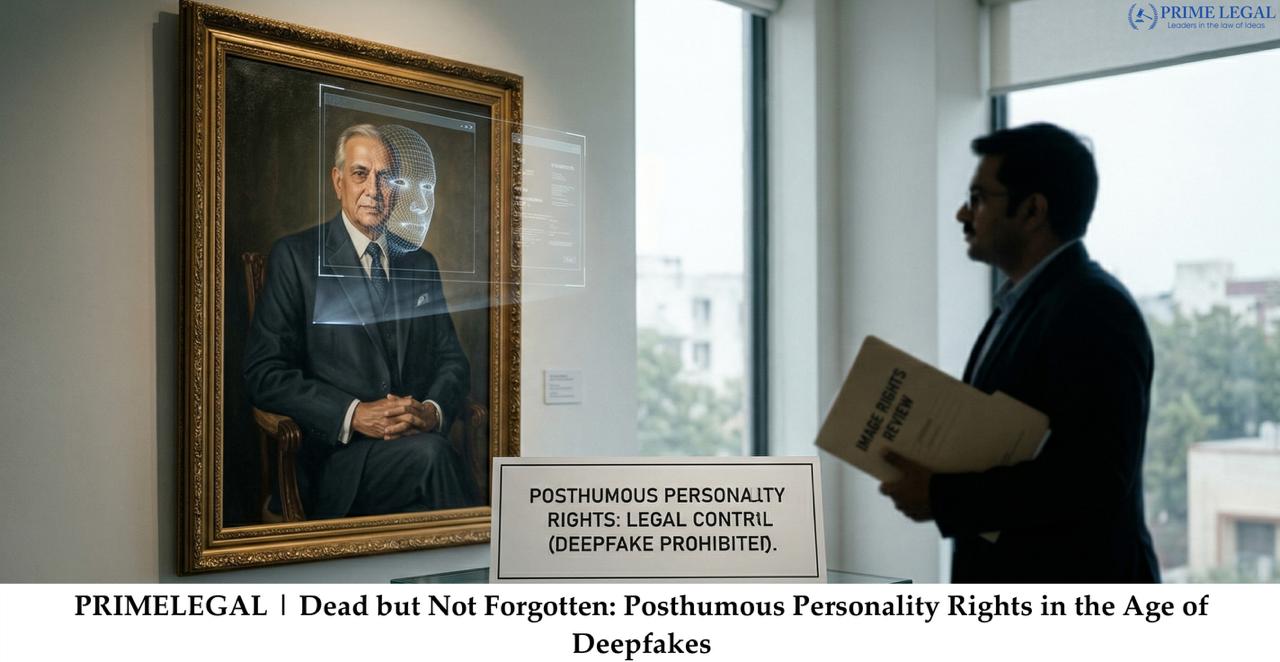
The posthumous personality works in protecting deceased individuals name, likeness, voice and identity from unauthorized commercial exploitation and gaining urgency with deepfakes technology that enables realistic digital recreations in the society. This talks about how AI can mislead society in today’s time. With the rapid rise of artificial intelligence and deepfake technology in the country, these rights have gained renewed urgency. Deepfakes enables the creation of hyper realistic digital replicas of deceased individuals, often without consent from their estates or families, raising serious concerns about dignity, misuse, and historical manipulation. This article, it examines global legal frameworks challenges posed by AI- generated deepfakes, key cases and reform the proposals to balance dignitary interest, property rights and free expression. It highlights jurisdictional variances and advocates for updated law to address the emerging harms like the emotional distress to heirs and historical distortion in the country.
KEYWORDS:
Deepfake, AI technology, reforms, regulations, privacy, Article 21
INTRODUCTION:
Deepfake technology, powered by advanced machine learning and neural tech networks, has transformed how digital content is created and consumed in today’s time. By using the publicly available data such as photographs, videos and voice recordings, these AI tools, it can convincingly create or recreate (Individuals both living and deceased) in entirely fabricated scenarios. This technological leap has blurred the line between reality and simulation, which is resulting in a greater threat to the country and the privacy of the citizens, it also requires the urgent need to be investigated it to be safe from such problems that might occur in the future in a more severe manner. Tackling AI is an essential issue and if not handled properly it can mislead the people and can misuse the data available without knowing the repercussions it may cause. The rights are being given to the individual’s personality or publicity which provide a mechanism to control and monetize their identity. These rights are grounded in privacy, dignity and economic value of the country. However, here the question becomes significantly more complex after the death of an individual. Whether going this far by even including a deceased individual in the trap of AI is how the country sees it to happen as a form of content. The emergence of AI tools can recreate deceased personality such as digital performance of iconic figures. It has intensified the need for legal clarity in the country without robust safeguards. These technologies risk enables exploitation, misinformation and distortion of a person’s legacy altogether. This article explores how existing laws address or fail to address these challenges and what reforms are necessary in the era of generative AI.
PERSONALITY RIGHTS DEFINED:
These rights are particularly significant for celebrities whose personas often carry substantial economic value even after the death, such as Marilyn Monroe or Michael Jackson, they continue to generate revenue through the licensing agreements, merchandising and media portrayals even today. In India personality laws are derived from the right to privacy under Article 21 of the Constitution, which is recognized in the landmark judgment of Justice K.S Puttaswamy v. Union of India (2017) 10 SCC 1, It talks about the personal rights of an individual that has privacy.
GLOBAL VARIATIONS:
The legal approaches to posthumous personality rights differ widely across various forms of jurisdictions. In France, it recognizes the combining dignity and property aspects with the protection extending up to 20 years post death hires may enforce rights, particularly where economic interests are involved of an individual.
Considering Germany, the personality rights and constitutional protections of human dignity under the Article 1 and 2. The posthumous rights generally last up to ten years in country.
Spain provides protection for up to 80 years, though primarily focused on safeguarding the memory and reputation of the deceased rather than the commercial exploitation of an individual.
UK does not recognize the Stand on the one right of publicity protection is instead derived from the doctrine, such as passing off copyright and defamation acts and not by a standard form of right in the country.
Similarly, Denmark has proposed. Of 50-year posthumous identity right which is like copyright protections in the country.
EVOLVING JURISPRUDENCE OF INDIA:
In India, personality rights are still in a developing phase. And codes have recognized these rights primarily through the lens of privacy and dignity mentioned under Article 21 of the Indian Constitution. However, a very significant limitation is that such rights are generally considered non heritable in this. Indian courts have generally taken the view that these rights do not continue after a person’s death. In the case of Sushant Singh Rajput Personality rights case the Delhi High Court. It clearly stated that rights like privacy and publicity end with the individual following the principle of ‘a personal rights dies with the person’ which in Latin is said as actio personalis moritur cum persona. This means that family members or hires usually cannot stop films, books or portrayals of the deceased if they are based on publicly available information. Both have also followed a similar approach in cases involving figures like Veerappan and Jayalalitha as well. Here India currently gives more importance to freedom of speech under Article 19 than to posthumous control over a person’s identity and there is no specific law yet revealed dealing with personality rights after that, especially in the context of modern issues like deep face which is being misused at a public level which can really cause harm to the people’s personal right.
DEEPFAKE TECHNOLOGY AND RISKS:
The deepfakes rely on advanced AI techniques, particularly Generative adversarial Networks, which creates highly realistic simulations of human faces, voices and actions. And these technologies or simulations are increasingly accessible, making misuse widespread and difficult to regulate. Considering today’s generative era, having a control over AI and its technology is very easy and handy and can be misused easily such as in the formation of deepfakes of the persons. The risks associated with posthumous deep wakes include the dignity, harm, misrepresentation of an individual or deceased person’s identity which violates their dignity and disrespects their identity. Posthumous deep fakes also make the families and hires suffer from psychological harm from seeing their loved ones digitally manipulated using technology. It also creates unauthorized use of identity for profit undermines legitimate state rights which is an ultimate wrong according to the law. Deep fakes can alter the public perception of historical figures which can mislead by spreading misinformation and rewriting narratives which are not even true. That’s why the scale and realism of these technologies demand urgent legal intervention and stringent laws to curb the misuse of such technology, to portray someone down, or to defame someone be it a living person or a deceased one. Causing harm to one’s identity through technology should have some stringent punishments involved so that it doesn’t happen in the country.
CHALLENGES AND REFORMS:
There are existing legal remedies which are considered inadequate to address the issues regarding deep fake harms. It involves defamation laws, which typically applies only to the living persons. Publicity rights vary by the jurisdiction and are often limited by free speech protections.
The key reform proposals which can bring a reform or a change in this sector. Such as establishing a uniform federal right of publicity in jurisdictions like the US and creating posthumous inheritable personality rights with defined durations. By introducing AI specific regulations, which addresses digital cloning and deep fakes and restricts it. Providing legal standing to heirs to sue for misuse of their deceased individual and by balancing rights with exceptions for news, parody and artistic expression. Considering a country like India, there seems to be a strong need for a stringent legal framework that explicitly addresses AI generated identity misuse, ensures consent-based usage and recognizes limited posthumous protections, only then the country will be protected from the misuse of the deepfake technology.
CONCLUSION:
The law governing the posthumous personality rights has not kept pace with the technological advancements, particularly the rise of AI driven deep fakes which is liable for creating misuse of AI technology and by spreading false narratives in the country. The ability to dig. Disrupt Individuals raises profound legal, ethical and philosophical questions about the identity, dignity and ownership, and about the reforms that should be made to curb this down. And without any comprehensive reforms, the identities of the deceased individuals remain vulnerable to exploitation distortion. Hence, there arises a need for a balanced legal framework which recognizes identity as both a dignitary factor and an economic interest. AI revolutions can easily be violated due to the advanced technology innovation, but it does not come at the cost of human dignity and without the consent. And ultimately the law must evolve to ensure that even in the digital age the dead are treated with respect and their legacy is preserved with integrity and not with misleading information and narratives about them.
“PRIME LEGAL is a National Award-winning law firm with over two decades of experience across diverse legal sectors. We are dedicated to setting the standard for legal excellence in civil, criminal, and family law.”
WRITTEN BY: MEENAKSHI DANGI
PRIME LEGAL | Dead but not forgotten: Posthumous Personality Rights in the age of Deepfakes
March 28, 2026by Primelegal Team