
Abstract
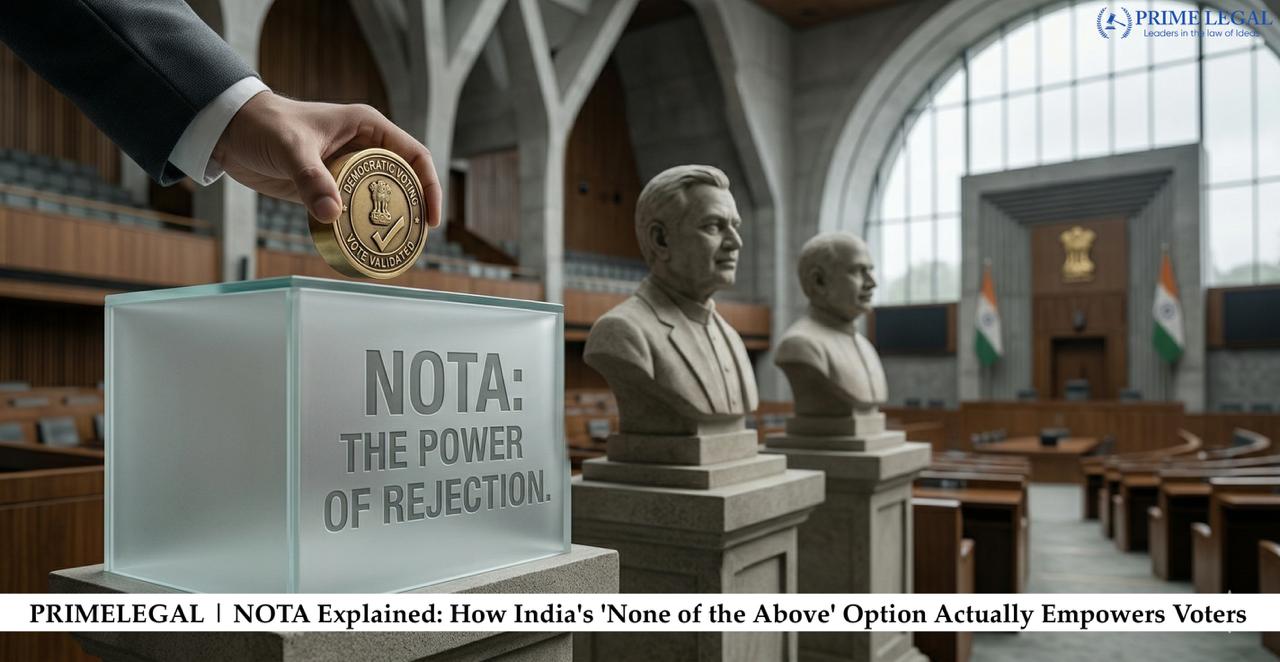
Born from the landmark judgement of the Supreme Court in People’s Union for Civil Liberties v. Union of India (2013) 10 SCC 1 introduction of None of the Above (NOTA) was a huge step forward from the conventional voting format in India. Embedded under Article 19)1)(a) of the Constitution the Court held that Right to Vote includes the Right to Express Disapproval of Candidates. It changed the course of electoral abstention to a constitutionally protected choice. This article seeks to examine the practical relevance, constitutional significance and efficiency of this constitutional tool.
Keywords
NOTA, Indian Election, Electoral Reform, Article 19(1)(a), Voter Participation, Right to Vote, Voter Choice, Negative Voting
Introduction
Democracy’s strongest pillar is the right of any ordinary citizen to choose or elect whom they want in power for them will help in advancing the country. This free exercise of franchise in a representative democracy like India is what bestows legitimacy on government. But what happens when there are no candidates who are fit or worthy of the office they are standing for? For an average citizen who wants to exercise their right, which unlike other fundamental rights is not just a right but a power over the very institution that governs them, what should s/he do?
This thought only occurred in 2013 when the Supreme Court asked the Election Commission of India to introduce None of the Above, or more commonly known by its abbreviation NOTA. ever since its inception NOTA has received large-scale attention in both Parliament and State Assembly elections. In fact, there have been times where the NOTA has received a majority of the votes in a particular constituency, indicating how unworthy and unfit the candidates were to contest in the elections. Thus, NOTA extends beyond its symbolic value and represents an electoral democratic reform in India which is long overdue.
The inception of NOTA
In 2013 the SCI was approached with an interesting writ petition by People’s Union of Civil Liberties (PUCL) under Article 32 of the Constitution. They asked isn’t forcing a voter to choose among candidates violates the secrecy of voting under the Conduct of Election Rules, 1961? Thus, the legal battle began for the Right to Not Vote. They challenged Rule 49-O of the Conduct of Election Rules, 1961 on the grounds that it compromised on the secrecy of the ballot. According to the said provision a voter may choose not to vote for the candidates standing for election but the presiding officer will be required to note such declination. Otherwise, they must choose not to come for the election at all. All of which violated the right to life and personal liberty and freedom of speech and expression under Articles 21 and 19(1)(a) of the Constitution.
The Court saw merit in the petitioner’s arguments and decided in favour of PUCL and directed the Election Commission of India to insert ‘None of the Above’ or “NOTA” on every electronic voting machines (EVM) and ballot papers so that the electors could freely exercise their right not to vote without having to prove to the presiding officer why they were not voting for any of the candidates in the long list or abstaining from elections.
The judgement emphasised that the institutionalisation of NOTA would encourage political parties to choose candidates of higher moral and ethical caliber, increasing voter turnout and reducing abstention.
Post PUCL developments
In December 2013 NOTA were introduced in five State Assembly elections and in the 2014 Lok Sabha election, and surprising everyone NOTA alone gained around 60 lakh votes in all these elections. Sounds revolutionary however, a major drawback of NOTA is that NOTA votes are invalid votes. In simpler terms, the Representation of People’s Act 1951 and its related rules treat the votes that were received under the NOTA category as ‘invalid votes’. Which means that even if NOTA receives a majority of the votes in a constituency the candidate with the next highest number of votes would be declared the winner, rendering the whole point behind the inception of this category pointless.
NOTA does not create any binding obligation on the party or on the candidates. And the Election Commissions would not call for a reelection or a disqualification of candidature. Thus, the political parties too are not obligated to choose a candidate who will be worthy of the position.
Since there is no quantitative difference voting for NOTA or for some unworthy candidate is going to make in the practical world, people argue that voting for NOTA is equivalent to wasting one’s vote. And, instead of doing that they could vote for another candidate who can at least reduce the majority with which other candidates can win the election.
Another interesting study has revealed that a higher percentage of NOTA votes has been seen in constituencies of lower literacy rates, this raises question whether NOTA represents informed rejection or uninformed abstention.
Another major drawback pointed out by experts is that NOTA focuses on treating the symptom rather than the cause. In other words, NOTA is the solution for voter disillusionment and not the deteriorating standards of political representation.
The only way NOTA will be able to create the impact it originally intended to create is by bridging in a law which says if NOTA votes reaches a certain threshold, say 50%, then there should be a reelection in that constituency, invalidating the earlier election and disqualifying the candidates. However, this is not something the judiciary can do as that will amount to judicial overbreach. The same was held in Shailesh Manubhai Parmar v. Election Commission of India, (2018) 10 SCC 417 where the SC declined to grant more power to NOTA as that fell under the purview of the Parliament. And the Parliament will not implement such a law as this might create frequent reelections disrupting the proper functioning and delay the formation of government. Not to mention the financial burden it is going to create on the States.
Conclusion
The objective behind introduction of NOTA was rooted on the principles of freedom of speech and expression and voter autonomy, where they can freely express their dissatisfaction without being judged, policed or having to give an explanation to any authority. However, the practical implication of it remains highly debated due to how the vote share will be treated even if NOTA got majority votes. Therefore, introducing more legal and binding consequences on it is the only way to make it more beneficial for voters. Yet, it cannot be done due to multiple reasons. Therefore, NOTA remains largely a symbolic tool rather than an effective tool for exercising one’s right to seek change.
“PRIME LEGAL is a full-service law firm that has won a National Award and has more than 20 years of experience in an array of sectors and practice areas. Prime legal falls into the category of best law firm, best lawyer, best family lawyer, best divorce lawyer, best divorce law firm, best criminal lawyer, best criminal law firm, best consumer lawyer, best civil lawyer.” WRITTEN BY: AARSHITHA UNNIKRISHNAN

