
INTRODUCTION
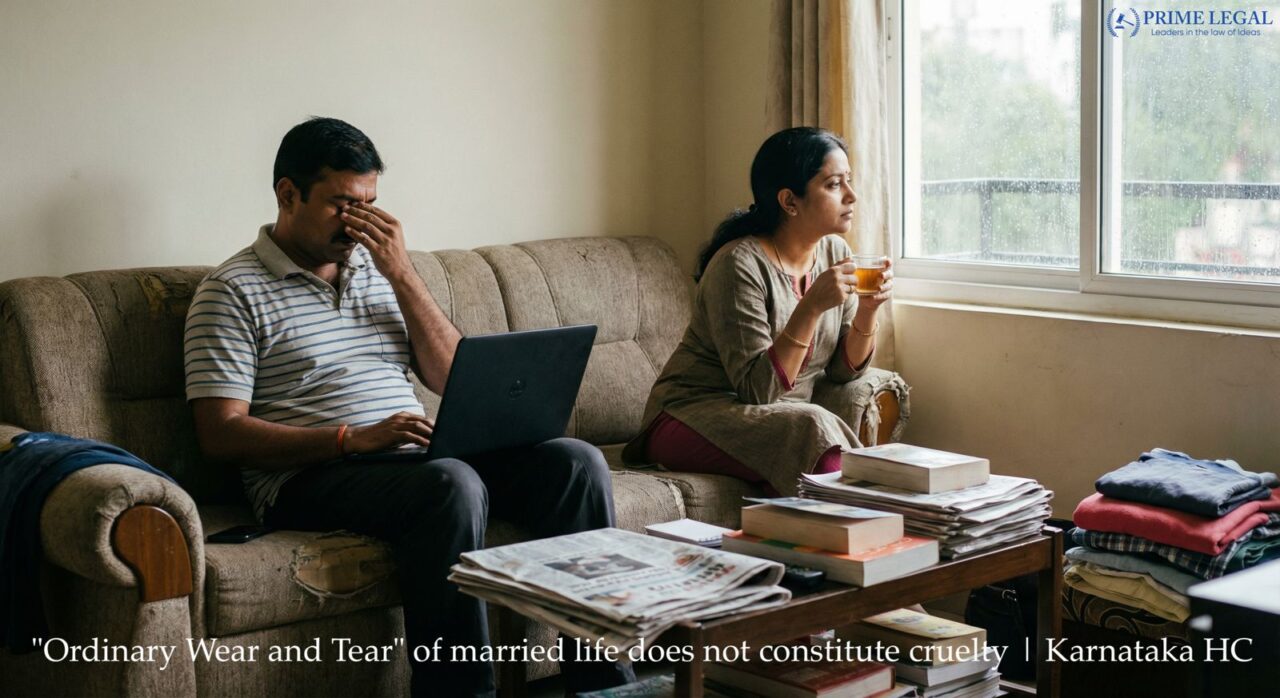
The Karnataka High Court has held that everyday disagreements, lifestyle differences, and routine domestic friction between spouses – the “ordinary wear and tear” of married life – do not amount to “cruelty” under Section 498A of the Indian Penal Code (IPC). Justice M. Nagaprasanna, sitting at the High Court of Karnataka, quashed an FIR and criminal proceedings for offences under Sections 498A and 504 IPC read with Sections 3 and 4 of the Dowry Prohibition Act, terming the case a “classic illustration” of misuse of the provision. The Court underscored that criminal law cannot be converted into a weapon to punish incompatibility or imperfect marriages and warned against using Section 498A as a “criminal dragnet” for ordinary marital
BACKGROUND
The petition was filed by a husband, his parents, and his brother seeking quashing of an FIR registered at Basavangudi Women Police Station, Bengaluru, in Crime No. 90 of 2024 for alleged cruelty and dowry harassment. The parties were married in August 2017 and subsequently lived in the United States for nearly six years, during which two children were born. In January 2023, the wife returned to India and lodged a complaint alleging harassment by the husband and his family members the following year.
The complaint contained grievances such as alleged insistence that the wife shall be obligated to perform household chores, constant criticism of her cooking, dietary restrictions and clothing, disagreements over television watching and an assertion that she was treated like a servant It also led to issuance of a Look Out Circular (LOC) against the husband, which restrains his travel. The petitioners contended that these allegations are mere minor matrimonial issues and do not deem the charge criminal cruelty. They further submitted that continuing the case would amount to abuse of process.
KEY POINTS
- The Hon’ble Justice Nagaprasanna has observed that the complaint alleged primarily about dietary restrictions, expectations regarding attire, distribution of household responsibilities and differences over daily routines. The Court held that even if considered based on the face value, these claims show a unilateral view of the marital altercations and fall immensely short of the grave, targeted cruelty contemplated by Section 498A IPC.
- The Court observed that the law does not criminalize incompatibility, nor does it punish imperfect marriages,” stressing that Section 498A is meant to address serious cruelty and dowry-related harassment. By taking reference from Supreme Court and High Court precedents, including Abhishek v. State of Madhya Pradesh (2023) SCC OnLine SC 1069; Belide Swagath Kumar v. State of Telangana (Diary No. 47072 of 2023) and other judgements which refrain the use of provisional safeguards against criminalization of recurring non-intense conflicts in the families, the Court held that trivial disputes or normal wear and tear cannot be elevated to criminal cruelty.
- The Court expressed particular concern about the routine implication of in-laws who were residing in India while the couple lived abroad. It noted the broader judicial trend lamenting the tendency to array all members of the husband’s family as accused on vague, omnibus allegations, without specific acts attributed to each. Regarding this, the Court held that it undermines the integrity of the criminal justice system and unjustly stigmatizes entire families.
- The judge held that permitting FIR and investigation to continue in the absence of legally cognizable cruelty would serve no purpose other than to prolonged harassment, stigmatization of petitioners and squandering of the precious time of criminal courts. The Court also criticized the issuance of LOC on such unsubstantiated allegations and observed that it compounded the injustice by restricting the husband’s liberty when the accusations themselves did not meet the statutory threshold.
- The judgment adds into the list of precedents with a settled view that cruelty must be something more serious than ordinary wear and tear of married life and cannot be decided based on the aversion of one of the spouses. The Courts have consistently held that normal quarrels and friction in marital life does not in itself constitute cruelty nor does it warrant prosecution under Section 498A or grant of divorce.
RECENT DEVELOPMENTS
Following this decision, legal commentators have described the judgment as part of a growing judicial effort to recalibrate the use of Section 498A IPC, ensuring that the provision remains available for genuine cases of grave cruelty and dowry harassment, while preventing its misuse in routine marital conflicts. Similar observations have recently been made by the Delhi High Court and other High Courts, which have emphasized that mere taunts, casual references, and general family friction fall within the “ordinary wear and tear” of married life and cannot be treated as criminal cruelty.
The Karnataka High Court’s ruling will be a guiding light to the trial courts and investigating agencies to assess complaints under Section 498A more carefully and with closer scrutiny of whether the allegations in circumstances wherein, even if accepted, cross the statutory threshold of cruelty or merely reflect incompatibility and daily domestic disputes. The decision also reinforces the need to apply Section 498A in a targeted manner so for it to remain as an effective tool against serious matrimonial violence and dowry abuse, rather than a routine response to every broken or strained marriage.
CONCLUSION
The Karnataka High Court’s ruling which declared that ordinary wear and tear of married life does not amount to cruelty under Section 498A of the IPC is an important development in the dimensions of Indian criminal and family laws. By quashing the proceedings as an abuse of process, the Court has reaffirmed that criminal law is a remedy for grave wrongs and not a mechanism to take revenge for animosities arising out of everyday marital friction or incompatibility. The judgment seeks to strike a balance between protecting genuine victims of matrimonial cruelty and preventing the over imposition of liability for occurrences which are of normal marital discord with the preserve both the credibility of Section 498A and the fairness of the criminal justice
“PRIME LEGAL is a full-service law firm that has won a National Award and has more than 20 years of experience in an array of sectors and practice areas. Prime legal falls into the category of best law firm, best lawyer, best family lawyer, best divorce lawyer, best divorce law firm, best criminal lawyer, best criminal law firm, best consumer lawyer, best civil lawyer.”
WRITTEN BY: KRISHNA

