
INTRODUCTION
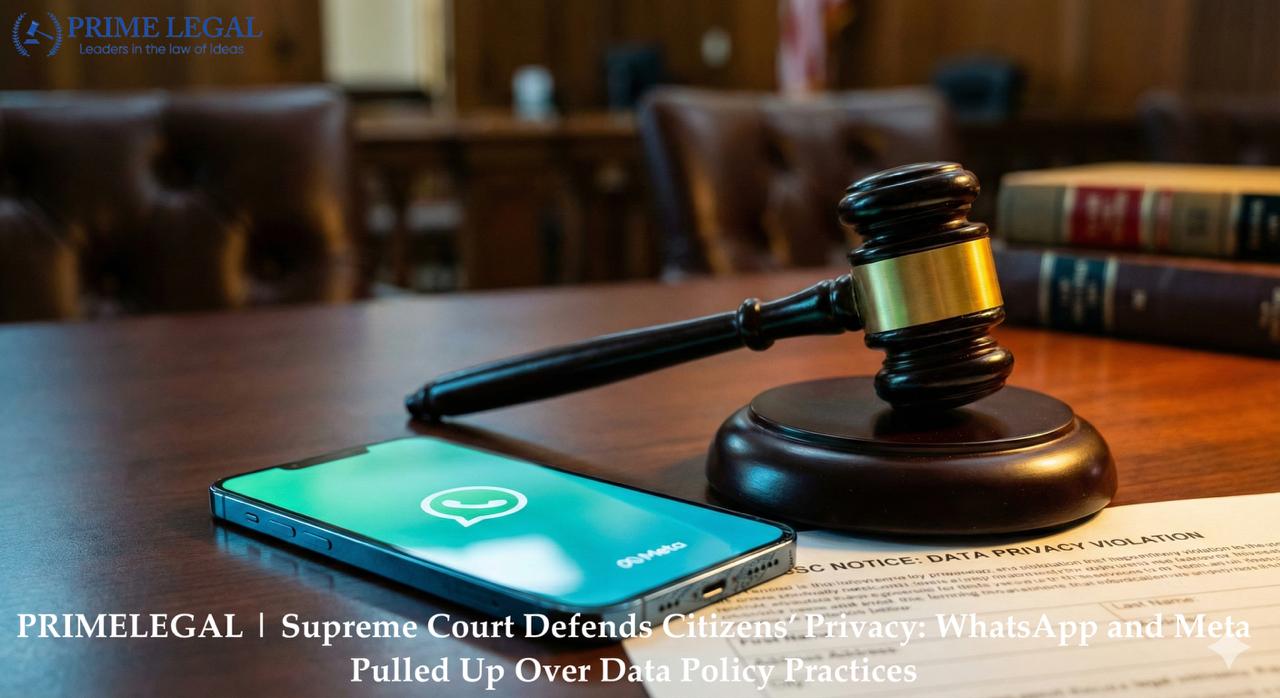
The Supreme Court of India issued a warning to WhatsApp and its parent company, Meta over the updated privacy policy of 2021. The bench, comprising of Chief Justice of India Surya Kant, Justice Joymalya Bagchi and Justice Vipul M Pancholi stated that the personal data of users of WhatsApp cannot be shared or exploited and their right to privacy cannot be breached for advertising or business purposes.
BACKGROUND
The foundation of the present legal debate is based on the revised terms of service and privacy policy of WhatsApp which was announced in January 2021, wherein it mentioned expanded sharing of user data with other entities belonging to Meta group for business messaging and advertising related purposes.
Observing this, the Competition Commission of India (CCI) took suo motu and took note of the complaints raised by individuals and civil society groups regarding possible abuse of dominant position by WhatsApp on 24 March 2021. The Director General of Competition Commission was directed to carry out an investigation of the privacy policy update which aimed to strengthen Meta’s data advantage leveraging unfair conditions imposed upon users, post which the commission passed a final order holding abuse of position by WhatsApp and imposition of penalty of Rs. 213.14 crores along with behavioural directions. WhatsApp and Meta thereafter challenged the investigation before the Delhi High Court alleging that the competition regulator lacked jurisdiction on data sharing and user consent. The objections were rejected by the High Court. The order of the Commission was challenged before the National Company Law Appellate Tribunal which on 4 November 2025 held that CCI is competent to examine the competition law implications of the privacy policy and rejected the argument that the matter was confined to data protection solely. Meta and WhatsApp moved to the apex court against the decision of NCLAT.
KEY POINTS
- The Honourable Bench of the Supreme Court slammed WhatsApp and Meta stating that an act of exploitation of privacy of citizens’ data was a mockery of the country’s constitutionalism and shall not be permitted. It was observed that the platform should not operate in India if the concerns about data sharing and exploitation cannot be adequately addressed.
- With regard to the data sharing policy, the bench observed that the customers did not have a choice of opt out mechanism from WhatsApp facility due to their monopoly in the market. The Supreme Court directed the companies to sign an undertaking that the data shall not be shared till the matter has been decided upon, with regard to which directions will be passed. It was observed that buying and selling of the company, as recently had been done with Facebook, involves the transfer of entire data of consumers. Concerns were raised that privacy and personal data are not only sold but commercially exploited.
- Further it was observed the concept of silent consumers, people who may not be aware of the privacy policy and may not understand the terms and conditions or the ‘cleverly crafted language’ associated with it. It was observed that such an action by the company amounts to a decent way of committing theft of private information. The bench pointed out that even educated people struggle to read and understand privacy policies. Considering this, expecting millions of ordinary users to give informed consent is unrealistic.
- It was argued on behalf of Meta and WhatsApp that the apex court had on an earlier occasion refused to stay the sharing and had asked it to issue newspaper advertisements in all languages, which had been complied with. The Honourable Bench stated that the platform issues messages on its platform frequently with regard to questions of sharing. The information with relation to opting out should not be through newspapers as consumers are not expected to read such disclosures in the newspaper.
- The bench while dealing with the issue of services being disconnected when data sharing is disallowed by the users observed that the objective of WhatsApp is to provide messaging communication services, not to collect, sell or share data.
- The bench referred to the hidden charges and aimed to examine the rent sharing of data along with addressing the privacy concerns dealt by the Digital Personal Data Protection (DPDP) Act of 2023. Concerns were raised on the behavioural tendencies and trends, its utilisation, monetisation and leveraging of data to the parent company for the purpose of gaining advantage on online advertising.
- The counsel on behalf of Meta and WhatsApp stated that the penalty amount had been deposited in furtherance of which the bench directed that the amount shall not be allowed to be withdrawn until further orders.
RECENT DEVELOPMENTS
The Supreme Court allowed the companies, WhatsApp and its parent company, Meta to file affidavits explaining their position. The Competition Commission of India was directed to suggest conditions which may be required to be put in place. The bench will be hearing the matter on a later date on the need for interim directions.
CONCLUSION
To conclude, the Supreme Court’s intervention in the WhatsApp Meta privacy policy dispute reaffirms the significance and importance of the right to privacy of consumers in the digital age. By subjecting monopoly holding companies to such strict judicial scrutiny, it emphasises that commercial interests cannot surpass fundamental rights of citizens, specially when consent is neither informed nor meaningfully voluntary. This case holds the potential to be marked as a landmark judgment, shaping the protection of digital autonomy of citizens of India.
“PRIME LEGAL is a National Award-winning law firm with over two decades of experience across diverse legal sectors. We are dedicated to setting the standard for legal excellence in civil, criminal, and family law.”
WRITTEN BY: STUTI ANVI

