
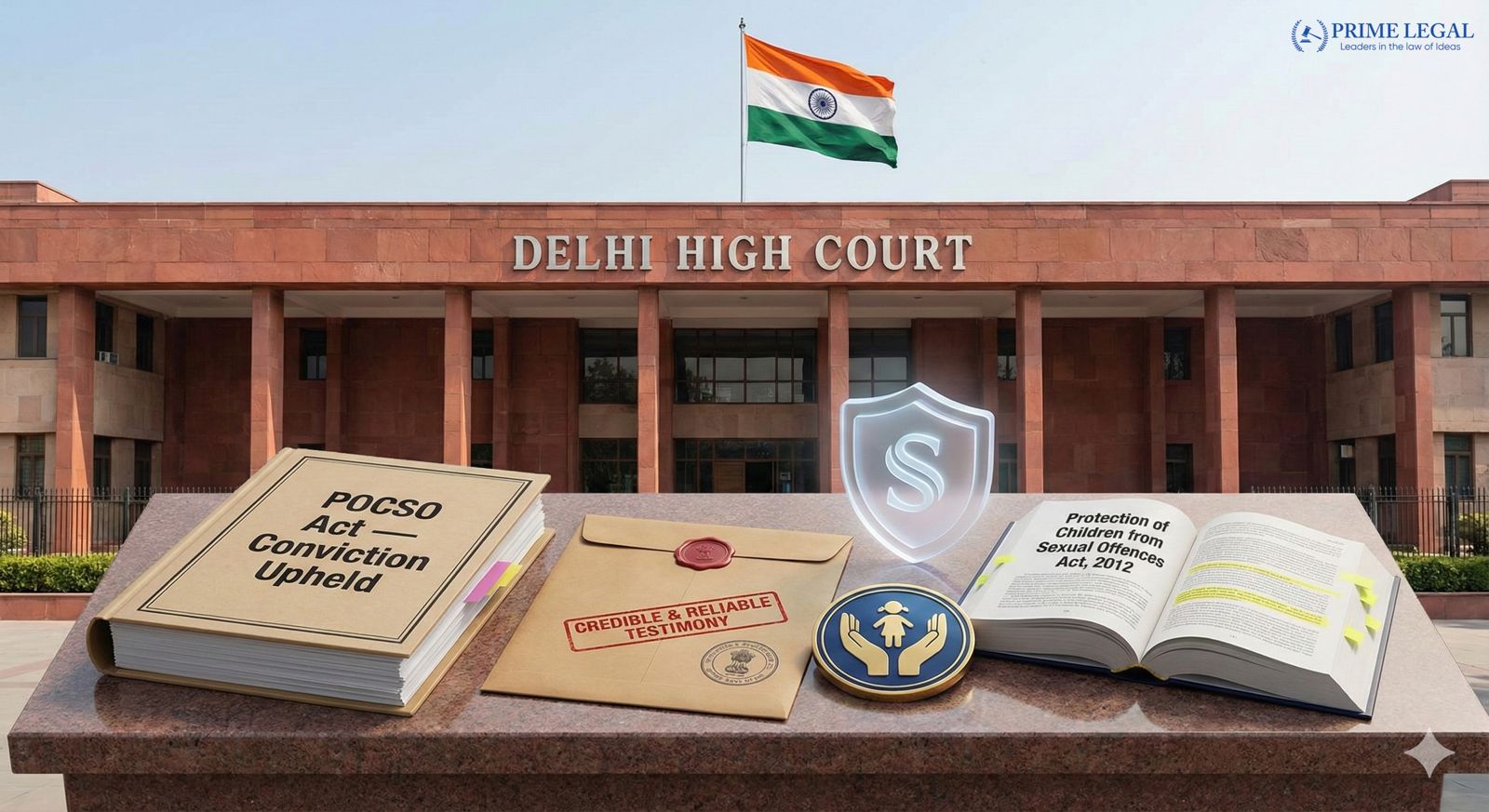
CASE NAME: Darshan Mohar v. State (NCT of Delhi) & Anr.
CASE NUMBER: CRL.A. 168/2025
COURT: High Court of Delhi
DATE: 10 December 2025
QUORUM: Justice Swarana Kanta Sharma
FACTS
A relative of the family allegedly committed sexual assault on the 17-year-old victim in January 2020 while she was by herself at home, issuing threats to ensure her silence. She held back from reporting due to intimidation until May 2020, when abdominal discomfort and absent periods led to a hospital examination confirming pregnancy. Responding to queries from physicians, she pointed to the appellant, which initiated the FIR, Child Welfare Committee consent for termination of pregnancy, and collection of fetal samples. The trial court found him guilty under POCSO for aggravated assault and related IPC offences, sentencing him to 20 years’ rigorous imprisonment, which led to this appeal.
ISSUES
- Did documentary and testimonial evidence establish the victim’s minor status during the offence?
- Was the victim’s account dependable for securing conviction?
- Did the defence overcome the POCSO presumptions?.
LEGAL PROVISIONS INVOLVED
- Sections 5 and 6, POCSO Act, 2012 – Covering aggravated penetrative sexual assault and its penalty.
- Sections 29 and 30, POCSO Act, 2012 – Establishing presumptions regarding guilt and mental culpability.
- Sections 376 and 506, Indian Penal Code, 1860 – Dealing with rape.
ARGUMENTS
APPELLANT:
The defence highlighted several concerns about the prosecution’s case. They emphasised the five-month delay in filing the FIR, contending that such a long gap cast serious doubt on the consistency and reliability of the survivor’s account. Without any DNA to link the appellant to the crime, they saw a major gap in the evidence. They also challenged the victim’s account as inconsistent and not strong enough to prove guilt beyond all reasonable doubt, pushing for the appellant’s release.
RESPONDENT
The State countered with straightforward school records proving the victim was a minor. Her consistent story matched the medical evidence from the hospital perfectly. They explained the delay as the natural result of her fear from threats and the trauma she endured—something courts see often in these cases. Above all, they stressed that POCSO’s legal presumptions protect child victims, and the defence offered nothing substantial to overturn them.
ANALYSIS
The court relied on solid school records—the defence left them untouched—to confirm she was a minor at the time. Her testimony remained calm and consistent, marked only by small lapses that reflected the emotional scars of her trauma—evident to anyone watching her in court. The inconclusive DNA report, caused by mishandling, did not erode the case. What stood firm was the survivor herself. She spoke with quiet consistency and sincerity, her words carrying emotional truth rather than invention. Her account was further strengthened by the legal presumptions under Sections 29 and 30 of the POCSO Act—presumptions the defence could not shake at any stage of the trial.
JUDGMENT:
The High Court chose not to interfere with the trial court’s findings. The appeal was dismissed, and the conviction along with the twenty-year sentence was affirmed. The court was convinced that the prosecution had presented a coherent and trustworthy narrative, leaving no meaningful doubt about the accused’s guilt.
CONCLUSION:
At its heart, this judgment recognises something deeply human: when a child speaks with honesty and courage about what they have endured, that voice deserves to be heard and believed. Justice, the court affirmed, does not depend only on technical proof—it also rests on the strength of a survivor who finds the courage to speak the truth.Delays, fear, or missing scientific proof cannot erase the reality of what a survivor has lived through. Under the POCSO Act, a child’s voice—when steady and sincere—carries its own strength, and that strength can be enough to secure justice.
“PRIME LEGAL is a full-service law firm that has won a National Award and has more than 20 years of experience in an array of sectors and practice areas. Prime legal falls into the category of best law firm, best lawyer, best family lawyer, best divorce lawyer, best divorce law firm, best criminal lawyer, best criminal law firm, best consumer lawyer, best civil lawyer.”
WRITTEN BY: ARCHITHA MANIKANTAN

