
CASE NAME: IDBI Trusteeship Services Limited v. Manish Jain & Ors.
CASE NUMBER: CS(COMM) 800/2025 & I.A. 7470/2026, O.A. 59/2026
COURT: High Court of Delhi
DATE: 23 March 2026
QUORUM: Hon’ble Ms. Justice Mini Pushkarna
FACTS
The dispute arose in a commercial suit filed by IDBI Trusteeship Services Limited against Manish Jain and others. Defendant No. 2 was facing personal insolvency proceedings under Section 95 of the IBC, and an Interim Resolution Professional had already been appointed. But he argued that an interim moratorium under Section 96 of IBC automatically operated. Subsequently the present suit was instituted and summons were issued. The main procedural fight was about a written statement., when the Joint Registrar had closed the right of Defendant No. 2 to file it, and the defendant challenged that order. He also said he had filed an application for rejection of the plaint, and therefore the written statement period should not be treated as over. The plaintiff contented this by pointing out that the plea for rejection of plaint was filed days after the expiration of the 120 days statutory period for filing the written statement.
ISSUES
- Whether Defendant No. 2’s has the right to file a written statement?
- Whether moratorium under Section 96 IBC operates automatically justifying the delay in filing written statement?
LEGAL PROVISIONS
- Order VII Rule 11 CPC – Rejection of plaint.
- Order VIII CPC and the 120-day outer limit for filing written statement in commercial suits.
- Section 95 and Section 96 of the Insolvency and Bankruptcy Code, 2016 – personal insolvency proceedings and interim moratorium.
- Case Laws: R.K. Roja v. U.S. Rayudu, Saleem Bhai v. State of Maharashtra, SCG Contracts v. K.S. Chamankar Infrastructure, and Zenith Vipers Solutions v. Jasmeet Singh Marwah.
ARGUMENTS
APPELLANT:
Defendant No. 2 argued that once personal insolvency proceedings were initiated and an interim moratorium under Section 96 IBC came into force, no suit could effectively proceed against him and the time for filing a written statement should not be treated as running at all. He also contended that because application for rejection for plaint was pending, the plaint’s maintainability had to be decided first and the written statement could not be insisted upon meanwhile.
RESPONDENTS:
The plaintiff replied that the commercial suit rules are strict and the 120-day period had already expired on 3 December 2025. It was only after that deadline had gone by that Defendant No. 2 filed the application for rejection of the plaint on 14 December 2025. As the right to file the written statement had already lapsed, he could not use that later filing to revive the lost time.
ANALYSIS
The Court first noted the dates were not in dispute. The statutory outer limit for filing the written statement expired on 3 December 2025, the plaintiff applied to close the right on 5 December 2025, and only on 14 December 2025 did Defendant No. 2 file his Order VII Rule 11 application. Relying on R.K. Roja v. U.S. Rayudu and SCG Contracts v. K.S. Chamankar Infrastructure, the Court reiterated that application for rejection of plaint may be filed before filing a written statement, and if the plaint is rejected, the written statement stage need not arise. But the Court was equally clear that this procedural choice cannot be used as a “ruse” to recover a time period already lost.
The Court also stated that the operation of interim moratorium under Section 96 of the IBC is a subject matter of the pending application under Order VII Rule 11 made by the Defendant No. 2. It would be examined separately while deciding the plaint rejection plea, but it could not by itself undo the fact that the written statement period had expired much earlier.
JUDGMENT
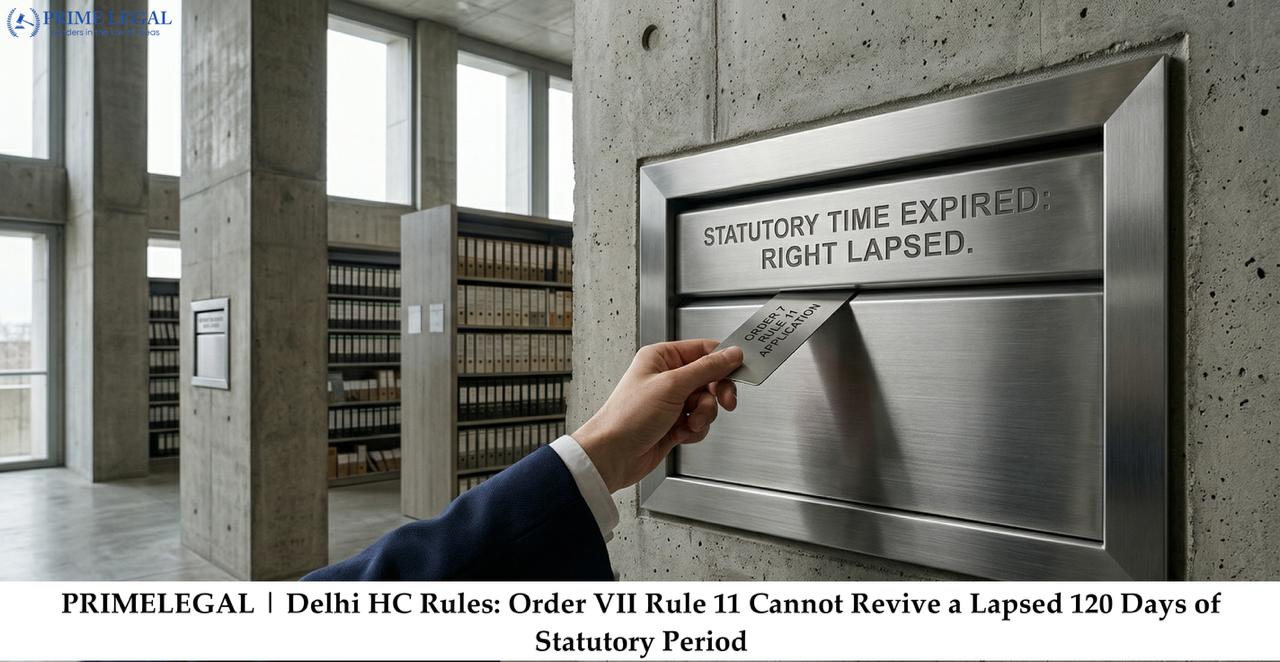
The appeal was dismissed. The Court upheld the Joint Registrar’s order closing the right of Defendant No. 2 to file a written statement, holding that a later Order VII Rule 11 application cannot revive a lapsed statutory period. The plea based on interim moratorium was left to be considered in the pending plaint rejection application.
CONCLUSION
The HC reiterates that the limitation of time given in the procedural law must be abided by. It emphasized that procedural strategy cannot replace statutory compliance. A defendant may challenge a plaint at the first instance, but if he waits until the written statement period is already over, Order VII Rule 11 will not rescue him. The Court also treated the insolvency objection as distinct from the procedural default in filing the written statement.
“PRIME LEGAL is a National Award-winning law firm with over two decades of experience across diverse legal sectors. We are dedicated to setting the standard for legal excellence in civil, criminal, and family law.”
WRITTEN BY: ABIA MOHAMMED KABEER
please read the judegement copy here

