
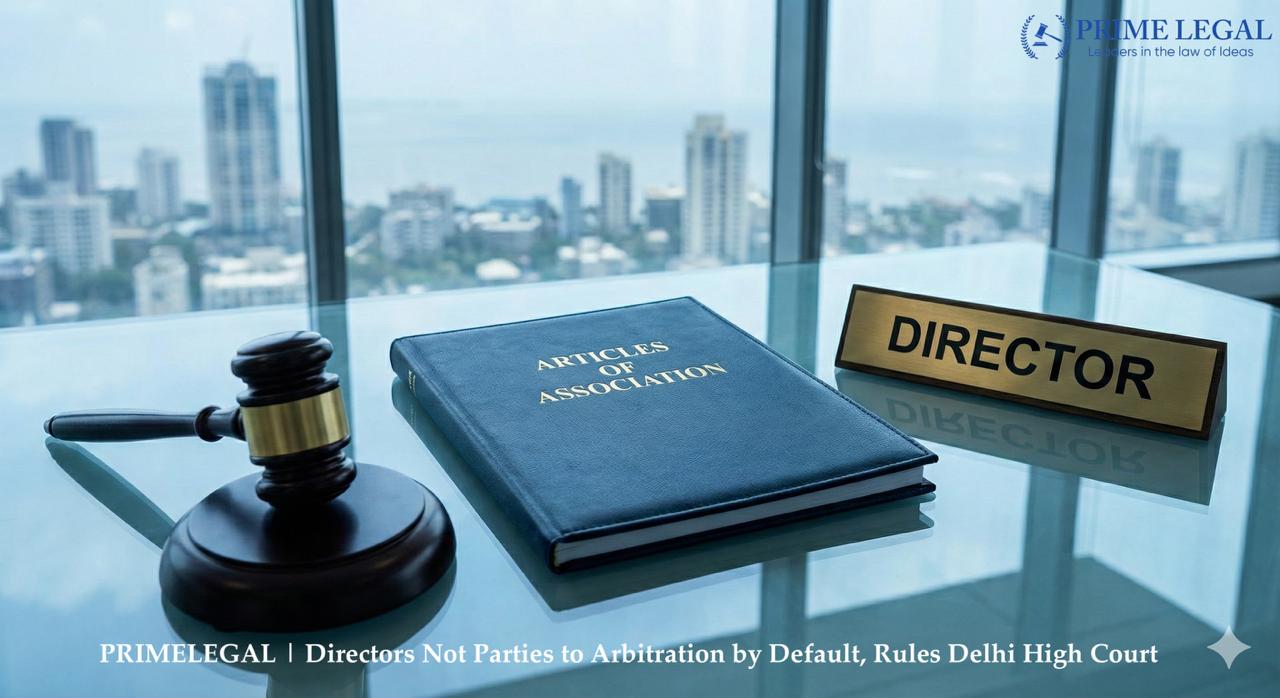
CASE NAME: Natasha Oberoi v. Rajaraman Shankar and Ors
CASE NUMBER: O.M.P. (I) (COMM.) 373/2025 & I.A. 22577-78/2025
COURT: High Court of Delhi
DATE: 15th January 2026 (Pronounced); 16th December 2025 (Reserved)
BENCH: Hon’ble Justice Purushaindra Kumar Kaurav
FACTS
The petitioner Natasha Oberoi who is the daughter of late P.R.S. Oberoi and managing director of Oberoi Hotels Pvt. Ltd., went on to file a petition under Section 9 of the Arbitration and Conciliation Act, 1996, seeking an interim stay on the Board resolution dated 6th June 2025. The pollution, which is being challenged grants authority to one, Mr. Tejaswi Dixit to handle legal matters relating to the deceased’s estate, including initiating and defending legal proceedings. Following filing of an Estate Suit on 10th September 2024 by respondent no. 4 seeking declaratory and mandatory injunctions concerning the deceased’s estate, respondent no. 1 filed a written statement on behalf of the Company on 9 January 2025 supporting respondents nos. 2-3 (deceased’s son and nephew respectively). Petitioner and respondent no. 4 objected to this Company written statement, alleging it should have remained neutral. Subsequently, the impugned resolution passed with respondents nos. 1 to 3 assenting and petitioner-respondent no. 4 objecting. The petitioner invoked Article 30A of the Company’s Articles of Association contending it constituted a valid arbitration clause binding all parties.
ISSUES
- Whether an unsigned document containing alleged arbitration clause satisfies the statutory writing requirement under Section 7(4)(a) of the Arbitration Act, 1996.
- Whether a director who is not a shareholder/member of the company constitutes a “party to arbitration agreement” within the meaning of Section 7 read with Section 2(1)(h) of the Arbitration Act.
- Whether Article 30A of the Articles of Association evidence clear intent to arbitrate binding disputes under the Arbitration Act or merely constitutes in-house dispute resolution mechanism.
- Whether petition under Section 9 is maintainable without an existence of valid arbitration agreement which satisfies all the statutory requirements.
LEGAL PROVISIONS
- Section 2(1)(h), Arbitration Act, 1996 which defines party as party to arbitration agreement.
- Section 7(1), Arbitration Act, 1996 which defines arbitration agreement as agreement by parties to submit disputes to arbitration.
- Section 7(4)(a), Arbitration Act, 1996 which requires for arbitration agreement to be in writing contained in document and signed by parties.
- Section 10 of Companies Act, 2013 which binds the company and members to memorandum and articles as if signed.
- Section 9, Arbitration Act, 1996 which permits party to an arbitration agreement to apply for interim measures before or during arbitral proceedings.
ARGUMENTS
PETITIONER:
The senior counsel on behalf of the petitioners went on to submit that Article 30A violated mandatory Article 18 provision prohibiting unauthorized power delegation. Disputes concerning compliance constituted arbitrable matter under Article 30A arbitration clause binding on Company and directors. The practice of naming company, lawyers, and auditors as the arbitrators which is being reflected in procedural mechanisms and auditors as arbitrators is a dissociable aspect from a substantive intent to arbitrate.
reflected procedural mechanism severable from substantive intent to arbitrate.
RESPONDENTS:
The counsel on respondent no. 1 argued Articles of Association bind company and shareholders, not directors simpliciter. Unlike Constitutions binding citizens, Articles govern directors without conferring party status for arbitration invocation purposes. Petitioner lacked Section 7 compliance. Respondents nos. 2-3 (through Dr. Abhishek Manu Singhvi and Mr. Akhil Sibal) emphasized Article 30A lacked sufficient indicia of arbitration clause and petitioner—as non-member director has failed satisfying party requirement. Respondent no. 5 contended Company faced no alleged wrongdoing allegations justifying arbitration petition.
ANALYSIS
Hon’ble Justice Purushaindra Kumar Kaurav’s judgment meticulously analyzes three statutory requirements under Section 7 Arbitration Act. First while addressing signing requirements, the Court has emphasized that Section 7(4)(a) mandates carrying an explicit signature by parties unlike English law permitting the non-existence of signatures. Secondly, noting on the New York Convention and Model Law precedents, Court held that signature constitutes sine qua non of valid arbitration agreement in documentary form. The Court went on to reject the argument that parties constituting ad idem regarding the lack of signature have absolved petitioner of obligation, finding parties were not ad idem regarding petitioner’s party status or agreement effects.
Secondly, while analyzing the party requirement, the Court has distinguished between the governing documents and status of the party. Section 10 of the Companies Act of 2013 creates a deemed fiction only for the members and company. By relying on the precedent set in the Hickman case, the Court has clarified that members enforcing arbitration clauses in Articles must establish member status. Court rejected petitioner’s argument that directors need not be in contractual relationship, holding Cox & Kings precedent addressed claim-arbitrability distinction, not party-requirement waiver.
Thirdly, regarding intent to arbitrate, the Court has held mere inclusion of arbitration terminology to be insufficient. While holistically analyzing article 30A, the Court found that it was positioned under indemnity heading, suggestive of limitation to disputes related to indemnity.
JUDGMENT
Hon’ble Justice Kaurav dismissed the petition under Section 9, concluding that unsigned Articles of Association fell afoul of Section 7(4)(a) writing requirements and went on to pronounce that the petitioner as non-member director failed satisfy the Section 7(1) party requirement and that Article 30A lacked clear intent to arbitrate, constituting instead in-house dispute resolution mechanism.
CONCLUSION
This landmark judgment is a step towards establishment of a critical distinction between document governance and arbitration agreement party status in corporate contexts. The application of statutory requirements, this Delhi High Court judgment aims to prevent the prevention of arbitration through unilateral indication of unsigned documents. The judgment highlights in the context of party consult, which is evidenced through signatures and clear binding intent to prevent non-involved parties from being trapped within the private adjudicatory mechanisms.
“PRIME LEGAL is a National Award-winning law firm with over two decades of experience across diverse legal sectors. We are dedicated to setting the standard for legal excellence in civil, criminal, arbitration and family law.”
WRITTEN BY: KRISHNA KOUSHIK
Click here to view the true copy of the Judgment: Natasha Oberoi v. Rajaraman Shankar and Ors

