
CASE NAME: Civil Court Bar Association & Anr. v. High Court of Judicature at Allahabad & Ors.
CASE NUMBER: WRIT-C No. 37 of 2026 & 42218 of 2025
COURT: High Court of Judicature at Allahabad
DATE: 24 March 2026
QUORUM: Hon’ble Ajit Kumar, J. & Hon’ble Swarupama Chaturvedi, J. (per Swarupama Chaturvedi, J.)
FACTS
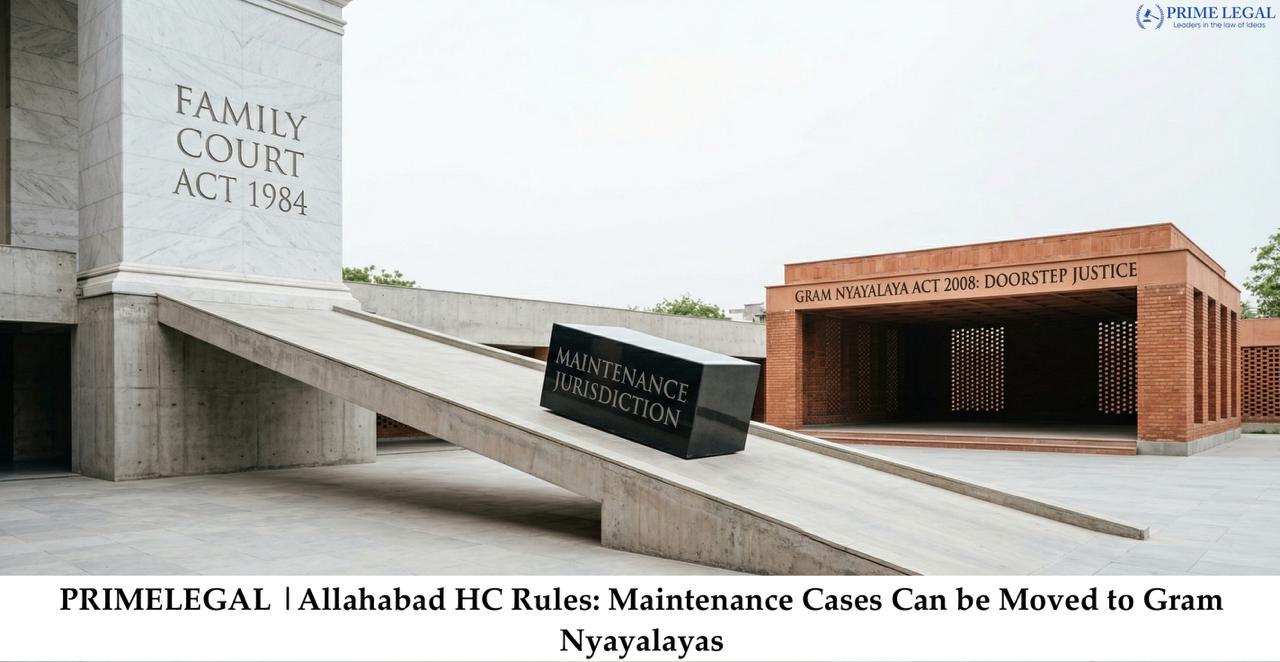
Two writ petitions were filed before the High Court of Judicature at Allahabad which challenged the administrative orders of Family Court to transfer the maintenance proceedings to Gram Nyayalayas.
Writ Petition No. 37 of 2026 was filed by the Civil Court Bar Association, Maharajganj against the order directing cases to Gram Nyayalayas at Nautanva and Nichlaul. Whereas, Writ Petition No. 42218 of 2025 was filed by the Bar Association of Gorakhpur.
The impugned orders were passed by District Judge and Principal Judge of Family Courts as per the provisions of the Gram Nyayalayas Act, 2008. The petitioners contended the validity of such orders and that they were against the provisions of the Family Courts Act, 1984, which provides exclusive jurisdiction over family disputes.
Since both the petitions were on the same subject matter and involved similar facts and issues, they were heard and dealt with together and decided through a common judgement.
ISSUE
- Whether the Family Court can transfer the pending maintenance case to Gram Nyayalays under section 16 of the 2008 Act?
- Whether the administrative orders based on the statutory provisions be challenged without challenging the vires of the statute?
LEGAL PROVISIONS
- Gram Nyayalayas Act, 2008
- Section 12 – Jurisdiction over criminal matters (including maintenance)
- Section 16 – Power to transfer cases
- Section 18 – Overriding effect
- Section 33 – Appeal to Sessions Court (Proviso preserves remedies under Articles 226 & 32)
- Family Courts Act, 1984
- Section 7 – Jurisdiction of Family Courts
- Section 8 – Exclusion of jurisdiction of other courts
- Section 19 – Appeal to High Court
- Chapter IX, Code of Criminal Procedure (CrPC) – Maintenance provisions
ARGUMENTS
PETITIONERS:
The petitioners argued that the Family Courts Act 1984 is a special statute which confers exclusive jurisdiction over family disputes and the same cannot be diluted by administrative orders. When transferring the pending matter before a Gram Nyayalaya the appeal to the same lies with the Sessions Court, whereas it is to the High Court when the matter is dealt by the Family Court. Thus, depriving the litigants their right to appeal to the High Court.
The petitioners further contended that the impugned order was based on the Registrar General’s letter, which lacks proper legal binding authority and cannot alter statutory jurisdiction. Moreover, both the 2008 Act and the 1984 Act are both intended for distinct fields and that Gram Nyayalayas lacked effective mechanisms for enforcement of maintenance orders.
RESPONDETS:
The Respondents argued that the Gram Nyayalayas Act is a beneficial legislation intended to decentralise the justice system and ensure accessibility to all. Thus, relying on sections 12 and 16 of the Act along with the Schedule it was argued that maintenance matters fall within the jurisdiction of Gram Nyayalayas and justified the transfer of pending maintenance cases.
They further contended that section 18 of the Act gave an overriding effect and that the petitioners had failed at challenging the validity of the statutory provisions, thus making their challenge to administrative orders unsustainable.
ANALYSIS
The Court adopted a harmonious construction whereby it held that both the 1984 Act and the 2008 Act are special legislations operating in complementary spheres. While the former is focused on specialised adjudication and conciliation, the latter focuses on grassroot accessibility to justice.
The Court applied the principle of leges posteriores priores contrarias abrogant, meaning the later enactment prevails. Thus, the Gram Nyayalaya Act, 2008 would override the inconsistent provisions of the Family Courts Act, 1984.
The Court further clarified that even though as per the provisions of the 2008 Act appeals from Gram Nyayalays lie to Sessions Court, the proviso to section 33 preserves the right to approach constitutional Courts under Articles 226 and 32, thereby safeguarding litigants’ rights.
While addressing the matter the Court relied heavily on Smt. Siya Dulari v. Awadh Naresh, where it was held that even though jurisdiction stems from statute and not from administrative directions, it does not prohibit transfers under section 16.
It also clarified that the Registrar General’s letter was a mere clarification and could not serve as a source of jurisdiction.
The Court also noted that the petitioners had failed to challenge sections 12, 16 and 18 of the 2008 Act, therefore, they could not challenge the actions taken in accordance with the same.
JUDGEMENT
The Court held that
- Transfer of pending maintenance cases from the Family Courts to the Gram Nyayalayas were valid in law Under Section 16.
- The writ petitions were not maintainable without any challenge to statutory provisions.
- The ‘leges posteriores priores contrarias abrogant’ principle further supports the legality of the transfers.
Thus, both the writ petitions were dismissed.
CONCLUSION
The judgement emphasises that statutory provisions form the foundation for jurisdiction and administrative actions taken in pursuant of them cannot be challenged in isolation. It reinforces principles of harmonious interpretation and later legislation prevails.
By upholding the transfers, the Court underscored the objective of decentralised and accessible justice delivery, while promising the availability of constitutional remedies to litigants’.
“PRIME LEGAL is a National Award-winning law firm with over two decades of experience across diverse legal sectors. We are dedicated to setting the standard for legal excellence in civil, criminal, and family law.”
WRITTEN BY: AARSHITHA UNNIKRISHNAN
read the judegement copy here
Civil Court Bar Association And Another v. High Court Of Judicature At Allahabad

