
ABSTRACT
The legal status of airspace above private property remains inadequately defined as India marches towards a future trajectory marked by logistics provided by drones, vertical urbanisation, and aerial networks powered by 5G. While old common laws conferred rights of airspace all the way up to the heavens on landowners, Indian statutes and aviation regulations have bypassed this prerogative and have only managed to perpetuate a volatile legal vacuum. This article examines the tension between conventional property rights and the new aerial economy, assessing major statutes including the Drone Rules 2021 and the Aircraft Act 1934, and stresses the imperative need for comprehensive legislation in respect of airspace.
KEY WORDS
Aerial Trespass, Airspace Rights, Digital Sky, Drone Rules, 2021, Easement Rights, Ordinary Use and Enjoyment, Privacy, Property Law, Vertical Urbanisation
INTRODUCTION
For centuries in India, ownership of property followed the Roman principle “Cujus est solum, ejus est usque ad coelum et ad inferos,” meaning whoever owns the soil owns it all the way to Heaven and all the way to Hell. In an agrarian world, this was a clear, enforceable idea. Yet as the 21st century unfolds, the vertical column of air above that soil has evolved from mere empty space to a valuable slice of commercial real estate. Today, delivery drones, surveillance quadcopters, and soaring high-rise developments are redefining what ownership means. The air above a home is no longer merely a source of light and ventilation; it has become a disputed corridor for logistics and a battleground for privacy, while Indian law remains largely tied to 19th-century notions of land rights.
THE EROSION OF THE “HEAVENS” DOCTRINE
The first real challenge to the ownership of absolute airspace within India’s national legal framework came with the Aircraft Act, 1934. According to Section 4, the Central Government was empowered to make rules, later widened to include the 1944 Chicago Convention, to determine the limits of the upper airspace for public use. In short, the state conveyed the impression that even though land could be owned by private individuals, the sky was still the state’s domain.
Still, the legal friction does not occur at the cruising altitudes of commercial jets-some 30,000 feet-but rather in the lower reaches of the atmosphere, or within about the first 500 feet off the ground. And that is just the zone in which the modern economy would wish to function. The Indian courts have indeed started recognising that the old concept of unlimited vertical ownership has in effect become obsolete, even as they remain staunch custodians of the lower layers of air integral to property enjoyment.
The Kerala High Court, in the landmark Koya Haji v. Bhaskaran (1984), 1984 KLT 929, did indeed provide a pointed evaluation of the bounds of neighbourly encroachment. While the issue was over sun-shades extending over a neighbour’s room, its propositions of law relating to “perennial trespass” have considerable resonance in today’s aerial domain. The court concluded that when one party persists in unauthorised construction or encroachment over the objection of a neighbour, such an act amounts to a conscious violation of legal rights.
The import of the Koya Haji ruling lies in its refusal to allow for a mere “buy-out” of rights; that is, it held that if a defendant acted in a blameworthy manner, he could not simply make up for it with damages. Rather, such reckless intrusion merits a mandatory injunction. What this suggests is that while infinite air rights have become a thing of the past, immediate air rights, the area needed for the ordinary use and enjoyment of a structure, still has strong protection. Thus, the common law has carved out a two-tier sky: a public highway in the upper reaches, and a private sanctuary in the lower. The unsettled question for the 21st century remains exactly where that boundary lies-and whether a hovering drone constitutes the same “perennial trespass” as a fixed sun-shade of concrete.
THE DRONE RULES 2021: A LEGALISED INTRUSION?
The most significant recent development in this area is the issuance of the Drone Rules, 2021, by the Ministry of Civil Aviation. These rules are a transition from a restrictive regime to a more liberalised “Digital Sky” platform. Indian airspace has now been demarcated into Red, Yellow, and Green zones. Significantly, in the area between 8 and 12 km from the airport perimeter, the Green Zone extends up to 200 feet (60 meters). However, inside the 8 km radius, the area is generally considered a Red or Yellow zone.
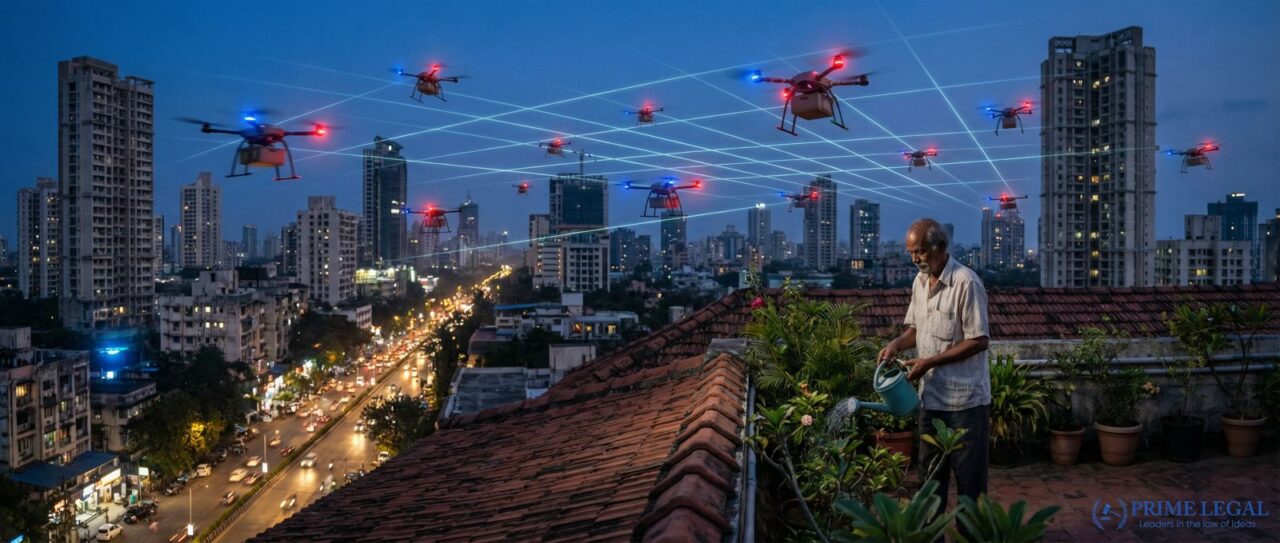
No permission is required to fly a drone in advance within a Green Zone. This creates an astonishing legal consequence: a commercial operator, think food delivery service or logistics company, could legally fly a drone 50 feet over a private residence without the owner’s consent, as long as they remain within the boundaries of the Green Zone. Unlike the UAS Rules, 2021, which contained some specific privacy protections, the more permissive Drone Rules, 2021 remain noticeably silent on privacy safeguards. That gap in the law leaves owners open to aerial surveillance and noise nuisance, with the avenues for redress limited to general tort claims for nuisance or constitutional challenges under Article 21 (Right to Privacy), which are often expensive and time-consuming to litigate.
VERTICAL REAL ESTATE AND THE RIGHT TO LIGHT
While drones loom over us from above, the real estate market is making the air a tradable commodity from below. In big cities like Mumbai and Bengaluru, the air itself is up for sale through instruments such as Transferable Development Rights (TDR) and Floor Space Index (FSI). These allow developers to buy the air rights of low-rise plots and transfer them for constructing higher and grander towers elsewhere. This vertical growth has triggered an increase in disputes related to the Right to Light. According to Section 15 of the Indian Easements Act, 1882, if the owner of a property has enjoyed light or air for his building uninterruptedly and peacefully for a period of twenty years, that right becomes absolute-a prescriptive easement. The trend in the Indian judiciary has been in favour of urban development and public utility, and has very often awarded damages without an injunction to stop the construction for the loss of light. In other words, even as the law recognises a right to air and light, it also puts a price upon it, allowing developers to “buy out” the sunlight of adjacent properties.
THE TRESPASS VS. NUISANCE DILEMMA
The next wave of litigation is going to be how to differentiate trespass from nuisance. Trespass is an intrusion into possession and is actionable in itself, without a requirement to prove that damage has been caused. Nuisance, for its part, demands proof of an interference with the enjoyment of the land. Therefore, in the case of the drone flying above a dwelling house, is that trespass? Applying the case of Koya Haji strictly, it is not trespass if it does not touch the house or affect the occupation of the structure. The continuous humming of the drones and the perpetual presence of the camera drone in the sky can well be described as a nuisance.
The United Kingdom precedent of Bernstein of Leigh v. Skyviews & General Ltd, [1978] QB 479, laid down the rule that rights terminate at the height required for ordinary use. The Indian courts will most likely follow this principle. However, they will certainly face the uphill task of determining what constitutes “ordinary use” in the contemporary context. Whether ordinary use includes the prospect of being able to build a 50-story tower over time? Whether it include the right to a drone-free airspace for aesthetic purposes? Current Indian laws do not answer these queries conclusively.
CONCLUSION
The air over Indian property has ceased to be a vacuum and has turned into an arena of competing interests; the interests of state sovereignty, commercial logistics, real estate development, and private privacy all contend for this piece of air. Our current legal framework is an unwieldy patchwork drawn from centuries-old easement laws, the 1934 Aircraft Act, and the liberalised Drone Rules of 2021, all of which fall woefully short in tackling the complexities of modern aerial ownership. We approach a tipping point beyond which the Invisible Frontier will urgently demand a singular Airspace Rights Act: a well-framed legislature that distinctly defines the vertical perimeter of private property, perhaps a privacy buffer between 100 and 200 feet, and lays down a system for awarding compensation to property holders for the commercial exploitation of their airspace. Until then, the Indian homeowner remains a king with a castle, yet operates without a roof over his legal jurisdiction.
“PRIME LEGAL is a full-service law firm that has won a National Award and has more than 20 years of experience in an array of sectors and practice areas. Prime legal falls into the category of best law firm, best lawyer, best family lawyer, best divorce lawyer, best divorce law firm, best criminal lawyer, best criminal law firm, best consumer lawyer, best civil lawyer.”
WRITTEN BY: USIKA K

