
ABSTRACT
The integration of artificial intelligence technology into educational systems has created new methods for students to access academic materials. Students in the past only had limited access to artificial intelligence technology and they did not understand its applications. Presently artificial intelligence technology has become a vital component of both educational environments and personal daily activities. Students use AI tools such as ChatGPT to complete their assignments which they use for research purposes and examination preparation activities.
KEYWORDS – Artificial Intelligence in Education, Student Learning Behaviour, Critical Thinking, Academic Integrity
INTRODUCTION
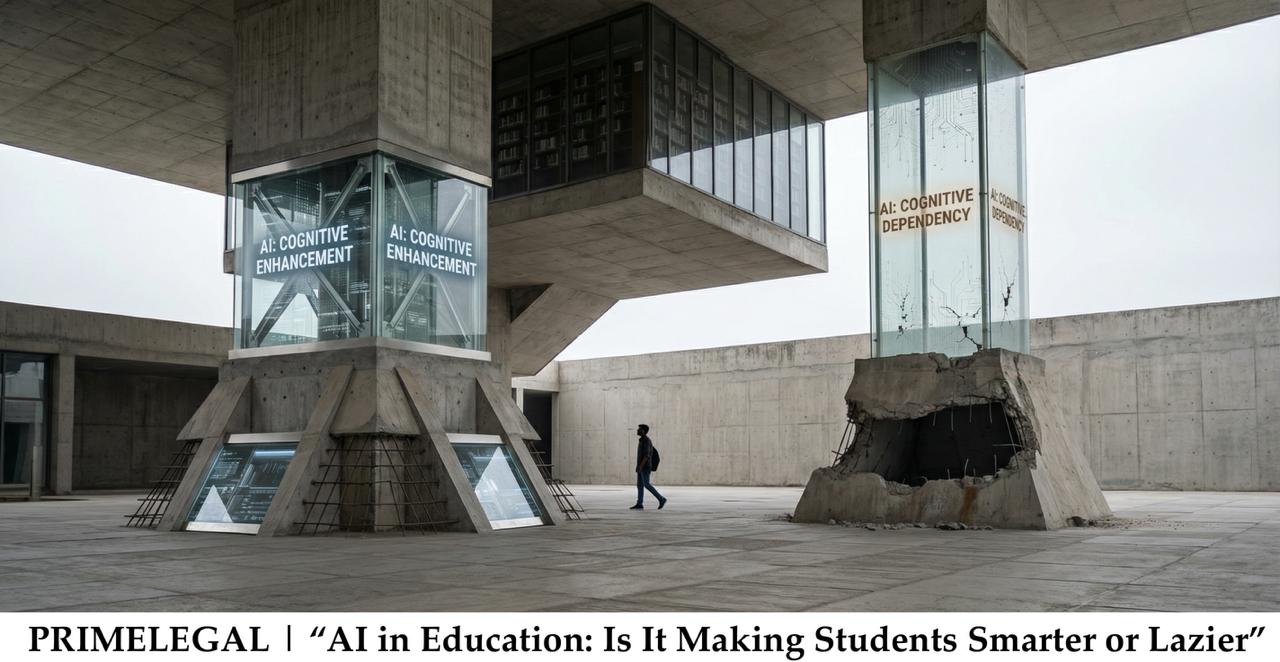
The growing usage of artificial intelligence technology raises a critical research question which investigates whether the technology enhances student learning or promotes their academic decline through inactivity. The matter becomes most important in universities because students develop their ability to think independently while they learn to assess information and make reasoned decisions.
AI MAKING STUDENTS LAZY
AI Making Students Lazy Artificial intelligence technology creates problems for students because it decreases the effort they need to dedicate to their studies. Students today prefer to use artificial intelligence systems for their work instead of thinking through problems themselves. Students become trapped in this pattern because they lose their ability to think independently after they acquire information through artificial intelligence tools. Artificial intelligence technology has an impact on both student motivation and their capacity to participate in learning activities. Students who receive complete answers to their questions will not spend time studying the material. Students who use artificial intelligence to answer questions stop thinking and analysing problems because they prefer to copy from the system. Students who use artificial intelligence to solve problems will lose their ability to think critically and analyse situations. AI discourages people from developing their skills in logical thinking and building logical arguments. Students who want to develop their logical reasoning ability need to practice creating their own answers.
Students lack sufficient knowledge about the topic which leads to unjustified AI-based decision making. A survey conducted in Pakistan and China revealed that 69% of students admitted that the use of AI tools is making them lazy. Excessive reliance on AI creates negative consequences which hinder students from developing their intellectual abilities. The legal profession faces a significant problem because professionals now use AI for both research and drafting work. A recent case from Andhra Pradesh highlights the dangers of such reliance. In this case:
- The trial court used AI-generated case laws to support its arguments
- The cited judgments were later found to be non-existent (hallucinated)
- The High Court acknowledged the issue
- The Supreme Court stayed the proceedings The Supreme Court clearly stated: “Relying on non-existent or fake judgments created through AI is an alarming issue. This is not just a mistake in decision-making; it is a form of misconduct.” Blind AI reliance leads to judicial integrity problems which create direct danger to court proceedings. Judges emphasized that decisions must be based on verified legal authorities, not AI-generated content. Justice B.R. Gavai also raised an important question: “Can a machine, devoid of human emotions and moral reasoning, genuinely comprehend the complexities and nuances of legal disputes?” Justice Dipankar Datta expressed doubt about AI because he believed that AI systems lack the necessary elements which lawyers need to succeed in their jobs. AI creates problems about maintaining confidentiality and protecting personal information. AI tools pose a security risk because they might retain or share personal data when users input sensitive information. Confidentiality violations occur when people share sensitive information in law-related professions.
The modern educational system now suffers from AI-based changes that disrupt its traditional teaching practices. Students are moving away from books and original sources. In legal education, students depend on basic AI-generated language instead of learning correct legal terminology and maxims and legal phrases. Their professional development will suffer because of this situation.
The overuse of AI technology results in:
- Reduced critical thinking
- Lack of independent reasoning
- Weak communication skills
- Over-reliance on technology.
AI MAKING STUDENTS SMARTER
AI Making Students Smarter AI presents both disadvantages and advantages for users. Users can obtain information instantaneously through the main benefit which provides them with immediate access to knowledge. Students use AI to create summaries and explanations which help them grasp complex subjects. AI supports students through its cognitive assistant function which enables them to do work in:
- Research
- Drafting
- Understanding difficult topics
Students spend less time searching for information because it improves their work efficiency while saving them time. The second benefit gives students the opportunity to learn through educational resources which now become available to more people. AI enables more people to access information because it operates as a resource for students who lack access to reliable educational materials. The program provides students with the same learning opportunities available to all other students.AI teaches students to organize their writing through its tools which help them build their writing abilities.
Students receive help to develop their ideas and present them in a structured way. The proper application of AI technology enables organizations to:
- Enhance learning efficiency
- Provide quick academic support
- Improve understanding of concepts
BALANCED PERSPECTIVE: AI AS A TOOL OR A TRAP
The usage of AI determines its effects. AI functions as both a beneficial tool and a dangerous trap which brings about dual consequences.
- If students rely completely on AI → it becomes a trap
- If students use AI for assistance and verify the content → it becomes a tool. Even professionals, teachers, and institutions are now using AI—for example, in preparing question papers or academic materials. The statement shows that AI itself is not wrong. The problem arises from people who misuse systems and depend on them excessively. The students must perform the following actions to fulfil their requirements:
- Use AI for guidance, not substitution
- Verify AI-generated information
- Apply their own reasoning A balanced approach is necessary to ensure that AI supports learning without replacing human thinking.
CONCLUSION
AI exerts both beneficial and detrimental effects on students according to the findings of the research. The system enables better information access while decreasing educational requirements and improving operational efficacy. The system produces adverse effects by diminishing essential analytical skills and impairing self-directed cognitive processes and making users dependent on it. The effect of artificial intelligence creates two main effects which need to be investigated.
The first part examines the Mental Aspect which consists of two questions. The first question asks whether AI enhances comprehension abilities or decreases cognitive function. The second question asks whether AI decreases tension or creates a state of dependence.
The Social Aspect examines two main functions of artificial intelligence. The first question examines whether artificial intelligence enhances communication abilities or decreases human social skills. The second question examines whether artificial intelligence substitutes for direct human contact. Students in the legal field use artificial intelligence to create legal documents without proper understanding of legal terminology according to AI research. AI functions as a supportive tool for human intelligence according to its intended purpose. The students need to handle AI technology according to their responsibilities instead of using it as a complete solution. Students need to find an appropriate balance between using technology and developing their independent thinking abilities. The use of artificial intelligence results in two distinct outcomes which bring about different effects on student performance because students need to determine their specific usage methods.
“PRIME LEGAL is a full-service law firm that has won a National Award and has more than 20 years of experience in an array of sectors and practice areas. Prime legal falls into the category of best law firm, best lawyer, best family lawyer, best divorce lawyer, best divorce law firm, best criminal lawyer, best criminal law firm, best consumer lawyer, best civil lawyer.”
WRITTEN BY: PRANAVI KOLLU

