
Introduction:
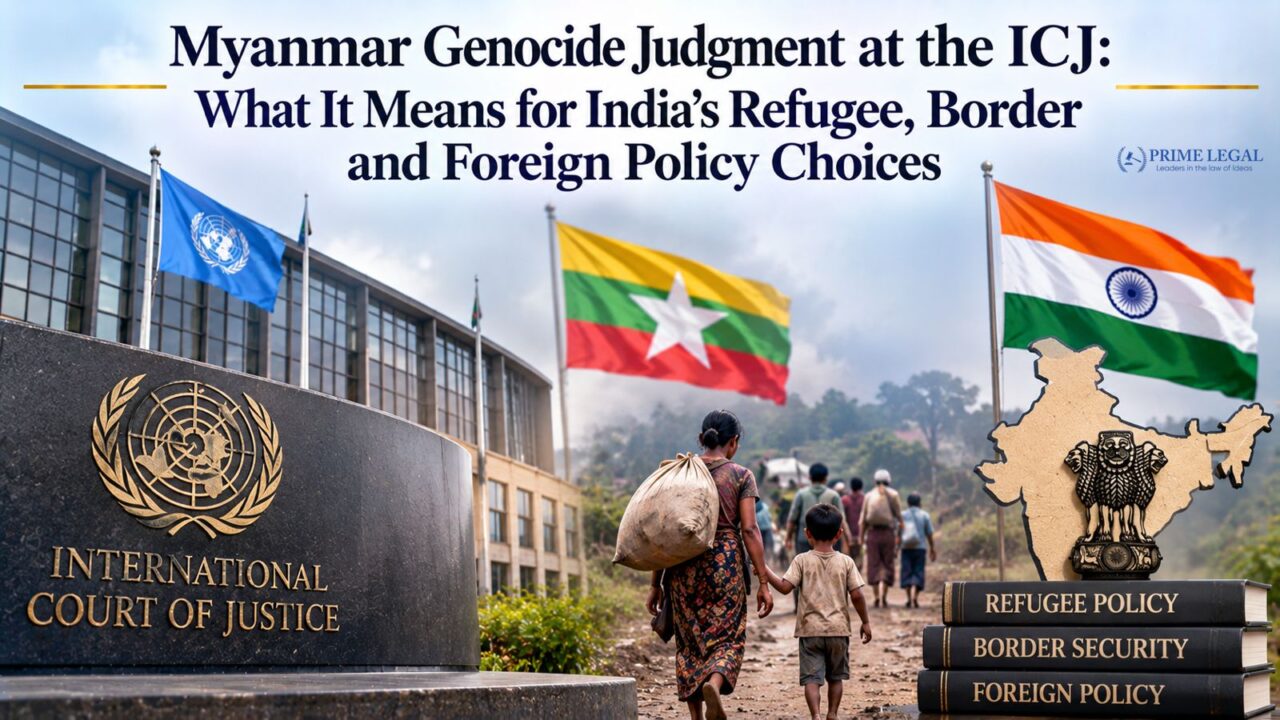
The crisis concerning the Rohingyas is among the worst crises that are experienced by South Asia. This crisis involves an ethnic minority from Myanmar called the Rohingyas. The Rohingyas consist mainly of Muslim ethnicity. Discrimination, denial of citizenship and persecution have been their major challenges. The conditions were made worse by clearance operations conducted by Myanmar military forces that included killings, sexual harassment, burning villages and displacement of hundreds of thousands of the Rohingyas. In 2017, this group mainly sought shelter in Bangladesh. In the judgment rendered on 19th November 2026 in The Gambia vs. Myanmar, the International Court of Justice (ICJ) found Myanmar guilty of crimes against the community by way of genocides. This decision has far-reaching consequences, not only in international law but also to India given its geographical location to Myanmar. Several critical concerns arise for India, in relation to displaced populations, human rights, security interests and humanitarian responsibilities. The judgment is, therefore, useful in reviewing whether the refugee and border policies of India align with its constitutional values and international laws.
Background of the Case
The case began after the persecution of the Rohingyas in Myanmar, especially during the clearance process carried out by Myanmar in 2017. Many Rohingyas do not have citizenship as per the Citizenship Law of 1982 in Myanmar, leaving them without citizenship. Many of them became stateless and were denied the enjoyment of their fundamental rights, including freedom of movement and education. As a result of the crackdown, more than 700,000 Rohingyas fled to Bangladesh in an attempt to seek refuge from persecution. In November 2019, The Gambia filed a claim against Myanmar before the International Court of Justice, accusing Myanmar of violating the Convention on the Prevention and Punishment of the Crime of Genocide. The Gambia accused Myanmar of committing genocidal acts through its military operations and also accused it of failing to take measures to prevent and prosecute the perpetrators. On 23 January 2020, the ICJ issued orders for provisional measures ordering Myanmar to stop acts of genocide, protect evidence and file periodical reports regarding compliance. In July 2022, the Court affirmed the standing of The Gambia in the proceedings despite not being victims. In July 2022, it was established by the Court that although not directly affected by the acts, The Gambia had the right to prosecute the case because of its legal standing. After going through all the evidence and submissions, which included those from the eleven States intervening, the ICJ rendered its verdict in favour of Myanmar’s genocide of the Rohingya on 19 November 2026.
Key points :
- The ICJ looked into whether the actions by Myanmar met the conditions of genocide as per Article II of the Genocide Convention, 1948.
- The Court looked into evidence of killings, causing serious bodily or mental harm and measures of preventing births among the Rohingya community.
- A very important aspect here is the need to prove the existence of specific genocidal intent which involves the desire to destroy the Rohingya community in whole or in part as an ethnic and religious group.
- Myanmar had justified its military operations as counter-terrorism operations. But the Court looked at the evidence to see if these operations were intended to destroy the Rohingya population.
- By a majority of 9 to 6 the Court found Myanmar guilty of genocide and of failing to prevent and punish genocide.
- The Court held Myanmar to be in breach of its obligation to adopt domestic legislation to prevent and punish genocide.
- Myanmar was also held responsible for not fulfilling its duty to preserve evidence as per the order of provisional measures issued by the ICJ in January 2020
- Furthermore, it was clarified that the prohibition of genocide amounts to a jus cogens norm of international law; thus, no State could derogate from it.
- Moreover, it confirmed the concept of erga omnes partes, under which all States party to the Genocide Convention have a common legal interest in the enforcement of the Genocide Convention.
- In addition, this judgment stressed upon the principles of accountability, prevention of future violations and reparation for the victims.
Analysis: The Implications for India’s Refugee, Border, and Foreign Policy Decisions
It has serious implications for India’s attitude towards the plight of the Rohingyas. India is not a state party to the 1951 Refugee Convention, but it is a party to the Genocide Convention and has a constitutional obligation to safeguard the right to life enshrined in Article 21 of the Constitution which is guaranteed to every person regardless of his/her nationality. India’s Supreme Court, in Mohammad Salimullah v. Union of India, 2021, rejected the plea for stopping the proposed deportation of Rohingyas living in Jammu, subject to due process of law. Nevertheless, findings of the ICJ make it all the more essential for India to consider the risk to refugees prior to deporting them, especially with regard to the threat of persecution, torture and to life. It also makes India consider the question of “non-refoulement” according to which no refugee should be returned to his/her place of origin in fear of his/her life and freedom. From a perspective of securing borders, India needs to tackle the issue of irregular migration across its porous border from Myanmar. In foreign policy, India needs to strike a balance between its strategic partnership with Myanmar, regional stability and humanitarian considerations. While it is true that India has declared its commitment to the safe, swift and sustainable return of the Rohingyas, this must be done in a voluntary, dignified manner with security guarantees. The judgment clearly indicates that there is a need for consistency in balancing national security and human rights.
Conclusion
The ICJ judgment in The Gambia v. Myanmar is indeed a landmark event for international law as it marks state responsibility for genocide committed on the Rohingya people and shows that grave violations of international law have to be held accountable. However, for India, this judgment is not only a diplomatic recognition of international law; it becomes a challenge for the balance between national security and border protection on the one hand and humanitarian law on the other hand. Despite all the reasonable Indian fears about illegal immigration and internal security and stability of the region, these fears should not take precedence over basic respect for human dignity and right to life. Moreover, as there is no specific Indian law that governs refugees’ identification, protection and deportation, such issues become even more complicated. In diplomacy, India can leverage its influence in the region to promote accountability, minority protection, and stability in Myanmar. In the end, the verdict is a reminder to India that sovereign power and national security must be exercised within the parameters of constitutional morality and human rights.
“PRIME LEGAL is a National Award-winning law firm with over two decades of experience across diverse legal sectors. We are dedicated to setting the standard for legal excellence in civil, criminal, and family law.”
Written by – Krittika Sengupta

