
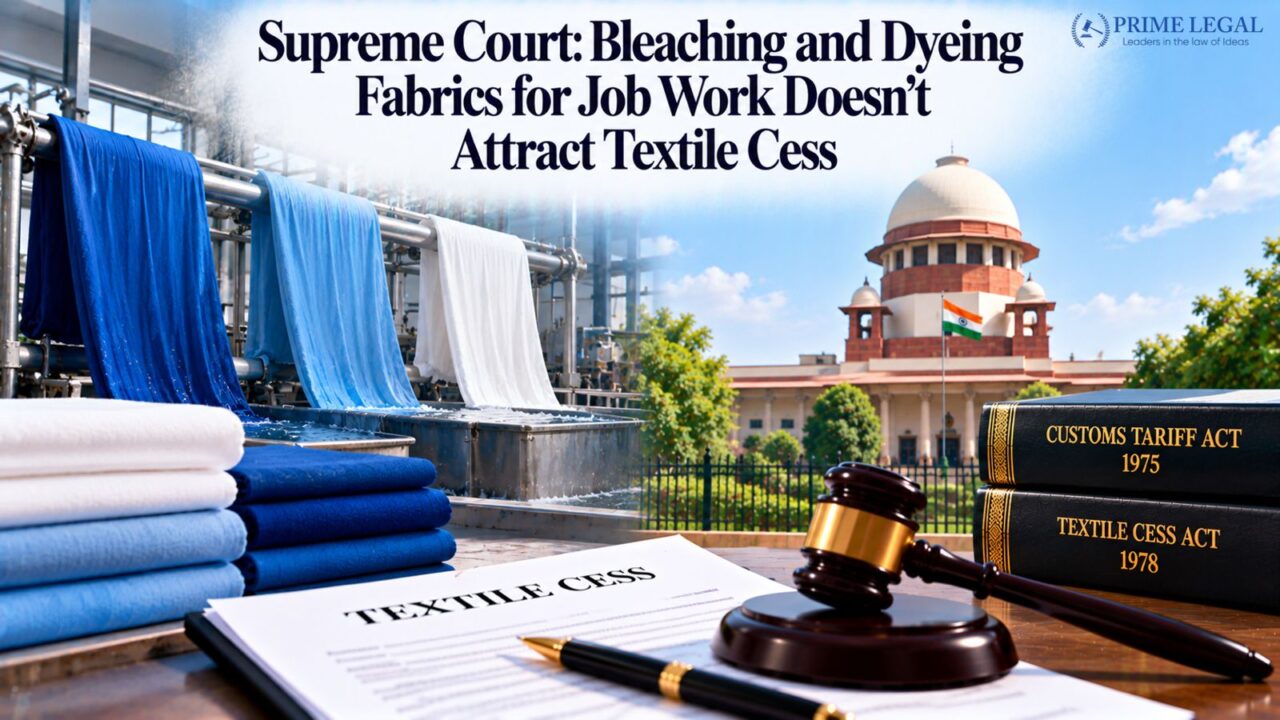
Case Name: The Assessing Officer, Textiles Committee v. M/s. Premium Suiting Pvt. Ltd. & Anr.
Case Number: Civil Appeal No. 785 of 2016 (2026 INSC 1158)
Date: Monday, Twenty-Sixth of October, Two Thousand and Twenty-Six
Court: Supreme Court of India
Quorum: Justice S.V.N. Bhatti and Justice N.V. Anjaria
FACTS
The Textiles Committee, a statutory body constituted under Section 3 of the Textiles Committee Act, 1963 (“Act, 1963”), levies a cess u/s 5A of the Act. Respondent No. 1 is a company engaged in bleaching, dyeing and processing of 100% man-made fabrics supplied by powerloom and handloom units, which it does on a job-work basis as an independent processor. An audit by the Comptroller and Auditor General found that only one of 30 independent textile processors in Uttar Pradesh was paying the cess. Following this, a show cause notice dated was issued to Respondent No. 1 and an assessment order fixed its cess liability at Rs. 2,68,293/-. The Textiles Committee Cess Appellate Tribunal dismissed the appeal, relying entirely on its own earlier decision in Chandok Textile Exporters Pvt. Ltd. v. Assessing Officer, Textiles Committee, which held that processing amounted to manufacture. Respondent No. 1 then filed Writ Petition before the Allahabad High Court, which quashed the cess demand. Aggrieved, the Assessing Officer, Textiles Committee, appealed to the Supreme Court.
LEGAL ISSUES
- Whether bleaching, dyeing and processing of fabric received from the powerloom and handloom industry, undertaken on a job-work basis, amounts to “manufacture” of textiles so as to attract cess under Section 5A of the Textiles Committee Act, 1963?
- Whether the definition of “manufacture” in Section 2(f) of the Central Excise Act, 1944 can be imported into the Textiles Committee Act, 1963, in which the term is undefined?
LEGAL PROVISIONS
- Section 5A(1) of the Act, 1963- Levies a cess, as a duty of excise, on all textiles and textile machinery manufactured in India. The Proviso states that no such cess shall be levied on textiles manufactured out of the handloom or powerloom industry.
- Section 2(g) of the Act, 1963- Defines “textiles” as any fabric, cloth, yarn, garment or other article made wholly or in part of cotton, wool, silk, artificial silk or other fibre, and includes fibre.
- Sections 2(da) and 2(db) of the Act, 1963- Define “powerloom” and “powerloom industry”, the latter being an industry in which a manufacturer of textiles has not more than 50 powerlooms in the factory.
- Section 2(f) of the Central Excise Act, 1944- Defines “manufacture” to include any process incidental or ancillary to the completion of a manufactured product.
ARGUMENTS
APPELLANT- The Appellant contended that although “manufacture” is not defined in the Act, the definition in Section 2(f) of the Central Excise Act, 1944 should be applied, under which any process incidental or ancillary to the completion of a manufactured product is manufacture. It was submitted that bleaching and dyeing is such a process, so the cess under Section 5A was validly levied. The Committee also relied on the inspecting officer’s clarification that powerloom and handloom fabric is exempt from cess only at the loom stage and not once it is further processed.
RESPONDENT NO. 1- Respondent No. 1 submitted that it is an independent textile processor working on a job-work basis on fabric received from small weavers with fewer than 50 powerlooms and without any spinning plants. It was argued that the Act exempts such fabric from the cess, and that its activity is an extended arm of the powerloom and handloom manufacturers and not manufacture.
ANALYSIS
The Court noted that Section 5A makes a manufacturer of textiles liable to the cess, but the word “manufacture” is not defined in the Act. It endorsed the High Court’s view that the definition in the Central Excise Act cannot be imported. Relying on Union of India v. R.C. Jain (1981) 2 SCC 308, it held that if an expression is not defined in an Act, its definition in another Act cannot be read into the former. The Court reiterated that a word must be construed in the context of the scheme, purpose and operational ambit of the statute in which it appears, and cannot be bodily lifted from another statute unless the legislature provides for it by reference or incorporation. Accordingly, after relying on various cases, it was held that “manufactured” in Section 5A had to be understood in its common parlance and not in a special sense borrowed from the Central Excise Act.
Applying this meaning, the Court found that Respondent No. 1 only processes fabric received from powerloom and handloom manufacturers and returns it to them after dyeing and bleaching on a job-work basis. No manufacturing takes place at its end, and the product is not “textile manufactured”. The Court described its activity as an extended activity supplementary and ancillary to manufacture by the powerloom industry, which is itself exempt under the Proviso to Section 5A.
JUDGEMENT
The Supreme Court dismissed the appeal as meritless and upheld the judgment of the Allahabad High Court which had quashed the textile cess demand of Rs. 2,68,293/- against Respondent No. 1.
CONCLUSION
This judgement reaffirmed that a term undefined in a statute takes its common-parlance meaning in the context of that statute, and that a definition from another Act cannot be imported unless the statutes are pari materia or the legislature provides for it.
“PRIME LEGAL is a National Award-winning law firm with over two decades of experience across diverse legal sectors. We are dedicated to setting the standard for legal excellence in civil, criminal, and family law.”
WRITTEN BY- T. R. AISIRI RAO
Read the Judgment copy below : The Assessing Officer, Textiles Committee v. M_s. Premium Suiting Pvt. Ltd. & Anr

