
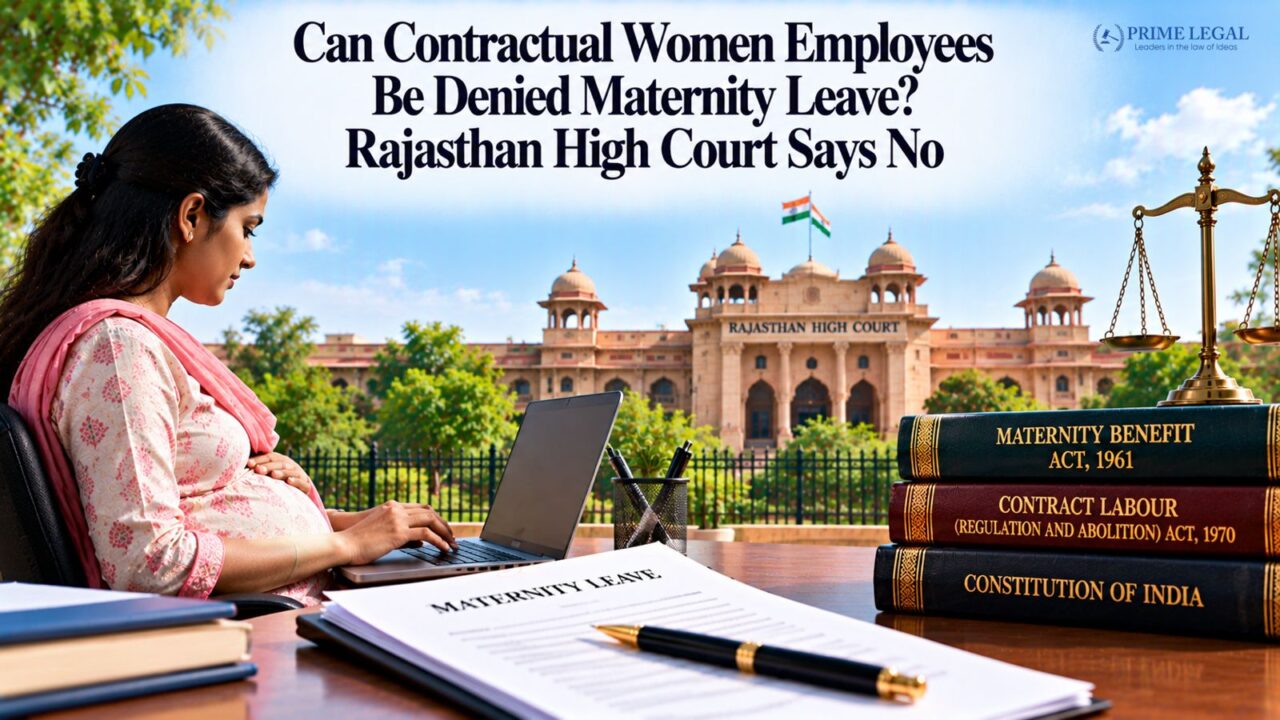
Case Name: Smt. Shivangi Khandelwal v. Principal Secretary, Department of Environment and Climate Change, State of Rajasthan & Anr.
Writ Petition No: S.B. Civil Writ Petition No. 1561/2023
Date: 16th October 2026
Court: High Court of Rajasthan
Quorum: Hon’ble Mr Justice Bipin Gupta
FACTS
Smt. Shivangi Khandelwal was appointed as ‘Consultant (AEE)’ by the Rajasthan State Pollution Control Board for a duration of one year under a contract. Tenure of her work began on August 4, 2022, and the fixed salary should be Rs. 40,000 per month. The official letter of employment to Mrs Khandelwal was received on 25.07.2022. After she started her job in the SPCB, she had to apply for maternity leave due to her pregnancy in the early days of her job.
On December 7, 2022, Petitioner submitted a written application for 180 days of maternity leave from December 26, 2022 onwards, as per her doctor’s advice, to the Board. On December 16, 2022, the application of petitioner for leave was rejected by the Board Secretary based on a Clause (Condition No. 5) in the terms of employment stating that she was entitled to be given only government holidays declared by the state government and therefore no leave could be granted other than that.
Petitioner was not happy with the judgment, and on December 22, 2022, she issued a legal notice to the Board for reconsideration. Khandelwal referred to an earlier letter of the Ministry of Labour and Employment issued in 2017 and quoted several High Court decisions which say that women on contract work have the right to receive maternity leave. Despite this, the respondents ignored the notice and denied the petitioner maternity leave, prompting her to file a writ petition in the High Court.
LEGAL ISSUES
- Is it possible for the employer to deny a woman her maternity leave solely on the basis that she is working under a temporary agreement (contractual basis) that prevents any sort of leave?
- Is the denial of maternity leave against the law related to maternity benefits in India, as well as the necessary rights of a woman concerning equality and a dignified life?
LEGAL PROVISIONS
- The Maternity Benefit Act of 1961 provides rules for the duration of maternity leave and thus makes it possible for a working woman to be provided with paid leave during the time of childbirth (Sec. 5).
- The law gives women the right to claim maternity benefits and protects them from the termination of employment only because they lack the necessary time due to childbirth (Section 12).
- The most significant thing about the legislation is that it places itself above any unjust terms of the employment agreement that might be present in the document (Section 27).
- Rajasthan Service Rules, 1951 (Rule 103): This regulation provides female employees of the state government with a right to 180 days of paid maternity leave.
- The Constitution of India establishes the fundamental rights of every citizen:
- Everyone is entitled to work under equal and fair conditions (Articles 14 and 16).
- Every citizen has the right to live a life full of meaning and dignity (Article 21).
- It is the duty of the government to ensure that working conditions in the country are humane, helping women (Article 42).
ARGUMENTS
PETITIONER
In her petition, the petitioner argued that denying her a chance to go on maternity leave was unreasonable and unlawful, given that according to Rule 103 of the Rajasthan Service Rules, a woman is entitled to 180 days maternity leave. She cited a letter sent by the Ministry of Labour and Employment which said that women employed on a contract basis are also entitled to maternity leave. She also cited a few cases like Hemlata Saraswat v. State of Rajasthan (S.B. Civil Writ Petition No. 4237/2006), Municipal Corporation of Delhi v. Female Workers (Muster Rolls) 2000 (3) SCC 224, and Dr Kavita Yadav v. The Secretary, Ministry of Health and Family Welfare Department & Ors. 2024 (1) SCC 421 to further her claim, which points to the fact that any contract can never be superior to any law regarding maternity benefit and violation of such law implies violation of Articles 14, 16, and 21.
RESPONDENT
The undertaking put forward by the interviewees argued that the applicant remained strictly obliged by the terms mentioned in Condition No. 5 of her appointment letter that strictly prohibited her from assuming any other leave apart from the officially declared holidays. Furthermore, it was put forward that as her period of contract expired on August, 3, 2023, without any extension, she had no rights arising in law to demand to remain in employment or receive wages.
ANALYSIS
The Court stated that the maternity benefits should not only be considered as a concession given but also as a legal protection under Article 42 of the Constitution, as it is meant to protect the health, dignity and welfare of women. The Court further pointed out that Section 27 of the Maternity Benefits Act states that the legal entitlements take precedence over different contracts, making them ineffective. The Court stated that maternity benefits apply even in cases of women employed casually or on muster rolls, based on the judgment in the case of Municipal Corporation of Delhi v. Female Workers (Muster Rolls), 2000 (3) SCC 224, as the main objective remains providing social justice.
The Court also referred to Dr Kavita Yadav v. The Secretary, Ministry of Health and Family Welfare & Ors., where it was ruled that maternity benefits can be claimed even after the end of a contractual period if the eligibility criteria are satisfied. Further, the Court drew from the earlier rulings in Minakshi Chaudhary v. Rajasthan State Road Transport Corporation, 2024 (4) RLW 2692 and Rani Tanwar v. State of Rajasthan, 2025:RJ-JD:28259 through which it concluded that providing maternity leave less than 180 days was a violation of the fundamental rights of the employees. Therefore, the Court deemed the rejection of the claims as being unsustainable in the eyes of the law.
JUDGEMENT
The writ petition filed was accepted by the High Court and the rejection order issued on December 16, 2022, was cancelled. The respondents were ordered to grant maternity leave for 180 days to the petitioner starting from December 26, 2022, and make payment of the salary due to her in the meantime.
CONCLUSION
The Rajasthan High Court strongly reiterated that maternity leave is an inherent statutory and constitutional right. The ruling clearly states that employers cannot evade their obligations under the law concerning maternity benefits under the pretext of the temporary or contractual nature of a woman’s employment or based on limitations mentioned in the appointment letter.
“PRIME LEGAL is a National Award-winning law firm with over two decades of experience across diverse legal sectors. We are dedicated to setting the standard for legal excellence in civil, criminal, and family law.”
WRITTEN BY: SWETHA DUTTA
Read the Judgment copy below : Smt. Shivangi Khandelwal v State of Rajasthan & Anr

