
INTRODUCTION
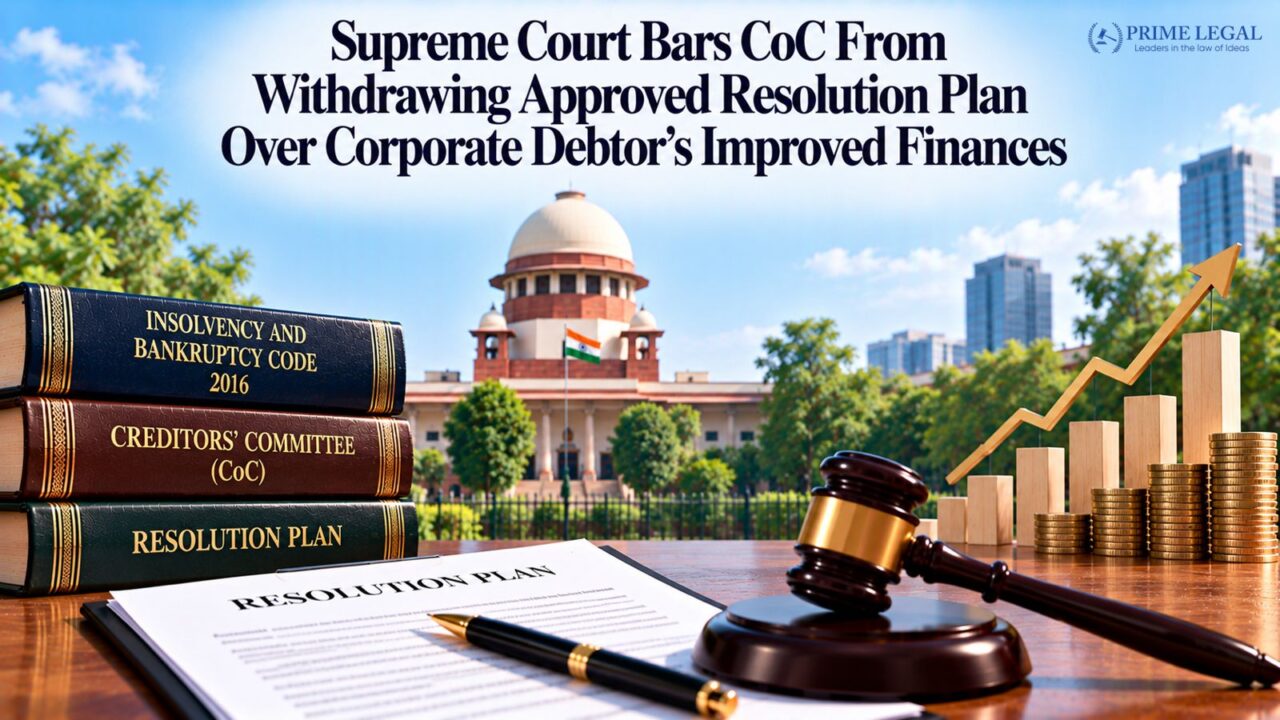
The Supreme Court, in Bank of India & Ors. v. S.M. Kamal Pasha & Ors. considered whether the Committee of Creditors (CoC), after approving a Resolution Plan by the requisite majority under the Insolvency and Bankruptcy Code, 2016 (hereinafter referred to as “the IBC”), can seek its withdrawal before the National Company Law Tribunal (NCLT) on the plea that the financial position of the Corporate Debtor (CD) has improved considerably. The Court did not interfere with the order of the National Company Law Appellate Tribunal (NCLAT), which had held that the CoC has no jurisdiction to withdraw its approval, and reiterated that an approved plan binds the CoC and the Successful Resolution Applicant (SRA) inter se.
BACKGROUND
The Corporate Insolvency Resolution Process (CIRP) was initiated against the CD, which ran a toll collection business on National Highway 45, on application of Financial Creditor u/s 7 of the IBC. The business had suffered due to the Covid-19 pandemic when the plan was submitted. A Resolution Plan was approved by the CoC and the Resolution Professional (RP) moved for its confirmation. Implementation was delayed because of a stay granted by the Supreme Court in earlier proceedings brought by the erstwhile promoter. By the time the Supreme Court dismissed that Special Leave Petition, the CD’s opening balance had risen to Rs. 165 crores. The holding company’s request for an OTS was directed to be considered and is pending before the NCLT.
The CoC then unanimously approved withdrawal of its approval and the issuance of a fresh Form G inviting Expressions of Interest (EoI). The NCLT allowed the RP’s application to this effect. The NCLAT set it aside, relying on Ebix Singapore and State Bank of India v. Consortium of Murari Lal Jalan and Florian Fritsch [(2025) 4 SCC 354]. Six members of the CoC appealed to the Supreme Court.
KEY POINTS
- The Supreme Court did not interfere with the NCLAT’s order and held that the CoC cannot withdraw from a Resolution Plan it has approved because the plan binds the CoC and the SRA inter se through the IBC framework and not merely through the law of contracts.
- Section 12-A, r/w Sections 30(2) and 31 of the IBC was interpreted to mean that withdrawal of the application can be sought only till the CoC approves the plan. Once the plan is placed before the Adjudicating Authority, neither the application nor the plan can be withdrawn.
- It was noted that improved profitability alone cannot be a ground to refuse approval if the plan meets the requirements of Section 30(2). The NCLT must verify the CD’s present financial position and cash balance against the plan terms, including fair and equitable distribution, before approving.
ANALYSIS
The Court began with Ebix Singapore, which held that even before the Adjudicating Authority approves it, the plan is binding inter se the CoC and the SRA, and this binding effect is produced by the IBC framework and not by the Contract Act. The statutory consequences point the same way. The Court held that Ebix applies squarely to the CoC, since the existing framework provides no scope for withdrawal or modification at the behest of either. It also reiterated that the NCLT cannot second-guess the commercial wisdom of the parties, direct a unilateral modification, or compel an unwilling CoC to renegotiate or agree to withdrawal.
Section 31 requires the Adjudicating Authority to be satisfied that the plan approved under Section 30(4) meets Section 30(2). Read together with Section 12-A, withdrawal can be sought only till the CoC approves the plan. The Court acknowledged that the CoC has a vital interest in the plan until it is implemented and does not become functus officio on approval. The continued existence of the CoC therefore does not detract from the binding nature of an approved plan.
The Court observed that the NCLT must be satisfied that the plan meets Section 30(2) after verifying the financial position of the CD, together with its cash balance, in light of the plan terms. The Court clarified that improved profitability alone cannot be a reason to refuse approval if Section 30(2) is satisfied. The Court noted that except for the binding nature of the plan vis-à-vis the CoC and the SRA, the observations are only prima facie and need not govern the final adjudication.
CONCLUSION
The Supreme Court held that a CoC that has approved a Resolution Plan cannot seek to withdraw it on the ground that the CD’s financial position has improved in the interim, as the plan binds the CoC and the SRA from the stage of CoC approval and Section 12-A withdrawal is available only till that approval. The decision does not, however, foreclose scrutiny at the confirmation stage. The NCLT must still examine the CD’s current finances against Section 30(2), but improved profitability alone cannot defeat an otherwise compliant plan. The CoC’s change of decision and the promoter’s OTS proposal will therefore be tested in the NCLT, not by withdrawal of the approved plan.
“PRIME LEGAL is a National Award-winning law firm with over two decades of experience across diverse legal sectors. We are dedicated to setting the standard for legal excellence in civil, criminal, and family law.”
WRITTEN BY: T. R. AISIRI RAO

