
INTRODUCTION
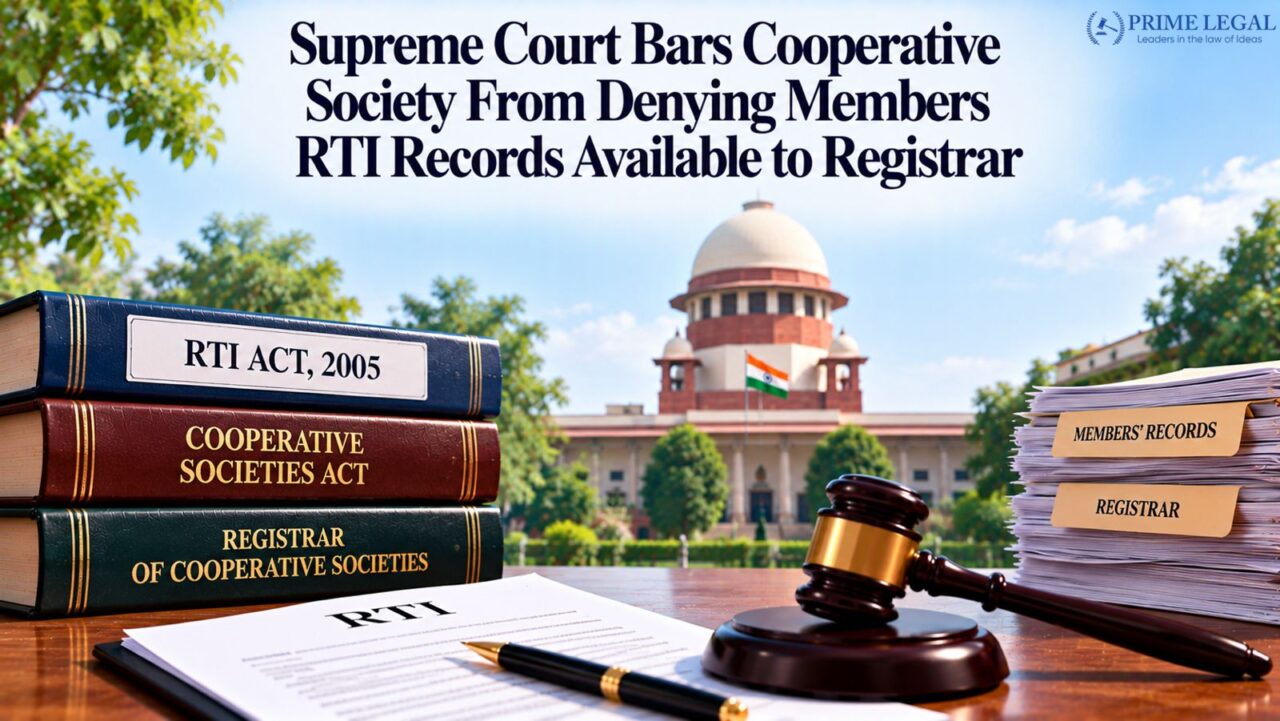
The Supreme Court of India has stated that members of a cooperative society cannot be denied access to records of the society, according to the RTI Act, 2005, if the respective Registrar of Cooperative Societies has legal access to such records. The court has pointed out that a cooperative society may not fit the description of “public authority” in terms of Section 2(h) of the RTI Act, yet the members can access records of the society through a public authority (the Registrar) entitled to obtain such records. The court’s ruling will have a huge impact on ensuring transparency and accountability in the cooperative sector and will provide members with a powerful means of checking on the financial and administrative workings of societies.
BACKGROUND
The legal conflict arose after one of the members of The Muppathadam Service Co-operative Bank Ltd. moved the Joint Registrar asking for two documents, namely the construction agreement that the Bank had executed with the Labour Co-operative Society for the new building, and the minutes of the last general body meeting of the Bank. The Bank rejected the requisition, and the matter went through various courts until the State Information Commission and the High Court decided that the documents should be disclosed. The Bank filed an appeal before the Supreme Court stating that it was a private body and not a public authority, thus making reference to the ruling in the case of Thalappalam Service Cooperative Bank Ltd. v. State of Kerala, (2013) 16 SCC 82. The Bank asserted that the Registrar could have only accessed the records of the Bank if the inquiry was initiated as per the provisions of the Kerala Co-operative Societies Act, which was not the case in the current instance.
KEY POINTS
- The cooperative bank’s appeal was squashed by the Supreme Court that reiterated that an individual member has the right to obtain the documents governing the operations of the society from the Registrar under the RTI Act.
- The Court explained that Section 2(f) of the RTI Act refers to “information” as including records of any private body, which is accessible by public authorities according to other laws.
- The bench consisting of Justices J.B. Pardiwala and K. Vinod Chandran stated that the access of the Registrar to the records of the society does not depend on any official inquiry being initiated beforehand.
- The court states that before deciding on whether or not the Registrar will conduct an inquiry into an organisation, it should first have access to the organisation’s records.
- The court also pointed out the distinction between a stranger and a member of the society, stating that a member has a built-in right to get such information, making it impossible to claim exemption by way of “personal information” under Section 8(1)(j) in the case of administrative records such as general body minutes or commercial contracts.
ANALYSIS
The ruling in the case of The Muppathadam Service Co-operative Bank Ltd. v. The State Chief Information Commissioner & Ors., 2026 INSC 1153, from the perspective of jurisprudence, is a progressive interpretation of Section 2(f) of the RTI Act. It fills the gap in terms of transparency that was created by the ruling in Thalappalam, which exempted cooperatives from directly entertaining RTI applications by taking them out of the definition of ‘public authority.’ In a way, the Supreme Court has interpreted the term in more of a practical sense by focusing on the statutory powers of the Registrar to have access to the information rather than the legal standing of the society. Thus, cooperative societies are not able to use their private status as an unconditional protection against accountability. The ruling signifies that the documents do not need to be physically with the public authority, but merely having the legal right to acquire them makes them fall within the purview of the RTI Act.
CONCLUSION
The judgment delivered by the Supreme Court has proven to be an important and notable milestone in the area of information law. It reinforced the right of members of a cooperative society to demand basic transparency in governance and, in this manner, it confirmed that the RTI route is appropriate through the Registrar of Cooperative Societies, thus curbing the powers enjoyed by the management of societies to conveniently refuse access to critical documents. The judgment creates a balance between the aspect of the private nature of cooperative enterprises and the requirement of statutory oversight over them.
“PRIME LEGAL is a National Award-winning law firm with over two decades of experience across diverse legal sectors. We are dedicated to setting the standard for legal excellence in civil, criminal, and family law.”
WRITTEN BY: SWETHA DUTTA

