
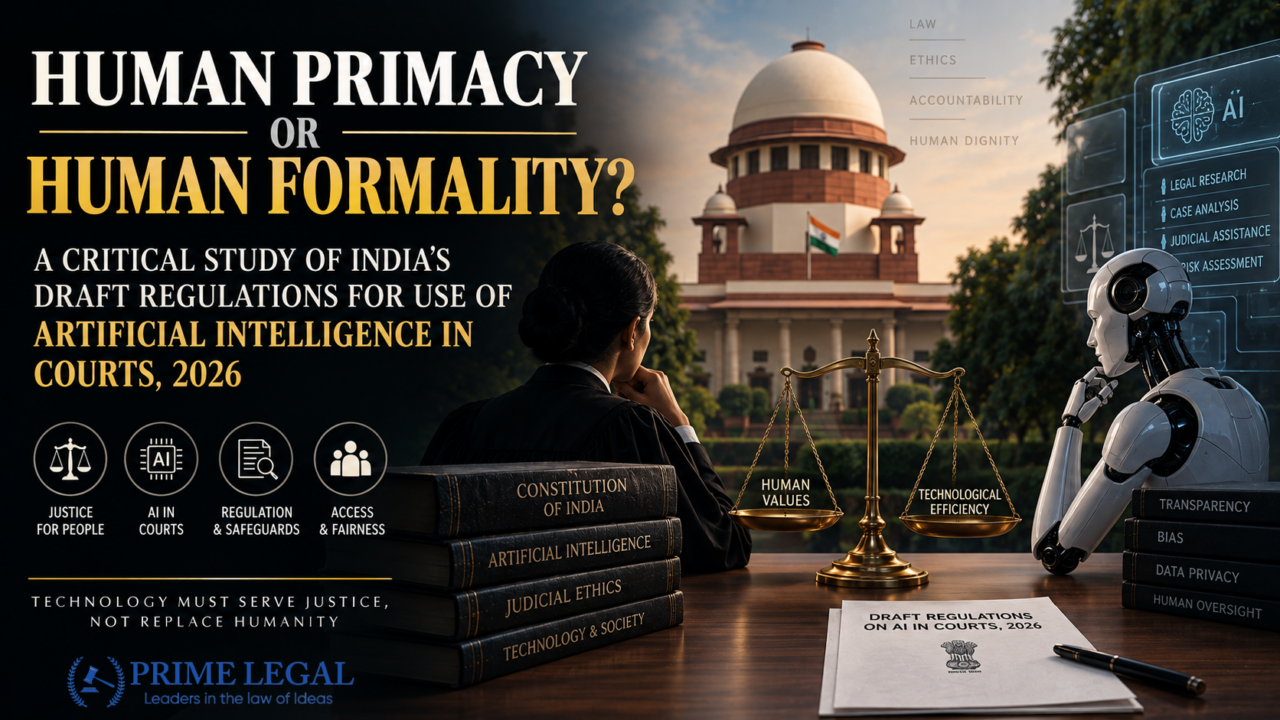
ABSTRACT
In June 2026, the Artificial Intelligence Committee of the Supreme Court of India released a draft regulatory framework governing AI use across Indian courts and tribunals, expressly grounded in the language of “human primacy.” This article asks whether that language describes a substantive constitutional commitment or a compliance vocabulary that shields institutions and vendors from liability while leaving decisional power with the machine. Examining the draft’s disclosure obligations, its Apex Body oversight architecture, and its remedial gaps, the article argues that the framework’s human-in-the-loop design is vulnerable to automation bias and structurally indifferent to the litigant’s ability to detect prohibited AI use. Read against Article 21’s due process guarantees and comparative regimes such as the EU AI Act, the draft currently privileges institutional accountability over individual empowerment. The article closes with reform proposals to convert nominal oversight into enforceable human control.
KEYWORDS
Human primacy; automation bias; algorithmic due process; judicial AI governance; fundamental rights impact assessment
INTRODUCTION
India’s constitutional order treats Article 21 as a living guarantee, one that the Supreme Court has repeatedly stretched to cover privacy, dignity, and the right to a reasoned decision. Any regulatory instrument that inserts automated systems into processes affecting liberty, property, or reputation must therefore be tested against this constitutional baseline, not merely against its own stated objectives. The 2026 Draft Regulations for Use of Artificial Intelligence, prepared under the Supreme Court’s AI Committee and opened for public comment through June 2026, is the first serious Indian attempt to write such rules for the judicial domain, and its language is unambiguous: AI may assist, but a human judge alone may adjudicate.
The difficulty is that a rule prohibiting a machine from signing an order does not, by itself, prevent that machine from shaping the outcome the human signs off. The central question this article investigates is whether the draft’s oversight mechanisms create genuine friction, a real possibility that a human reviewer will catch, question, and override a flawed AI output or whether they create a formality: a signature block that converts an automated recommendation into an authorised decision without meaningfully testing it. Once a disclosure requirement, an approval body, and an audit trail exist on paper, institutions can point to “compliance” as evidence of accountability even where the underlying human review is cursory. The article proceeds by mapping the draft’s mechanics, testing them against known behavioural and administrative-law failure points, and situating India’s approach within a comparative field that has already grappled with these questions.
THE 2026 DRAFT FRAMEWORK: MECHANISMS OF OVERSIGHT
The draft rests on three declared pillars. First, AI systems may assist with legal and administrative work such as research, drafting support, translation, transcription, scheduling, and case management but may never perform the adjudicatory function itself.
Second, any party or advocate who uses AI in preparing pleadings, submissions, or evidence must disclose that use.
Third, a permanent Apex Body operating out of the Supreme Court is tasked with approving, certifying, and supervising AI tools deployed across the Supreme Court, the High Courts, subordinate courts, tribunals, and statutory commissions performing adjudicatory functions, with implementation dates to be separately notified by each court.
The institutional design gives this Apex Body described in commentary as an AI Secretariat audit and inspection rights over deployed systems and the data feeding them, alongside a requirement that data breaches, security incidents, or AI-related incidents be reported to the appropriate authority without delay.Industry stakeholders, including chambers of commerce making formal submissions, have pressed for a risk-tiered classification model that calibrates obligations to how much influence a given AI use case has over judicial outcomes, together with clearer definitions of “AI” and “AI Service Provider” that fix responsibility across the technology supply chain. Notably, this risk-tiering is a recommendation on the table, not yet a settled feature of the draft, an absence that matters considerably for the analysis below.
‘HUMAN PRIMACY’ VS. ‘HUMAN FORMALITY’: THE ILLUSION OF CONTROL
A disclosure obligation and a certifying body answer the question of whether AI was used. They do not answer the harder question of how well a human actually scrutinises what the AI produced. When a system routinely produces plausible, well-formatted, seemingly authoritative output, human reviewers tend to defer to it, especially under time pressure and heavy caseloads precisely the conditions of the Indian judiciary, which processes hundreds of millions of matters annually. A judge or registrar asked to “review” an AI-drafted summary of voluminous case material has little practical incentive, and often little time, to independently reconstruct the underlying record. The oversight step exists, but its cognitive content can shrink to near zero.
The draft’s silence on how “human-in-the-loop” review must actually be performed compounds this risk. There is no requirement that a reviewing judicial officer document the specific points of independent verification undertaken, no mandated minimum engagement standard, and no institutional metric for detecting rubber-stamped approvals after the fact. Without such structure, “human primacy” risks becoming a label attached to a workflow rather than a description of what happens inside it which is a formality dressed as safeguard.
CONSTITUTIONAL FRICTION: DUE PROCESS AND ALGORITHMIC ARBITRARINESS
Indian administrative law, built on Maneka Gandhi v Union of India AIR 1978 SC 597 expansive reading of Article 21 and reinforced by decades of natural justice jurisprudence, requires that decisions affecting rights be reasoned and open to meaningful challenge. If a litigant wants to challenge the improper use of AI in their case, they first have to know it happened. But AI systems are often used precisely because their inner workings are hard to see from the outside that’s part of what makes them useful for research and drafting. So, a litigant has almost no way of finding out, on their own, that a banned use of AI affected their case. And the draft doesn’t give them any tool to check, no way to verify this independently, and no rule that shifts the burden onto the court or vendor to prove AI wasn’t misused. This also weakens judicial review. Indian courts normally strike down administrative action that is “arbitrary,” but arbitrariness is hard to prove when the person harmed has no way of even knowing something went wrong.
COMPARATIVE PATHWAYS: LESSONS FROM GLOBAL PRECEDENTS
The EU AI Act requires to assess, before deploying a high-risk AI system, exactly which rights it could affect and how those risks will be managed. This is a proactive check that comes before any harm happens not a disclosure that comes after. The EU also writes risk classification directly into law, rather than leaving it as a suggestion still waiting to be adopted. The US approach is more scattered: a mix of sector-specific rules, state laws on automated decisions, and voluntary guidance like the NIST AI Risk Management Framework but even this patchwork usually asks for some kind of documented impact assessment or a way to contest the outcome.
India’s draft takes a different path. It focuses heavily on institutions, an Apex Body, certification, audit powers but says very little about protecting the individual. There’s no required rights assessment, no fixed risk tiers based on how much an AI system can affect a case’s outcome, and no way for a litigant to find out if a banned AI tool was used in their matter.
CONCLUSION
The 2026 Draft Regulations do mark real progress. They put “human primacy” forward as a core value, clearly ban AI from making judicial decisions, and set up institutional systems disclosure rules, certification, audits, incident reporting that India has never had before. But stating a value isn’t the same as building rules that actually enforce it. Right now, the framework is better at showing that institutions followed the process than at ensuring a human actually checked the AI’s output before it affected someone’s case.
Three changes could fix this. First, adopt the risk-tiering system stakeholders have already suggested and go further by setting minimum review standards for each tier, not just requiring tool approval. Second, make human review traceable: reviewers should have to record what they actually checked, so “review” means something real, not just a rubber stamp. Third, flip who carries the burden of disclosure- courts and AI vendors, not litigants, should be responsible for flagging when AI was used in a case. This would close the awareness gap that currently makes the remedy clause almost useless in practice.
Without these fixes, “human primacy” will stay a stated goal on paper rather than something the system actually delivers.
“PRIME LEGAL is a National Award-winning law firm with over two decades of experience across diverse legal sectors. We are dedicated to setting the standard for legal excellence in civil, criminal, and family law.”
WRITTEN BY: HARSHMEET KAUR SUDAN

