
CASE NAME: Gajanan v. Pralhad
CASE NUMBER: Civil Appeal No. 3524 of 2026 (arising out of SLP (C) No. 20405 of 2025)
COURT: Supreme Court of India
DATE: 18 March 2026
QUORUM: Justice Rajesh Bindal and Justice Vijay Bishnoi
FACTS
A civil suit was filed in 1997 by the appellant seeking declaration, possession of agricultural lands and mesne profits of respondent. The suit was decided in favour of the appellant on December 2nd 1999, directing the respondent to hand over the possession.
First appeal was filed by the respondent in 1999, which was dismissed on default on 25th November 2004 for non prosecution. And no stay was granted during the appeal.
The appellant initiated execution proceedings in 2015, which was objected by the respondent claiming that it was barred by the period of limitation as 12 years has already passed.
The Execution Court rejected the claim of limitation and held that the limitation period started from the date of dismissal of the appeal in 2004. The respondent challenged the same in the Bombay High Court and it reversed the earlier decision holding that limitation period started from the date of original decree in 1999, thus making the execution time barred.
The appellant has now approached the Supreme Court.
ISSUE
- Whether the execution proceedings filed in 2015 are barred by limitation?
- Whether appeal’s dismissal for default gives a fresh starting point of limitation?
LEGAL PROVISIONS
- Article 136, Limitation Act, 1963 (Contained under ‘The Schedule’ of the Act)
- Section 96 CPC
- Order 41 Rule 1 CPC
- Order 20 Rule 12 CPC
- Doctrine of Merger (qualified application)
ARGUMENTS
PETITIONERS:
The petitioner argued that the limitation period must be computed only from the date on which the appeal was dismissed, that is 25th November 2004. He argued that an appeal is continuation of the original suit and the matter is in sub judice when in appeal. Hence, the suit gets finality only upon dismissal of the appeal.
Relying on Shyam Sundar Sarma v. Pannalal Jaiswal (2005) 1 SCC 436, the petitioner also argued that dismissal of appeal on default is final disposal thus giving rise to a fresh starting point for limitation.
The petitioner also argued the malafide intention of the respondent where he falsely denied the filing of the appeal.
RESPONDANTS:
The respondent argued that the period of limitation had already expired in 2011 as the limitation period had commenced in 1999 when the decree was first awarded to the appellant.
He further contended that mere filing of appeal does not affect enforceability of the decree unless and until a stay order was granted by the appellate court.
Relying on Ratansingh v. Vijaysingh (2001) 1 SCC 469 he further submitted that dismissal of appeal does not renew or extend limitation period from a new starting point.
ANALYSIS
Relying on Sheodan Singh v. Smt. Daryao Kunwar AIR 1966 SC 1332 and Shyam Sundar Sarma v. Pannalal Jaiswal & Ors.(2005) 1 SCC 436 the Court held that an appeal is the continuation of the original suit proceedings and its dismissal whether on the grounds of default or merits is final disposal of the lis.
The Court also made a clarification on the doctrine of merger. It distinguished between formal merger and practical finality of litigation.
The Court also rejected the application of Ratansingh case as it had already been overruled by the three Judge Bench in Shyam Sundar Sarma case.
JUDGEMENT
The Supreme Court in its judgement held that
- Appeal was allowed
- Bombay High Court’s judgement was set aside
- Executing Court’s order was restored and execution application was within limitation
CONCLUSION
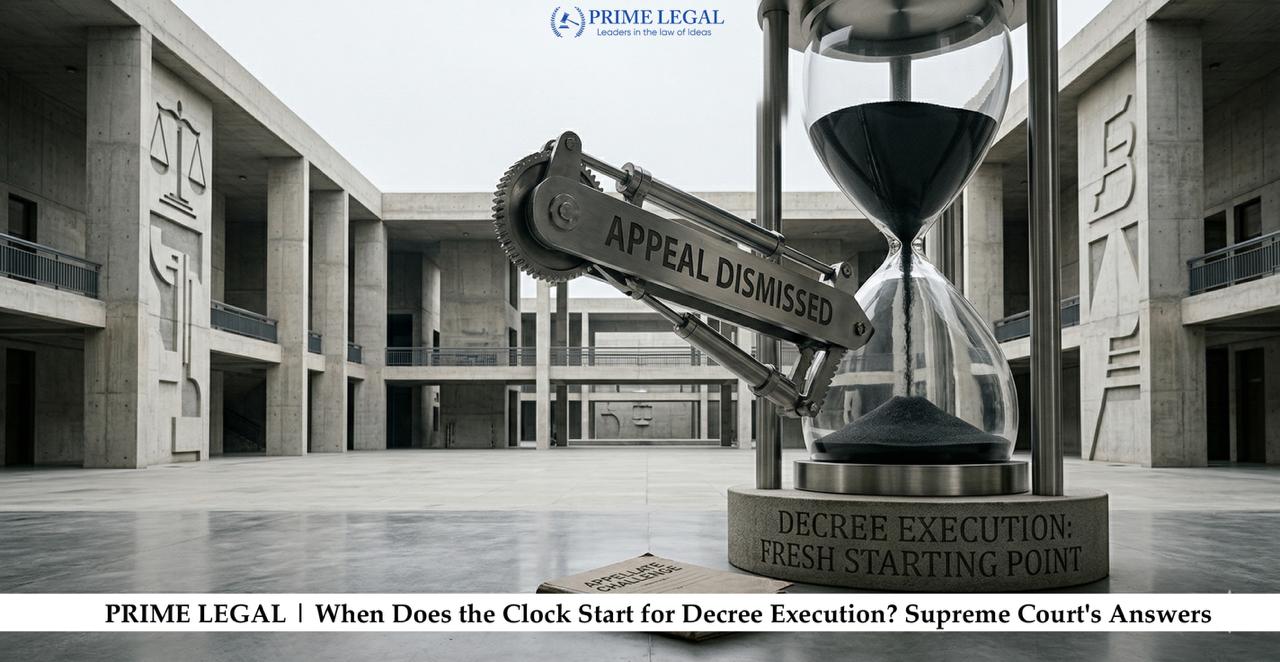
The judgement established that dismissal of appeal, on merit or on default, gives a fresh starting point for limitation under Article 136 of the Constitution. The Court also clarified that even though doctrine of merger is not strictly applicable in such cases, the practical effects of finality still resets limitation.
“PRIME LEGAL is a National Award-winning law firm with over two decades of experience across diverse legal sectors. We are dedicated to setting the standard for legal excellence in civil, criminal, and family law.”
WRITTEN BY: AARSHITHA UNNIKRISHNAN
read the judegemt copy here

