
INTRODUCTION:
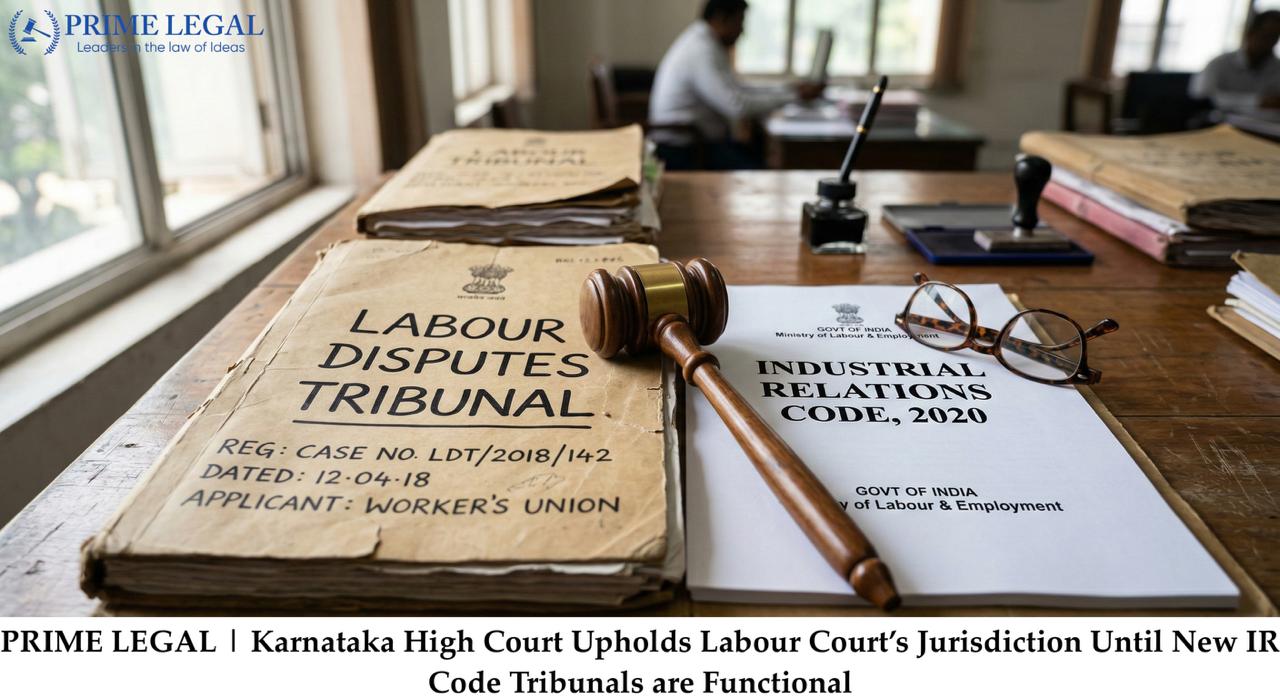
On 26 February, 2026, Karnataka High Court in Glastronix LLP Vs Glastronix Karmika Sangha & Ors., W.P. No. 3784 of 2026, Labor Courts and Industrial Tribunals constituted under the Industrial Disputes Act, 1947 will retain jurisdiction even after the enforcement of Industrial Relations Code, 2020, till tribunals under the new Code are formally constituted & functional. The Court refused to hear the writ petition moved from the Glastronix LLP against the continuance of the proceedings before the Industrial Tribunal under the repealed 1947 Act.
BACKGROUND:
The Industrial Relations Code, 2020 came into force from 21 November 2025 combining the various central labour laws including Industrial Disputes Act, 1947, the Trade Unions Act, 1926 and the Factories Act, 1948 as part of the labour law reforms in India.
Following its enforcement, it was enquired about the jurisdiction of pre-existing Labour Courts and Industrial Tribunals constituted under the repealed 1947 Act. In the present case, Glastronix LLP challenged a reference order passed by the Labour Department conducted in terms of Industrial Tribunal pursuant to the Industrial Disputes Act, 1947 where an industrial dispute was referred to said tribunal. The petitioner argued that as the Industrial Relations Code came into force the earlier forums lost jurisdiction.
The petitioner also contested a notification of the Central Government under Section 103 of the Code that was made in light of problems encountered in transition due to the implementation of the Code. The dispute raised critical questions on issues relating to continuity of pending and fresh industrial disputes during the transitional period.
KEY POINTS:
- Following of Existing Forums:
The Court ruled that Labour Courts and Industrial Tribunals constituted under the Industrial Disputes Act, 1947 were to continue to remain in place till tribunal formalized and jointly administered under the Industrial Relations Code, 2020.
- Bypassing of Adjudicatory Vacuum:
While the Code provides for the constitution of new Industrial Tribunals and National Industrial Tribunals, these are yet to function. Immediate transfer of jurisdiction would leave a gap in the jurisdiction, on the industrial disputes, the industrial resolutions thus interfere with legality and vitiate the legislative intent.
- Interpretation Provisions Transitional and Saving:
The Court had relied on the transitional and saving provisions of the Code, namely Section 104 for continuity in adjudication and ensuring that no interference is made with the pending and fresh industrial disputes. The emphasis of purposeful reading was by way of legal and procedural stability, according to the Court.
- Mechanism of Application of Saving Principle:
The Court relied on Section 6 of the General Clauses Act, 1897, which states that action under a repealed statute, unless the contrary legislative intention is clearly expressed, shall be exempted. As such, orders passed under the 1947 Act that are reference orders have remained valid during the transitional phase.
- Normative scope of “Statutory Authorities”:
The term statutory authorities under Section 104 of the Code defined in the Court held that it was wide enough to cover Labour Courts and Industrial Tribunals constituted under the 1947 Act in the absence of any express reference thereof so as to enable continuity of dispute resolution.
- Dismissal of Petition:
The writ petition filed by Glastronix LLP was dismissed and the jurisdiction of the Industrial Tribunal was upheld with respect to the Industrial Tribunal having jurisdiction under the provisions of Industrial Disputes Act, 1947.
RECENT DEVELOPMENTS:
The judgment of Karnataka High Court is in accord with the judgments of other High Courts in the State of Kerala including that of Kerala High Court which also upheld the continuance of Labour Courts and Industrial Tribunals during the transitional phase of implementation of Industrial Relations Code, 2020. The Court stressed that reforms should not be made in legislatures without interrupting the created mechanisms for dispute resolution.
The ruling provides for legal certainty, procedural continuity and industrial harmony in the context of an important transition in India’s ideology in labour law. It has raised precisely the issues of the importance of purposive interpretation of the transitional provisions so as to prevent judicial and administrative vacuums.
CONCLUSION:
In Glastronix LLP v. Glastronix Karmika Sangha & Ors. over the Labour Court and Industrial Tribunal, where the Karnataka High Court held that the industrial tribunals and labour courts under the Industrial Disputes Act, 1947 have jurisdiction until the constitution of the new tribunal and complication of the Industrial Relations Code, 2020 are undertaken. This decision avoids disruption in the process of dispute resolution and enhances continuity of labour adjudication, and it will set a precedent for the interpretation of the transitional provisions in the process of enactment of large-scale legislation for labour law in India.
“PRIME LEGAL is a full-service law firm that has won a National Award and has more than 20 years of experience in an array of sectors and practice areas. Prime legal falls into the category of best law firm, best lawyer, best family lawyer, best divorce lawyer, best divorce law firm, best criminal lawyer, best criminal law firm, best consumer lawyer, best civil lawyer.”
WRITTEN BY: TANUSH RAJ

