
INTRODUCTION
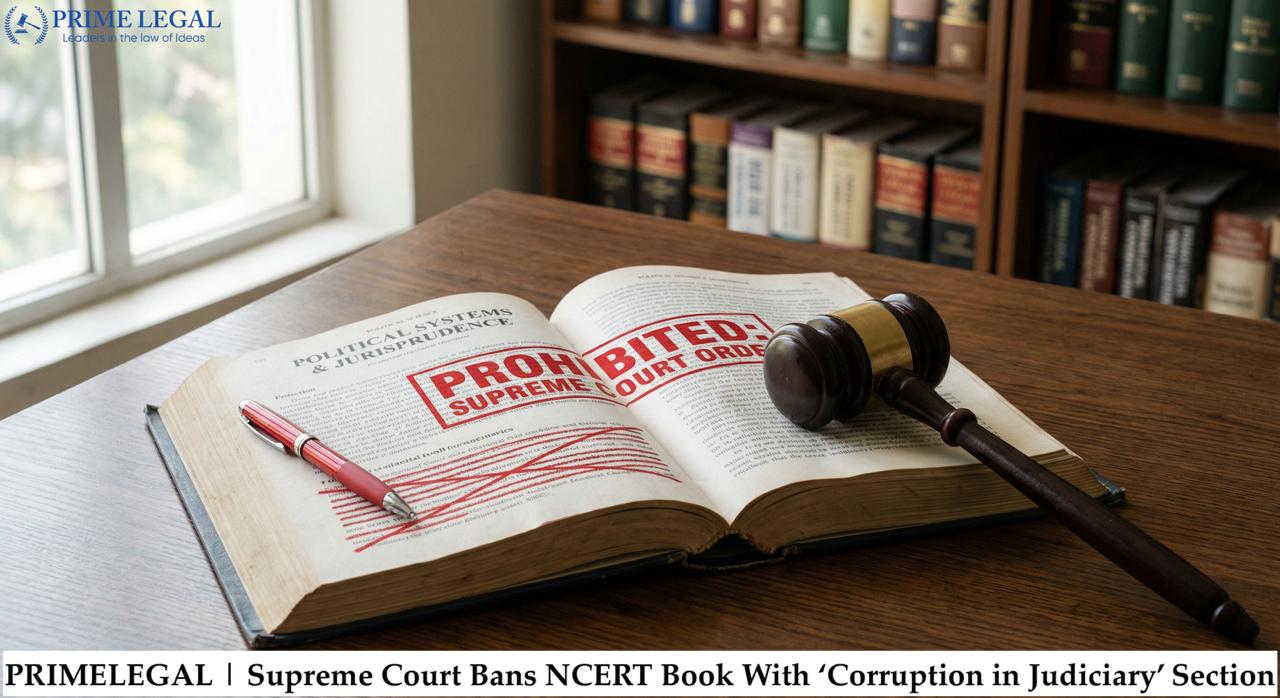
Recently, the Supreme Court of India issued show cause notices to the Secretary of the Department of Education and Literacy (Ministry of Education) and to the NCERT Director, Dr Dinesh Prashad Saklani, and imposed a blanket ban on publication, printing, or digital dissemination of the Class 8 NCERT Book, which had a chapter on corruption in the Judiciary.
BACKGROUND
The case is regarding a Class 8 Social Science Textbook, namely, “Exploring Society – India and Beyond” published on 24 February 2026, by the National Council of Educational Research and Training (NCERT), wherein a passage dedicated to the topic “Corruption in the Judiciary” has sparked controversy. This passage is within the Chapter recognised as “The Role of the Judiciary in our Society”. The chapter identifies corruption at various levels of the judiciary and the massive backlog of cases, which is a result of multiple factors such as an inadequate number of judges, complex legal procedures, and poor infrastructure, as among the key challenges confronting the judicial system. The matter was heard suo motu by the Supreme Court and was flagged by Senior Advocate Kapil Sibal and Abhishek Manu Singhvi for urgent hearing.
KEY POINTS
- The Supreme Court ordered the seizure of all physical copies of the textbook, whether held in storage, retail outlets, or educational institutions, along with the takedown of the digital versions of the book. The Centre and State authorities are directed to comply with its directions and have been warned of serious action in case of defiance of directions in any form.
- Chief Justice of India Surya Kant stated it to be a calculated move with an aim to undermine the institution and demean the dignity of the judiciary. The bench directed a deeper investigation and held that such misconduct would fall under criminal contempt as it has an everlasting impact on the judiciary.
- The issued show cause notices seek an explanation as to why appropriate action, either under contempt proceedings or under any other applicable law, should not be taken against those responsible for preparing the sub-chapter titled “Corruption in the Judiciary” in the textbook. The Supreme Court directed the NCERT to place on record the details of the National Syllabi Teaching-Learning Materials Committee that approved the chapter, along with their names, qualifications, and credentials.
- NCERT issued a statement of justification with respect to the inclusion of the said chapter and expressed regret. The bench refused to stall the suo motu proceedings, stressing that the attempt to circumvent or bypass the order shall be treated as a direct interference with the judicial administration and will amount to contempt of court. Solicitor General Tushar Mehta tendered an unconditional and unqualified apology on behalf of the Ministry of Education.
- The court found that such an action erodes the sanctity of judicial office in the estimation of the public at large and within the minds of youth. It noted that the choice of words in the book may not be a simpliciter inadvertent bona fide error.
- The Court has fixed personal responsibility on the NCERT Director and the principals of all schools where the book has been circulated or made available to ensure its immediate seizure within their respective premises. They have been directed to submit a compliance report and to ensure that no further pedagogical instruction is imparted on the basis of either the physical or digital copies of the concerned textbook.
- The principal secretary of the Department of Education across all states and UTs has been directed to comply with these directions and send their compliance reports through affidavits within two weeks.
RECENT DEVELOPMENT
The matter will be next heard on 11 March 2026 before the three-judge bench comprising Chief Justice of India Surya Kant, along with Justices Joymalya Bagchi and Vipul M Pancholi.
CONCLUSION
To conclude, the Supreme Court’s decision to impose a blanket ban reflects the Court’s aim of preserving the dignity, credibility, and institutional authority of the judiciary. However, the broader debate surrounding this controversy shall lie in balancing two vital constitutional values: safeguarding the integrity of the judiciary and protecting academic freedom and informed civic education.
“PRIME LEGAL is a National Award-winning law firm with over two decades of experience across diverse legal sectors. We are dedicated to setting the standard for legal excellence in civil, criminal, and family law.”
WRITTEN BY: STUTI ANVI

