
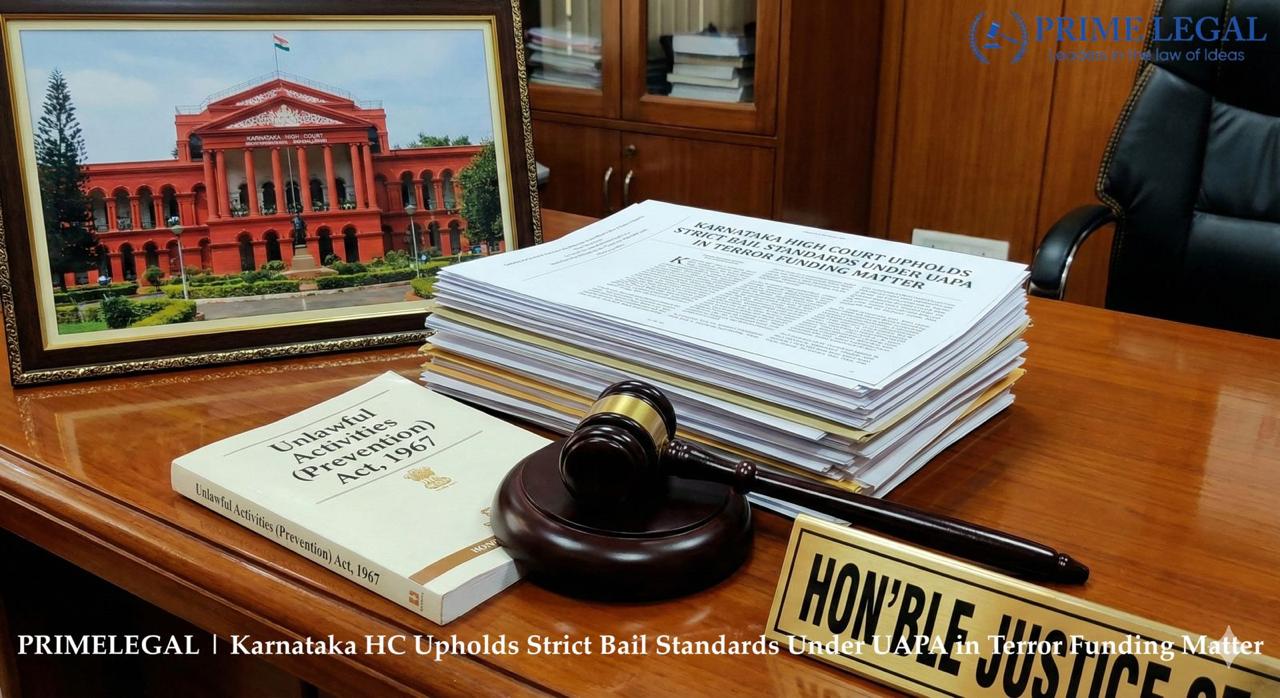
CASE NAME: Reeshaan Thajuddin Sheikh v/s The National Investigation Agency
CASE NUMBER: Criminal Appeal No. 1548 of 2025
COURT: High Court of Karnataka
DATE: 22 January 2026
QUORUM: Justice H.P. Sandesh, Justice Venkatesh Naik T.
FACTS
The present appeal was filed to challenge the order of rejection of the bail petition dated 20 May 2025, passed by the City Civil and Sessions Judge for the offences punishable under IPC, 1860, UAPA, 1967 and Karnataka State Prevention of Destruction and Loss of Property Act, 1981.
The allegation against the appellant (accused No. 4) is that he is a member of the proscribed terrorist organization, Islamic State and was radicalized and recruited by accused No.2, who is his college mate at PA College of Engineering, Mangaluru. As part of a larger conspiracy, the appellant participated in reconnaissance and arson activities in Mangaluru with the intention to wage war against the Government of India. He is also accused of facilitating the transfer of terror funds by sharing cryptocurrency wallet details, converting the received funds into cash and handing it over to accused No.2 and allegedly purchasing a Honda Activa for use in these activities, funded by money received through an online handler named “Colonel”. The appellant was thereby arrested on 5 January 2023 and his voluntary statement recorded that accused No. 2 radicalised and recruited him to further the activities of the proscribed terrorist organisation, Islamic State, sent him videos/PDFs related to ISIS, the beheading of kafirs, jihad, bayans of radicalised maullana and videos demonstrating arson and the use of Molotov cocktails (petrol bombs). The appellant also stated that he received cryptocurrency into his Zebpay account from online handlers as well as into the crypto account of his college friend, Shadab. He further stated that he, along with accused No.2, participated in the arson of an Innova car in Mangaluru and a paint shop in Bramhavara and conducted reconnaissance at several locations in and around Mangaluru. The Trial Court noted the involvement of the appellant in the said activities, the role played by him and his engagement in cryptocurrency activities, and rejected the bail petition.
ISSUES
- Whether the appellant has made out the ground to enlarge him on bail by setting aside the order impugned, and whether it requires the interference of this Court.
LEGAL PROVISIONS
- Sections 120B, 121A, 427 and 435 of IPC, 1860.
- Sections 15, 16, 17, 18, 20, 38, 39, 40 and 43D (5) of the Unlawful Activities (Prevention) Act, 1967.
- Section 2 of the Karnataka State Prevention of Destruction and Loss of Property Act, 1981.
ARGUMENTS
APPELLANT:
The counsel on behalf of the Appellant contended that the Trial Court committed an error in rejecting the bail petition and that the appellant was not involved in any such acts, but the Trial Court proceeded to believe the case without any material proof. The allegations were contended to be made on mere conjectures and surmises and not based on any material evidence. They contended that none of the ingredients of Section 15 of the UAPA of 1967 with regard to which the allegations were made, were fulfilled, and there are no reasonable grounds for believing that the accusation against the appellant is prima facie true. Furthermore, it was contended that no allegation whatsoever to the effect that the appellant has committed any criminal conspiracy for the commission of a terrorist act or any act preparatory to the commission of a terrorist act as defined under Section 15 of the UAPA of 1967. They contended that the allegation against the appellant, that he has committed offences punishable under Sections 38, 39 and 40 of the UAPA of 1967 are imaginary and without any material to substantiate the involvement of this appellant in these offences.
RESPONDENT:
The counsel on behalf of the Respondent contended that the charges were already framed and the trial had commenced. The detailed statement of objections filed to this appeal, along with Annexure-R1 and R2, was submitted, and it was contended that the appellant was involved in transferring the terrorist money and also involved in the acts against the waging war, the final report of which had been filed by the respondent. The counsel further contended that it was relevant to examine Section 43D (5) of the UAPA of 1967 for the purpose of determining the question of bail. Further, it was contended that when a similar allegation was raised against accused Nos. 6 and 10, the same was considered by this Court and rejected the same as per Annexure-R1 and R2.
The counsel relied upon the judgment of the Apex Court in the case of Pankaj Bansal v/s Union of India (2024) 7 SCC 576 wherein an observation is made particularly with regard to the statutory mandate of Section 19 (1) PMLA of informing the arrested person of the grounds of arrest and also stated ‘henceforth’ and the same is also explained in the subsequent judgment of Ram Kishor Arora v/s Directorate of Enforcement (2024) 7 SCC 599.
ANALYSIS
The Honourable Bench, upon considering the arguments advanced and the materials submitted, stated that the FSL report revealed the images of electric substations, boatyards, gas stations, oil tankers, shops and various locations identified during the reconnaissance by the appellant. The appellant was actively involved in reconnaissance and arson activities in and around Mangaluru and was recruited by accused No. 2 to further the agenda of the proscribed organisation, Islamic State. They stated that the appellant received funds through cryptocurrency fronline handler affiliated with the terrorist outfit, and these funds were subsequently utilized to carry out the terrorist activities. It was observed that the Trial Court held that the facts which have been taken together provide reasonable grounds to believe that the accusations levelled against accused No.4 are prima facie true and precluded from granting bail when prima facie evidence supports the allegations of involvement in terrorist activities. The Honourable Bench of the High Court stated that the present case is not a case for setting aside the order of the Trial Court since there was in detail discussion on the material collected against the appellant, which substantiated the prima facie case against him. Hence, the appellant did not possess any ground to enlarge on bail. Furthermore, it was held with reference to the judgment cited by the counsel of respondents that the appellant is not entitled to bail, having considered the material collected by IO during the investigation and the matter requires trial and the same is commenced.
JUDGMENT
The present Criminal Appeal was dismissed, and it was held that the Appellant did not have any ground to enlarge on bail by setting aside the order of the Trial Court.
CONCLUSION
This judgment upholds the strict approach of the courts while dealing with cases associated with bail applications under the Unlawful Activities (Prevention) Act, 1967. It highlights that once the Court is satisfied and have found reasonable grounds to believe that the accusations are prima facie true, the statutory bar comes into operation, leaving little discretion to grant bail.
“PRIME LEGAL is a National Award-winning law firm with over two decades of experience across diverse legal sectors. We are dedicated to setting the standard for legal excellence in civil, criminal, and family law.”
WRITTEN BY: STUTI ANVI
Click here to read the judgement

