
INTRODUCTION
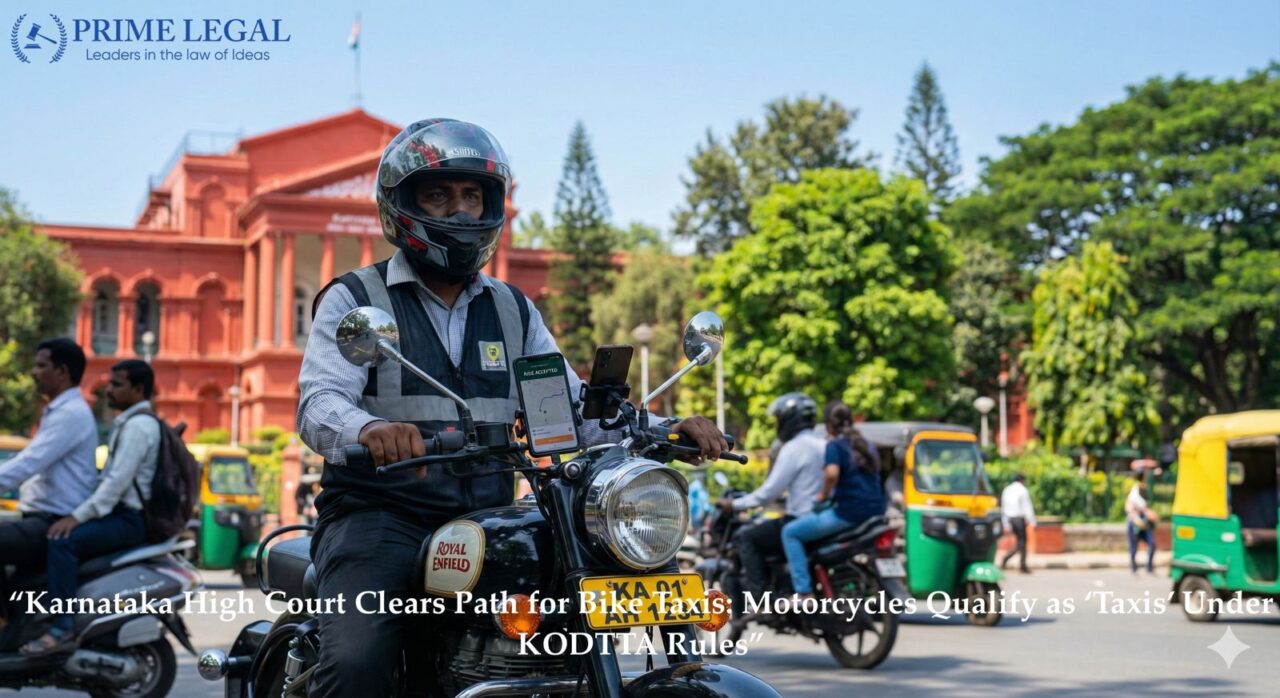
In a landmark judgment, the Karnataka High Court on 23rd January of 2026 went on to lift the state’s blanket prohibition on bike taxi services and held that motorcycles deployed for passenger transport purposes fall within the statutory definition of transport vehicles and taxis under the Motor Vehicles Act, 1988 and the Karnataka On-Demand Transport Technology Aggregator Rules (KODTTA Rules) of 2016. A Division Bench comprising Hon’ble Chief Justice Vibhu Bakhru and Hon’ble Justice C.M. Joshi allowed a multiplicity of Writ Appeals filed by leading mobility aggregators including ANI Technologies Private Limited (Ola), Uber India Systems Private Limited, Rapido, individual motorcycle owners and the Bike Taxi Welfare Association and went on to effectively overturn a Single Judge’s order which suspended all bike taxi operations pending government framing of rules regarding this matter.
BACKGROUND
The dispute originated from the State Government’s refusal to consider and register motorcycles as transport vehicles and from the issue of contract carriage permits for bike taxi operations. State authorities argued that the KODTTA Rules, 2016 have been specifically designed to regulate app-based ride-hailing aggregators which went on to contemplate that only four-wheeled motor cars and explicitly excluded two-wheeled motorcycles. The State went on to conclude that the policy considerations arise concerns regarding road safety, environmental pollution, and regulatory consistency, which apparently justified the maintenance of blanket prohibition on non-electric bike taxis. When the platform sought to expand operations beyond the four-wheeler vehicles, the applications were categorically rejected, and suspension of license were threatened. This led to individual motorcycle owners and aggregators to simultaneously challenge these restrictions and lead to contentions that motorcycles are a lawful transport under the Motor Vehicles Act, 1998.
KEY POINTS
- The Court held that motorcycles fall within the ambit of motor cab under Section 2(25) of the Motor Vehicles Act, 1988 when they are used for the carriage of passengers for hire or reward. Consequently, such motorcycles qualify as taxis under Section 2(7) of the KODTTA Rules, 2016.
- While rejecting the State’s restrictive interpretation limiting the applicability of the KODTTA Rules to four-wheeled vehicles, the Court clarified that since the KODTTA Rules adopt the definition of motor cab and the as the Motor Vehicles Act, 1988 recognizes motorcycles used for hire as motor cabs, the KODTTA licensing regime necessarily extends to bike taxi aggregators. The Court further held that owing to the absence of an express reference to two-wheelers in the KODTTA Rules, 2016 cannot be a justification for the complete exclusion.
- The Court opined that the State’s blanket ban on bike taxi services amounts to imposing an unreasonable restriction which violates the drivers’ fundamental right to practice any profession or carry on any occupation, trade or business under Article 19(1)(g) of the Constitution of India. Although there is a public interest exception under Article 19(6), the State has failed to produce credible material to demonstrate that this prohibition could be held and justified under the pretense of public safety protocols.
- The Court observed that several States such as Haryana Punjab, Rajasthan, Uttar Pradesh, West Bengal, Mizoram, Bihar, Jharkhand, Gujarat and Telangana have permitted bike taxi operations by invoking Section 93 of the Motor Vehicles Act, 1988 and went on to demonstrate that the regulatory framework for bike taxi services is feasible in practice and could be an effective decision from the point of view of functioning across several jurisdictions.
- Accordingly, the Court directed the State authorities to process all pending and future applications for registration of motorcycles as transport vehicles and to issue carriage contracts. It further held that while Regional Transport Authorities may impose appropriate conditions under Section 74(2) of the Motor Vehicles Act, applications cannot be rejected solely on the ground that the vehicles concerned are not four-wheeled.
RECENT DEVELOPMENTS
Upon the High Court’s order, platforms have started providing bike taxi onboarding procedures, with Ola and Uber directing vehicle owners to obtain requisite regulatory documentation prior to commencement of operations. The Karnataka Transport Ministry went on to green light State compliance with judicial directive and went on to express intent to frame comprehensive bike taxi regulatory policy addressing insurance, driver qualification standards and safety protocols. The motorcycle driver community has characterized this judgment essential for providing essential livelihood protection with estimated 6 lakh operators potentially regaining operational capacity.
CONCLUSION
The judgement of Karnataka High Court is representative of a transformative regulatory moment which establishes motorcycles as statutorily recognized transport vehicles and taxis under existing legal frameworks. By removing the blanket prohibition contradicting the original legislative intent of Motor Vehicles Act and constraining state administrative discretion through constitutional scrutiny, the Court has fundamentally repositioned bike taxis within legitimate regulatory architecture. The decision is made upon giving priority to statutory hierarchy over administrative policy preferences and goes on to promote an innovation-compatible regulatory interpretation. The success of the implementation requires the State to formulate supplementary guidelines addressing insurance, safety standards and driver qualifications while respecting Court’s foundational determination that motorcycles constitute lawful taxi-service vehicles requiring permit issuance.
“PRIME LEGAL is a National Award-winning law firm with over two decades of experience across diverse legal sectors. We are dedicated to setting the standard for legal excellence in civil, criminal, and family law.”
WRITTEN BY: KRISHNA KOUSHIK

