
INTRODUCTION
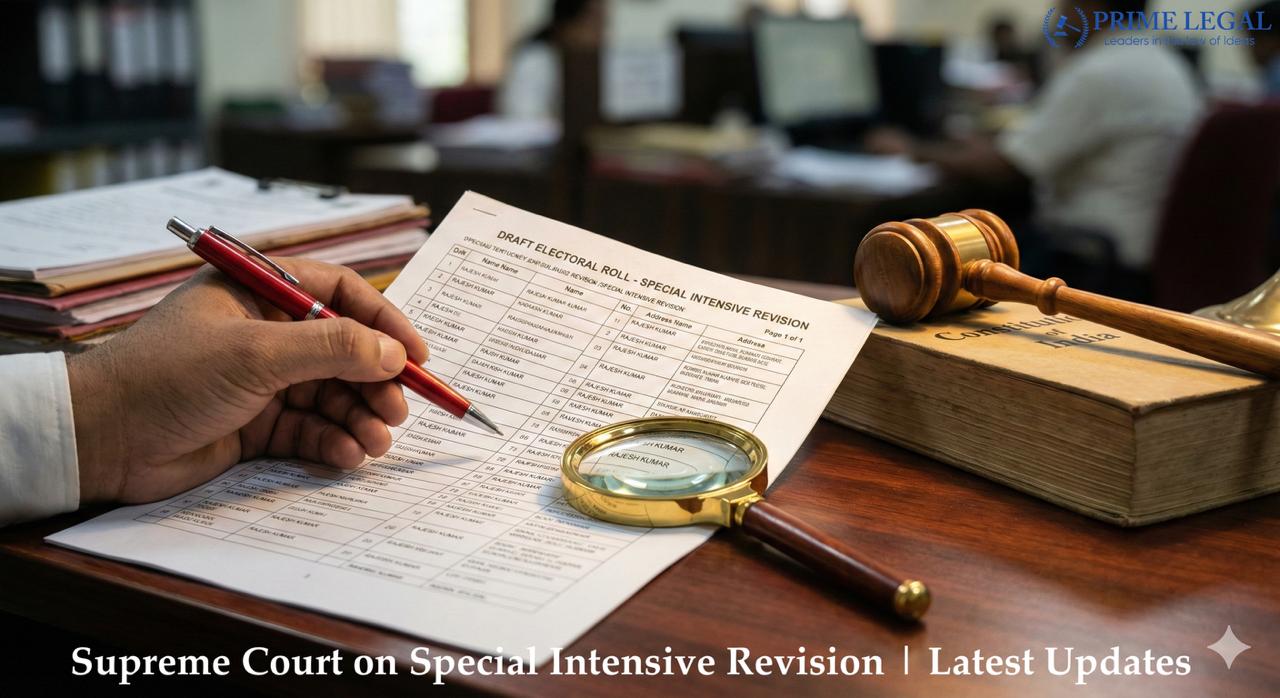
The Supreme Court of India has interposed decisively in the ongoing Special Intensive Revision (SIR) of electoral rolls by issuing a set of comprehensive directions on January 19th of 2026 to ensure voter transparency, preventing arbitrary deletions from voter rolls and protecting the citizens of India from arbitrary disenfranchisement. A Bench consisting of Hon’ble Chief Justice Surya Kant and Hon’ble Justice Joymalya Bagchi and Hon’ble Justice Dipankar Datta has responded to petitions with challenge the Election Commission of India’s act of deletion of approximately 65 lakh voters from electoral rolls from several states.
BACKGROUND
The Special Intensive Revision constitutes a comprehensive electoral roll correction exercise involving house-to-house enumeration, verification, and removal of duplicate entries, deceased voters, and ineligible persons. In accordance with Section 21(3) of the Representation of the People Act of 1950 and Article 324 of the Constitution of India the ECI is vested with authority to conduct changes and deletions to electoral rolls. During July of 2025, with Bihar being the focus, the SIR has conducted major deletions in vote pools citing reasons including logical discrepancies and documentation deficiencies concerning effecting migrants, students living outside the state and economically backward populations. Several civil society organizations, political parties and constitutional scholars have challenged this exercise and have alleged violation of adult suffrage guarantees under Article 326 without existence of any proper statutory procedures and inadequate opportunity for affected voters to respond before deletion.
KEY POINTS
- The Court has mandated for public display of all the names included in logical discrepancy and unmapped categories at Gram Panchayats, block offices, Talukas, sub-divisions and wards to ensure that affected voters receive actual notice before deletion proceedings are commenced. This transparency mandate prevents administrative action to take place without voter knowledge or participation opportunity.
- Upon recognizing the practical roadblocks and constitutional protections, the court has exempted specific water categories from mandatory physical hearing attendance. This pool includes students residing outside the states for academic purposes, government paramilitary personnel posted outside the state, individuals aged above 85, persons suffering from chronically ill diseases and NRIs.
- The Bench decision has articulated that no government power can act the scope of judicial review and has questioned Rule 21 of Electors Rules which permit ECI deviation from procedures during the exercise of SIR. The Court has directed ECI to bear strict compliance to regulatory framework with functioning and conduct unless explicit authorization is permitted for alternative procedures to be employed.
- There has been a modification made to the publication of final electoral rolls based on the Courts directive. The publication of West Bengal’s final electoral roll was pushed to 14th February of 2026 with hearings scheduled to be concluded on 7th February 2026 to provide adequate opportunity for the document submission and oral representations for the affected voters before the final deletion decisions.
- There has been a modification received to publication of final electoral rolls based on court directive. The final electoral roll publication for the state of West Bengal has moved 14th of February 2026 with hearing processes to be concluded by 7th February of 2026 to ensure that affected waters are provided with an opportunity to submit their documents and oral presentations before the final deletion decisions are made.
- The Court has acknowledged the existence of practical implications in production of documents especially for marginalized populations and has directed ECI to take into consideration alternative documents such as AADHAR, ration cards and voter identity documents to prevent the verification of citizenship from becoming an oppressive mechanism against populations whose documentation places them in a position of disadvantage.
RECENT DEVELOPMENTS
While bearing compliance to directions provided by the Supreme Court on 19th January, the Election Commission has issued guidance for implementation which mandates strict adherence by states. The West Bengal administration has received explicit directions for adequate police manpower in handling this matter, adherence to peaceful hearing conduct and stringent consequences for non-compliance for such directions. Legal scholars are of the opinion that this judicial intervention is a key moment, which establishes electoral roll maintenance as a transparent, judicially supervised process rather than administrative exercise which carries a scope to act beyond democratic integrity. Additionally, human rights organizations view this decision as a step towards providing protection to vulnerable voters from systematic disenfranchisement. However, the ECI still asserts that the constitutional empowerment provided by Article 324 provide provides for discretionary procedures not explicitly lay down by any statutory rules.
CONCLUSION
The Supreme Court directions indicate a transformational judicial safeguard for democratic citizenship rights through transparency mandates, maintaining procedural, fairness, protections and administrative accountability mechanisms. By imposing mandates of public disclosure, categorical exemptions, statutory compliance standards and providing flexibility for document verification, the Court has aimed to rebalance electoral administration to maintain suffrage rights which are constitutionally protected. This judgment establishes a precedent that suffrages trigger Article 326 when such powers over reach their constitutional empowerment and threaten voter exclusion. The success of the implementation is dependent on state compliance coupled with Court directed timelines and procedural fairness.
“PRIME LEGAL is a National Award-winning law firm with over two decades of experience across diverse legal sectors. We are dedicated to setting the standard for legal excellence in civil, criminal, and family law.” WRITTEN BY: KRISHNA KOUSHIK

