
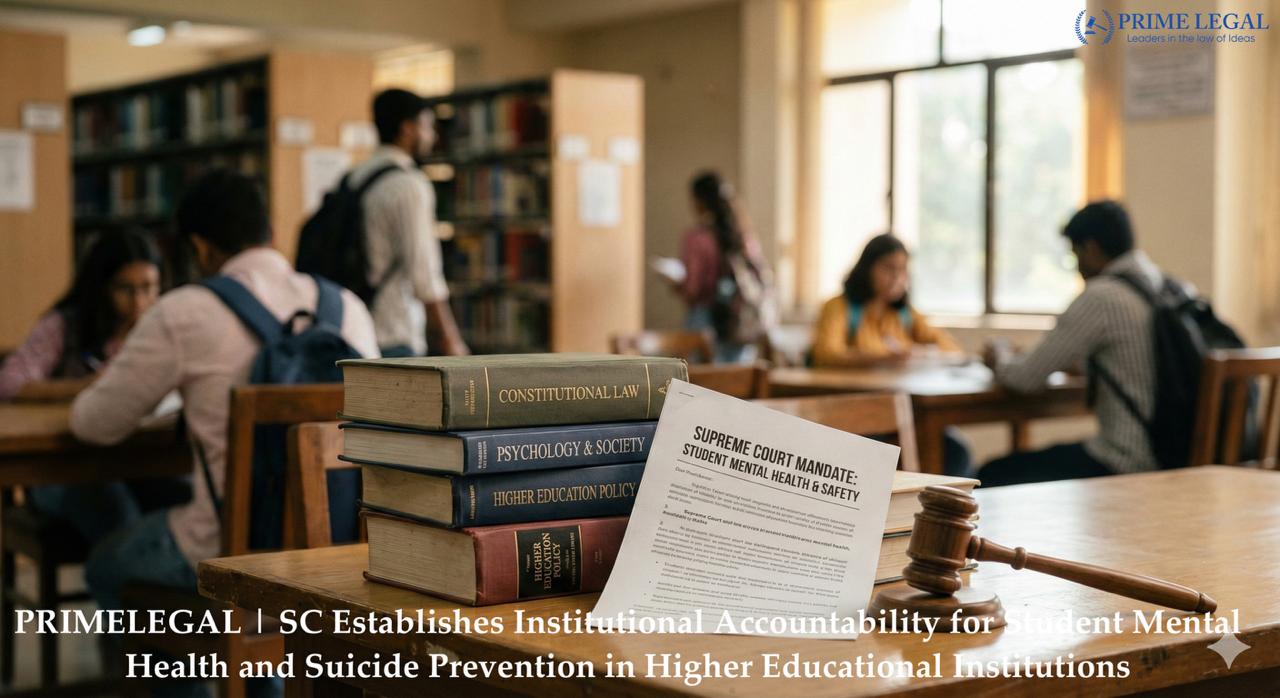
CASE NAME: Amit Kumar and Ors. v. Union of India and Ors.
CASE NUMBER: Criminal Appeal No. 1425 of 2025 @ SLP (CRL) No. 13324 of 2024)
COURT: Supreme Court of India
DATE: 24th March 2025
BENCH: Hon’ble Justice J.B. Pardiwala and Hon’ble Justice R. Mahadevan
FACTS
The Supreme Court examined a petition arising from the Delhi High Court judgment dated 30 January 2024, which had rejected a writ application by parents seeking mandamus directing police registration of FIRs concerning their sons’ deaths at the Indian Institute of Technology (IIT), Delhi. In this case, two student who were pursuing B.Tech namely Ayush Ashna and Anil Kumar were found dead in their hostel rooms on 8th July and 1st September 2023 respectively. Ayush Ashna was discovered in Udaigiri Hostel, Room WH-02 located on the Seventh Floor, while Anil Kumar was found in Vidhyachal Hostel, Room EA-18 which is located on the Ground Floor. The petitioners are the parents of both deceased students belonging to Scheduled Castes, alleged caste-based discrimination committed by faculty members and have also alleged failures and discrepancies in police investigation. They contended that the deaths of their children represented murders concealed as suicides and went on to claim that their sons had repeatedly reported caste discrimination incidents and institutional harassment to family members before their deaths.
ISSUES
- Whether Higher Educational Institutions carry the obligation of institutional accountability for student mental health, well-being and suicide prevention mechanisms through statutory duty of care.
- Whether caste-based discrimination within Higher Educational Institutions amount t0o issuance of cognizable offence warrant requiring independent investigation under SC/ST (Prevention of Atrocities) Act, 1989.
- Whether institutional failures in implementation of mental health support systems and identification of crisis in a timely manner are enforceable through constitutional remedies.
- Whether the existing police investigation protocols are you enough to sufficiently address the dimension of caste-based discrimination in cases involving student suicides.
LEGAL PROVISIONS
- Article 21 of Constitution of India, 1950 which provides fundamental protection of life and personality to all the citizens of India.
- Schedule Caste and Schedule Tribe (Prevention of Atrocities) Act, 1989 which items to prevent the violence and atrocities caused against the members of SC and ST communities.
- Bhartiya Nyaya Sanhita (BNS), 2023: a substantive legislation containing provisions which address criminal investigation procedures and crime scene examination protocols.
- National Education Policy 2020: The framework which establishes student welfare as institutional responsibility within Higher Educational Institutions.
ARGUMENTS
PETITIONERS:
The counsel for petitioners contended that institutional failures in student mental health support, combined with documented caste discrimination incidents, constituted contributory factors to students’ deaths. Postmortem examinations establishing asphyxiation by hanging obscured investigation into possible foul play and caste-motivated circumstances. Police investigation inadequately addressed caste discrimination allegations despite SC/ST Act applicability. Parents claimed their sons explicitly communicated caste-based harassment experiences, yet institutions failed implementing protective mechanisms. Investigation protocols insufficiently examined whether institutional discrimination caused psychological distress to the students, culminating their deaths.
RESPONDENT:
The counsels representing Union of India and respondent officials contended that the post-mortem conclusions which establish that the cause of death to be suicide coupled with records reflect a deteriorating academic performance of both the students as psychological distress which led to the events. The Police documented lower examination grades and academic stress as causative factors for psychological distress and deaths. The statements derived during the investigation from peers, relatives and institutional witnesses validated lack of institutional discrimination complaints during investigation phases. The official position went on to assert that institutional mental health mechanisms and investigation procedures were adequate in dealing student crises.
ANALYSIS
The collective judgement passed by Hon’ble Justice Pardiwala and Hon’ble Justice Mahadevan’ proves to be a landmark one in the Education policies jurisprudence, wherein, it established obligations of institutional accountability for student mental health and suicide prevention. The Bench highlighted that student well-being constitutes fundamental institutional responsibility transcending mere peripheral welfare function. The Court noted systematic institutional failures: which include inadequate mental health infrastructure with the Higher Educational Institutions, insufficient crisis identification protocols and insufficient preventive mechanisms within the infrastructure of IITs. Significantly, the judgment criticized several Higer Educational Institutions for their non-compliance to requirements of sharing of information regarding institutional mental health initiatives despite multiple National Task Force intimations. The Bench enunciated that institutional negligence regarding student mental health institutes actionable breach of duty of care which is enforceable through constitutional remedy invocation.. Hon’ble Justice Mahadevan’s reasoning established that institutional failures and discriminatory circumstances together create multi-dimensional causative factors distinguishing mere suicide from institutional-failure-facilitated deaths meriting independent investigation.
JUDGMENT
The Supreme Court set aside the Delhi High Court’s dismissal order and directed the concerned police bodies to register FIRs which concern student deaths with mandatory independent investigation examining caste discrimination dimensions. The Apex Court further ordered for a constitution of a National Task Force charged with developing comprehensive suicide prevention guidelines for all Higher Educational Institutions equipped with mandatory mental health infrastructure establishment with standardized counsellor-student ratios across all Higher Educational Institutions. The directives included immediate employment of all vacant faculty positions and scholarship disbursement completion preventing student economic distress and strict compliance enforcement mechanisms with substantive consequences for institutional non-compliance.
CONCLUSION
This landmark judgment aims to redefine institutional accountability and its compliance within higher education by establishing mental health protections and suicide prevention as enforceable institutional obligations rather than discretionary initiatives. By taking into consideration several factors such as institutional negligence and discrimination circumstances, the judgment establishes a protective framework addressing systemic gaps historically facilitating student mental health crises. The success of its implementation depends upon rigorous compliance monitoring coupled with adequate resource allocation and genuine commitment of institutions for mental health well-being of students over administrative convenience.
“PRIME LEGAL is a National Award-winning law firm with over two decades of experience across diverse legal sectors. We are dedicated to setting the standard for legal excellence in civil, criminal, and family law.” WRITTEN BY: KRISHNA KOUSHIK

