
INTRODUCTION
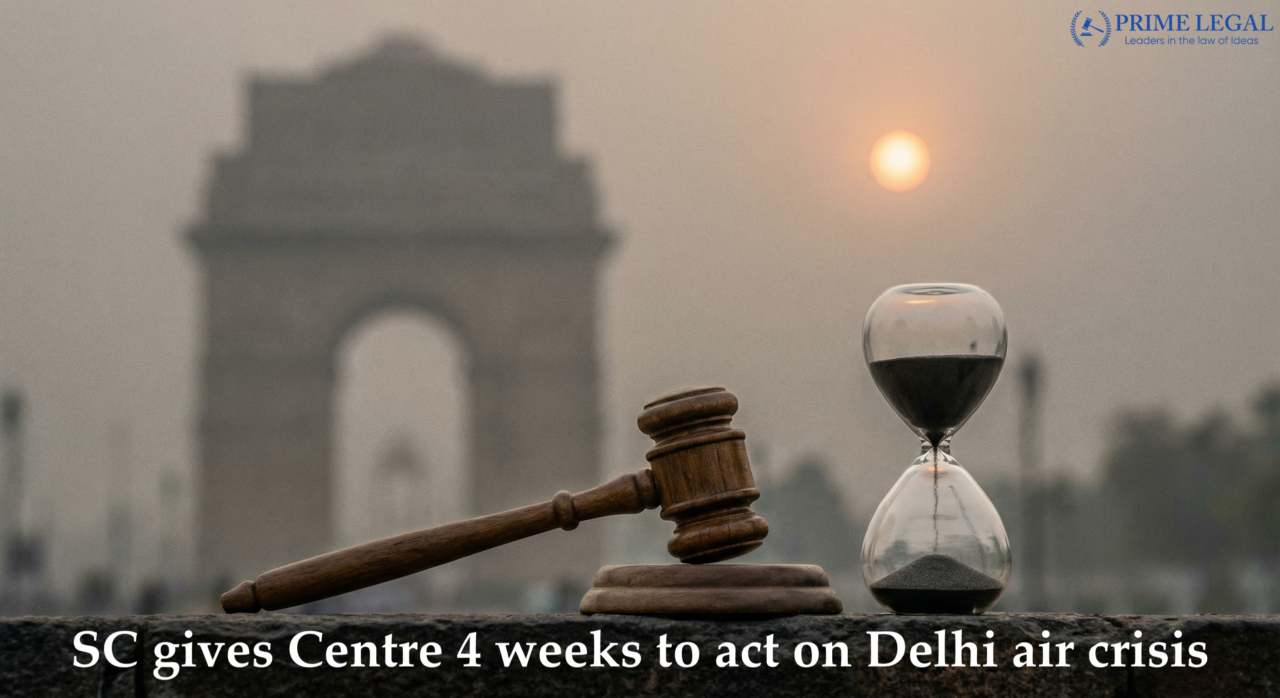
The Supreme Court on Wednesday ordered the Union Government, the Delhi Government, and other concerned authorities to submit their respective action plans on the long-term measures recommended to reduce the deteriorating air quality in the Delhi-National Capital Region (Delhi-NCR). The Supreme Court made it clear that it would not accept any objections to the measures recommended to address what it had earlier termed as an “annual” pollution crisis.
BACKGROUND
The orders came in a case related to the deteriorating Air Quality Index in the Delhi-NCR region. The case has been under constant judicial observation, especially during the winter season when the pollution levels increase sharply. On January 6, the Supreme Court had severely criticized the Commission for Air Quality Management (CAQM), saying that it is “failing in its duty” and lacks seriousness, as it had sought an adjournment of two months on the issue of reducing traffic congestion at the borders of Delhi by shifting or closing toll plazas.
Earlier, in the hearing on December 17, the Court had described the air pollution problem in Delhi as an “annual feature” and emphasized the need for finding practical long-term solutions to the problem. The Court had also modified its earlier interim order of August 12 to allow coercive measures against older vehicles that are not in compliance with Bharat Stage-IV norms.
KEY POINTS
From the Supreme Court’s Order
A three-judge Bench consisting of Chief Justice of India Surya Kant, Justice Joymalya Bagchi, and Justice Vipul M. Pancholi noted the status report filed by Additional Solicitor General Aishwarya Bhati on behalf of the CAQM.
The Bench observed that the CAQM has recommended 15 long-term strategies to deal with air pollution and has also identified the competent authorities which are responsible to implement each of these strategies. While underlining the binding nature of these recommendations, the Court said: “There can be no doubt that these long-term measures recommended by CAQM are required to be given effect to with no delay… This Court is not inclined to entertain any objections with respect to these measures.”
The Court, therefore, ordered all stakeholders to submit their action-taken plans within four weeks.
From the findings of CAQM on Sources of Pollution
According to the report filed with the Supreme Court earlier this week, the CAQM has identified vehicular emissions as the most “prominent source of air pollution in the Delhi-NCR region, especially during the winter months.” The transport sector, including both on-road and off-road vehicles running on petrol, diesel, and CNG, was identified as a source of particulate matter and nitrogen and sulphur oxides.
The report pointed out that even with the progressive removal of the old vehicles, diesel vehicles remain a major source of pollution. Traffic congestion and snarls also add to the pollution. Biomass and dust were found to be the next major sources of pollution, while secondary particulate matter formed due to the emissions of other sources also contribute significantly to winter pollution.
RECENT DEVELOPMENTS
ASG Bhati has informed the Court that the 15 long-term measures include the phasing out of polluting vehicles based on their emission standards, improvement in the Pollution Under Control (PUC) regime, development of rail and metro connectivity, changes in the electric vehicle policy, and so on. She also said that the concerned departments have been identified to form an environmental compensation charge fund in order to support implementation.
Senior Advocate Aparajita Singh, appearing as amicus curiae, drew attention to the fact that such steps had been recommended in earlier plans too and asked the Court to lay down timelines for effective implementation.
CONCLUSION
Through the imposition of a four-week deadline and the refusal to consider objections, the Supreme Court has made it clear that it is no longer willing to wait for a long-term solution to the air pollution problem in the Delhi-NCR region. With vehicular pollution having been identified as the main cause of the problem and the responsibility having been placed squarely on the shoulders of various agencies, the next few weeks will be critical in determining whether the intentions of the government are finally translated into action.
“PRIME LEGAL is a National Award-winning law firm with over two decades of experience across diverse legal sectors. We are dedicated to setting the standard for legal excellence in civil, criminal, and family law.”
WRITTEN BY: USIKA K

