
INTRODUCTION
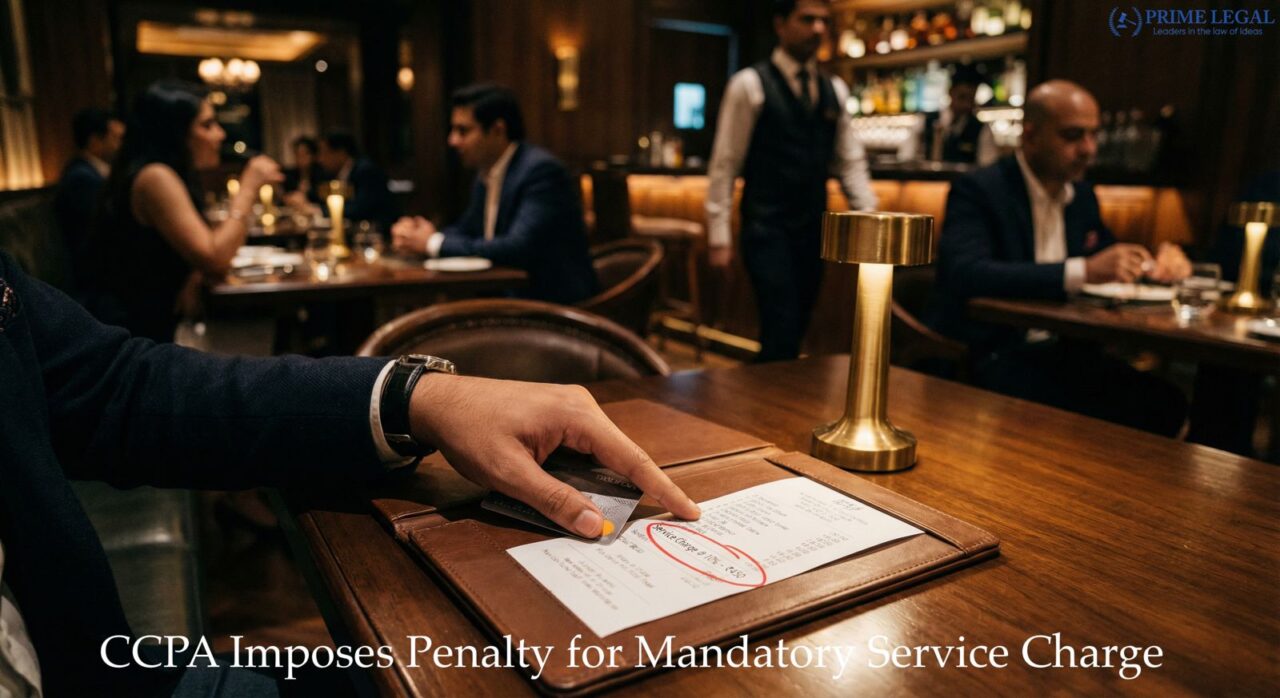
On 29 December 2025, a penalty of ₹50,000 was imposed by the Central Consumer Protection Authority (CCPA) on China Gate Restaurant Private Limited, running the Bora Bora restaurants in Mumbai, for unlawfully charging mandatory service charges to its consumers, which was held to violate the CCPA’s enforcement guidelines and the judgment of the Delhi High Court passed on 28 March 2025, which held that service charges cannot be mandatorily charged to consumers along with food bills, as it amounts to an unlawful trade practice.
BACKGROUND
Service charges in restaurants have been a regulatory and judicial concern since 2022, when the CCPA issued an important guideline stating that the service charge levied by restaurants is optional and cannot be charged automatically. These guidelines were contested by trade associations in the restaurant industry, such as the National Restaurant Association of India and the Federation of Hotel and Restaurant Associations of India, resulting in an interim stay granted by the Delhi High Court in July 2022.
The legal scenario finally got clarified on the 28th of March, 2025, when the Delhi High Court, through the case of National Restaurant Association of India & Ors v. Union of India & Ors, MANU/DE/2062/2025, upheld the guidelines of the CCPA, thereby stating that the concept of mandatory or default Service charges is illegal and violative of consumer protection laws.
KEY POINTS
Even though, post-28 March 2025, the position of law is clear on the subject, the issue arose when a Mumbai consumer visited an eating outlet of Bora Bora on 19 April 2025. To his dismay, a service charge at the rate of 10%, amounting to ₹624, was added automatically, and to make matters worse, GST was also charged upon the service charge itself. He objected to the levy and thus requested its removal. According to him, the restaurant refused to remove the charge and misbehaved with the consumer. The bill was paid under protest.
After this incident, a complaint was filed by the consumer through the National Consumer Helpline (NCH). On suo motu cognizance of the complaint, a preliminary inquiry was initiated by CCPA, since the service charge was shown on a software-based bill, implying that it was a default billing feature.
A detailed investigation was subsequently carried out by the Director General (Investigation), CCPA. The investigation revealed that the service charges were mandatorily added to all the bills between the 28th of March 2025 and the 30th of April 2025, long after the verdict by the Delhi High Court. Furthermore, the finding revealed that the GST on the service charges was charged contrary to the guidelines, the consumer complaint was still pending without any response to the reminders, and the email address provided by the restaurant for grievance redressal was not functioning.
RECENT DEVELOPMENTS
China Gate alleged that the service charge is discretionary and ceased it after an internal memo was issued on 30 April 2025, and further averred that the revised menu cards had the following statement: “We levy no service charge.” The customer was reportedly refunded on 8th December 2025, out of goodwill. However, the CCPA observed that the refund was made only after regulatory action, and no proof was submitted for compliance during the period of violation.
Finally, the CCPA, through the final order passed on the 29th of December, 2025, believed that the defence of voluntariness on the part of the service charge was not tenable. This was because the CCPA felt that the charge itself was generated through the billing computer software, which automatically generated the service charge on the entire amount, thereby rendering it not voluntary. Secondly, it was also noted that the restaurant chain was more prominently present in Mumbai, which would then doubtlessly affect a large number of consumers.
CONCLUSION
The CCPA ordered the China Gate Restaurant Private Limited to immediately change their billing software and ensure that functional consumer grievance redressal measures are maintained at all times. They were asked to provide a report on this compliance within the next 15 days. They were again advised that while customers can freely provide tips to the serving staff, the restaurants cannot charge or indirectly charge the customers for the services and link them with the final bill.
“PRIME LEGAL is a full-service law firm that has won a National Award and has more than 20 years of experience in an array of sectors and practice areas. Prime legal falls into the category of best law firm, best lawyer, best family lawyer, best divorce lawyer, best divorce law firm, best criminal lawyer, best criminal law firm, best consumer lawyer, best civil lawyer.”
WRITTEN BY: USIKA K

