
INTRODUCTION
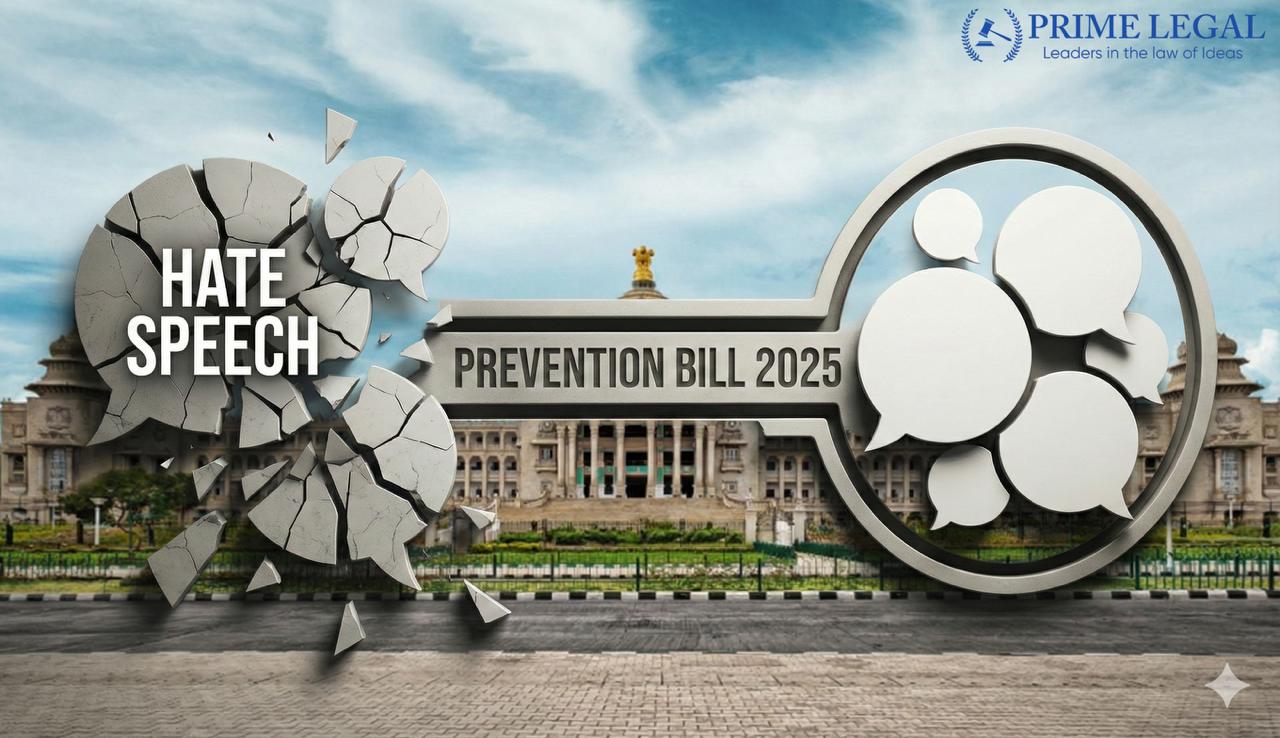
The Karnataka Legislative Assembly recently introduced the Karnataka Hate Speech and Hate Crimes (Prevention) Bill, 2025. The Bill projects itself as a necessary response to an increasingly polarised social climate and the documented surge in hate speech incidents across India in recent years. Framed as a protective measure, the Bill positions itself as a statutory shield against the rising wave of communal, caste-based and identity-based hate that has been repeatedly found by reporters. The Bill is not only a charter of “prevention”, it is most crucially a charter of “discretion”.
BACKGROUND
It is in this charged atmosphere that Karnataka has introduced the Hate Speech and Hate Crimes (Prevention) Bill, 2025. It is considered as the most pointed state-driven attempt yet to confront the menace of hate expression. The law stretches across forms of communication, including spoken, written, digital, and visual forms that spread hatred, hostility, or ill-will among communities marked by religion, caste, gender, sexuality, language, or disability. The punishments include imprisonment from one to seven years for a first offence and up to ten years for repeat acts, with every offence treated as cognisable and non-bailable. The Bill delivers a firm message that states that hate speech cannot take shelter behind the defence of free speech. But intent, no matter how well-meaning, cannot by itself justify authority. The law’s wide wording and the extensive powers placed in the hands of the executive conceal an underlying danger, that a measure framed to contain violence might, in practice, be wielded to quieten dissent. In drawing the boundaries of acceptable expression, the State risks erasing the distinction between curbing hatred and constraining the freedoms on which democracy depends.
KEY POINTS
- The Bill defines hate speech as any spoken, written, visual, or electronic expression meant to incite hatred, hostility, or illwill against a person or group based on religion, caste, gender, sexual orientation, language, disability, or similar grounds.
- Hate crime refers to the act of communicating, publishing, propagating, or supporting such hate speech to spread social tension or animosity among individuals or communities.
- Punishment ranges from one to seven years in prison and a fine of ₹50,000 for a first offence, and from two to ten years with a ₹1 lakh fine for repeat offences. All offences are cognisable and non‑bailable.
- Organisations are held responsible for offences under their watch, and those in charge must prove they lacked knowledge or took all possible steps to prevent them.
- Courts may order compensation for victims, considering emotional, social, and physical harm caused by the offence.
- A designated state officer can direct platforms or intermediaries to block or remove hate‑related content, and the police can take preventive action based on credible suspicion of a possible offence.
- Exemptions apply to content created for public good, whether scholarly, artistic, literary, or religious, as long as the intent is genuine and not aimed at provoking hatred.
RECENT DEVELOPMENTS
It was approved by the Karnataka Cabinet in early December 2025, with the State Legislative Assembly passing it unanimously later that month. This has sparked heated debate among politicians and jurists. While many see it as a welcome move to curb the growing trend of hate speech that has captured the social narrative, others fear that the Bill could chip away at the constitutional right to the freedom to speak freely provided in Article 19(1)(a) due to the rather vague language used in the Bill to place too much State power over the citizenry.
CONCLUSION
The escalation in violent outbreaks, provocative utterances, and cyber extremists in our society demonstrates beyond doubt that hate ideologies can no longer be wished away. This goes on to show that it has become highly pertinent for society to take up the challenge against hate. Instead, it appears that it is a reality that has been endorsed by the Bill which recognizes this unpleasant reality and takes a brave step to tackle it. This particular initiative by the State of Karnataka has triggered a much-needed debate on this issue in the State.
“PRIME LEGAL is a full-service law firm that has won a National Award and has more than 20 years of experience in an array of sectors and practice areas. Prime legal falls into the category of best law firm, best lawyer, best family lawyer, best divorce lawyer, best divorce law firm, best criminal lawyer, best criminal law firm, best consumer lawyer, best civil lawyer.”
WRITTEN BY: ARCHITHA MANIKANTAN

