
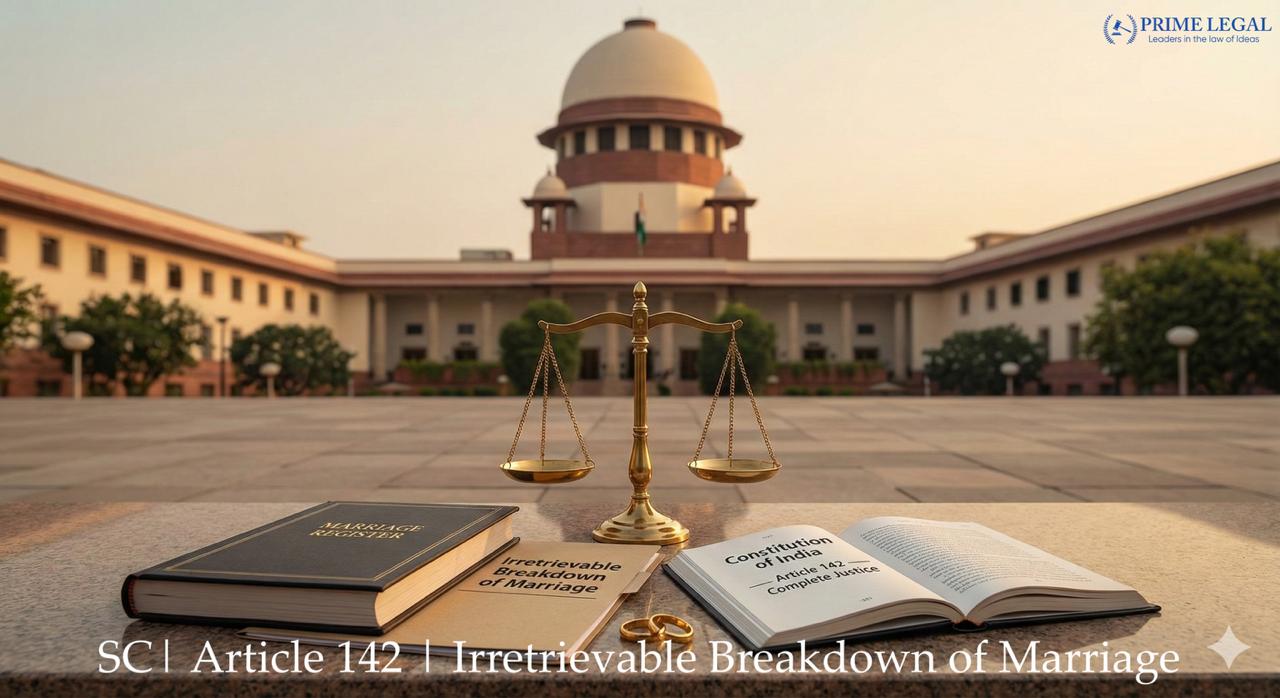
CASE NAME: Nayan Bhowmick v. Aparna Chakraborty
CASE NUMBER: Civil Appeal No. 5167 of 2012
COURT: Supreme Court of India
DATE: 15 December 2025
QUORUM: Hon’ble Mr. Justice Manmohan, Hon’ble Mr. Justice Joymalya Bagchi
FACTS
The appellant-husband and respondent-wife tied the knot in August 2000 following Hindu customs. They already knew each other beforehand, both working as Development Officers at the Life Insurance Corporation of India. Soon after the wedding, friction surfaced when the appellant and his family allegedly began pressuring the respondent to give up her employment, despite her obligation to support her own family financially. Within about a year, in 2001, the respondent left the matrimonial home and began living separately.
In 2003, the husband first approached the court seeking divorce on the ground of desertion, but that petition was rejected as being premature in law. He then instituted a fresh divorce petition in 2007, which resulted in a decree of divorce being granted by the trial court in 2010. In 2011, however, the Gauhati High Court overturned that decree, holding that the allegation of desertion had not been established. The husband, dissatisfied with this reversal, carried the matter in appeal to the Supreme Court.
ISSUES
- Did the wife desert the husband under Section 13(1)(i-b) of the Hindu Marriage Act, 1955?
- Does prolonged separation with no hope of getting back together count as cruelty?
- Can the Supreme Court dissolve the marriage invoking its powers under Article 142 of the Constitution, given the irretrievable breakdown?
LEGAL PROVISIONS
- Sections 13(1)(i-a) and 13(1)(i-b), Hindu Marriage Act, 1955
- Article 142(1), Constitution of India
ARGUMENTS
APPELLANT
The husband pointed out that they had been living separately since 2001, and every attempt to reconcile had come to nothing. He stressed that the marriage was irreparably broken, surviving only as a hollow formality on paper. He went on to say that this drawn-out separation on its own inflicted mental cruelty, making divorce the right call.
RESPONDENT
The wife countered that she had been driven out of the home by mistreatment and relentless pressure to abandon her job. She rejected any claim of desertion, insisting she was still ready to resume married life. She drew on past court rulings that prioritize keeping marriages intact where possible.
ANALYSIS
The Supreme Court took note that the couple had been living apart for more than twenty-four years, with no children and no real chance of ever getting back together. It pointed out how such a long separation, dragged on by endless court battles, inflicts mental cruelty on both sides.
The Court made clear that while the fault grounds laid out in the Hindu Marriage Act matter, they don’t tie the hands of the Supreme Court’s powers under Article 142. Drawing from earlier cases like Naveen Kohli, Samar Ghosh, and Shilpa Sailesh, it ruled that a marriage that’s dead emotionally and practically shouldn’t be kept alive just for the sake of some legal label.
In rare situations like this, the Court said, the old ideas of fault and finger-pointing have to step aside to let true justice happen between the two people involved.
JUDGEMENT
The Supreme Court sided with the husband, overturning the Gauhati High Court’s decision and bringing back the trial court’s divorce decree. Using its powers under Article 142 of the Constitution, the Court put an end to the marriage on grounds of its complete and irreparable breakdown.
CONCLUSION
This decision highlights how the Supreme Court is changing its approach in matrimonial matters, viewing drawn-out separations and emotional deadlocks as genuine cruelty.It confirms Article 142 as a key mechanism to wrap up dead marriages with dignity when regular laws fall short. The ruling favours true justice over inflexible fault requirements, revealing a kinder perspective on family law.
“PRIME LEGAL is a full-service law firm that has won a National Award and has more than 20 years of experience in an array of sectors and practice areas. Prime legal falls into the category of best law firm, best lawyer, best family lawyer, best divorce lawyer, best divorce law firm, best criminal lawyer, best criminal law firm, best consumer lawyer, best civil lawyer.”
WRITTEN BY: ARCHITHA MANIKANTAN

