
Case Name: Central Bureau of Investigation vs Dayamoy Mahato, Etc.
Case Number: Criminal Appeal Nos. of 2025 (Arising out of SLP(Crl) Nos. 12376-12377/2023)
Date: 11 December 2025.
Court: Supreme Court of India
Quorum: Hon’ble Mr. Justice Sanjay Karol and Hon’ble Mr. Justice Nongmeikapam Kotiswar Singh
Facts
The present case is an appeal by the CBI against the order dated 9 November 2022 and all subsequent orders granting bail to the accused respondents by the Calcutta High Court. The respondents of this case were charged with derailment of the Jananeshwari Express train, which caused the death of 148 individuals and caused injuries to 140 persons. The accused were charged under Section 120B, 212, 302, 307, 323, 325, 326, 440 of the Indian Penal Code, 1860, followed by sections of the Indian Railway Act, 1989, and the Unlawful Activities (Prevention) Act,1967. The FIR was registered on 9 June 2010, and the trial began in the same year. However, to date, there are still 28 witnesses left to be examined by the court. Ultimately, the High Court granted bail primarily relying on Article 21 and the delay involved in the trial.
Issues
- Whether section 436A of the CrPC applies to offences carrying a death sentence when there is a delay in the trial?
- Whether the application of Article 21 of the Constitution by the Calcutta High Court legally valid?
- Whether statutory restrictions and the reverse burden of proof can be overridden by the delay in trial?
Legal Provisions
- Section 436A of CrPC (Now under section 479 of BNSS, with more lenient release criteria for first-time offenders)
This section mandates the release of under trial prisoners if they have served half of their maximum prescribed imprisonment period. - Indian Penal Code 1860.
Section 120B (criminal conspiracy), Section 212 (harbouring Offender), Section 302 (punishment for murder), Section 307 (attempt to murder), Section 323 (punishment for voluntarily causing hurt), Section 325 (punishment for voluntarily causing grievous hurt), Section 326 (Voluntarily causing grievous hurt by dangerous weapons or means), Section 440 (Mischief committed after preparation made for causing death or hurt). - Unlawful Activities (Prevention) Act 1967.
Section 16 (Punishment for terrorist act), Section 18 (Punishment for conspiracy, etc), Section 43E (Presumption as to offence under section 15) - Article 21
Protection of life and personal liberty.
Arguments
Appellants
The CBI contended on the application of section 436A of the CrPC. It stated that section 434A cannot be applied to heinous offences which include death as punishment, merely because of the delay in the trial. They stated that the present offence was a matter of public importance as it included the question of national security and sovereignty. Thus, CBI asked for stricter judicial scrutiny rather than the release of the accused.
Respondents
The respondents pleaded with the court to uphold the order of the Calcutta High Court. They stated the right of liberty as enshrined under Article 21. They argued that Section 436A of the CrPC should not act as a barrier to the liberty of an individual due to a delayed trial. They contended that keeping an accused in jail for a prolonged period directly violated their right to liberty, regardless of the statutory restrictions or the gravity of the offences.
Analysis
The apex court, after hearing both sides, gave a judgment balancing the seriousness of the offence and the right of liberty. The Supreme Court highlighted the error in the usage of section 434A of the CrPC when the offence included death as punishment, setting aside that specific line of reasoning. However, the court sided with the grant of bail due to Article 21.
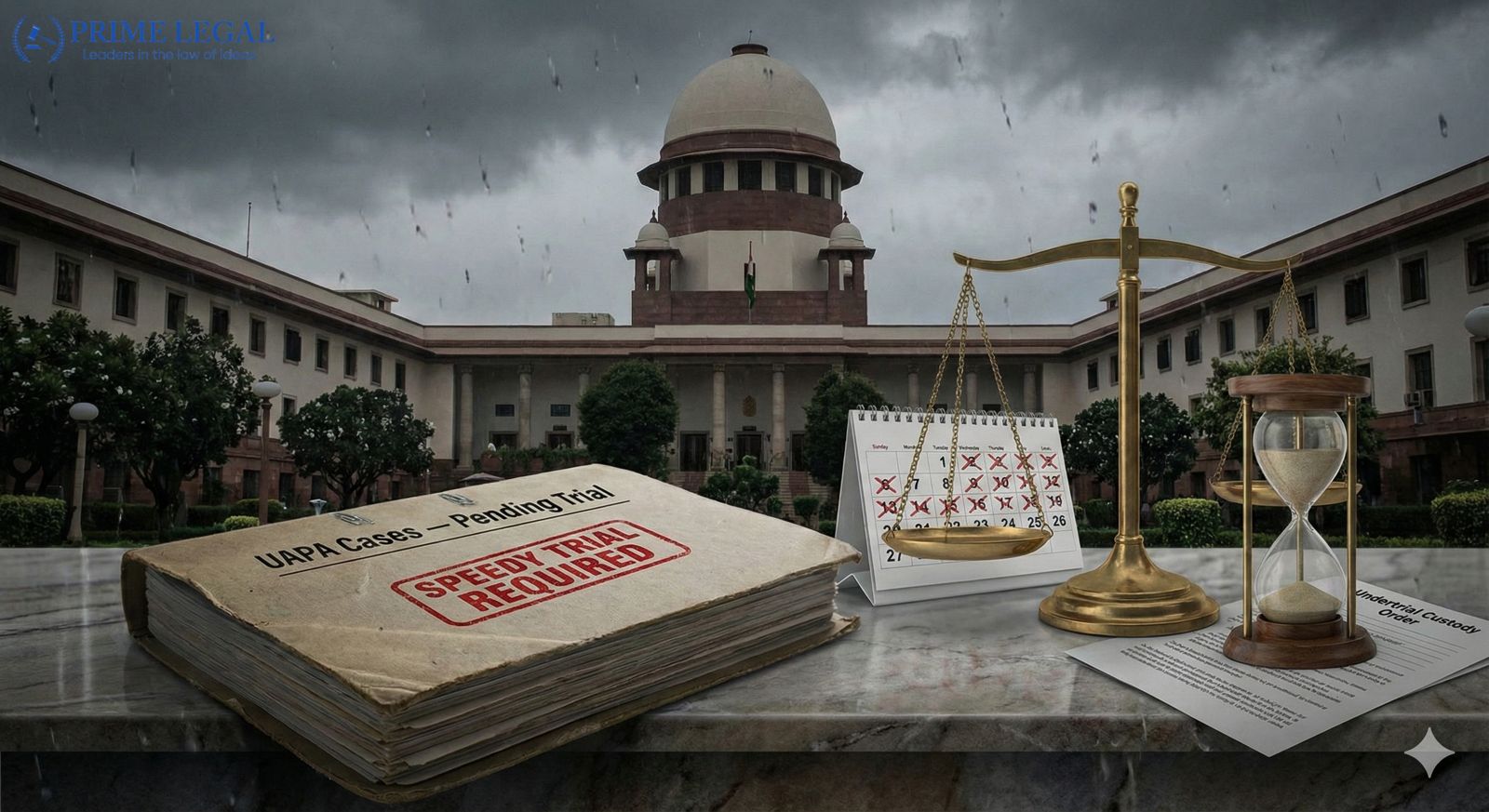
Article 21 not only grants the right to liberty but also grants the right to a speedy trial, which is immaterial to the grievous nature of the crime. Thus, the court accentuated the inability of the state to conclude the trial within a reasonable period and therefore did not reject the bail granted to the accused.
Judgement
The court gave the judgment not only to the parties involved but also to the parties outside the case. As a right in personam, the parties were granted the bail petition and were asked to appear in the case as and when required. While right in rem, the court asked all the high courts to examine the pending cases under strict laws like the UAPA. It has also instructed the courts to look at the number of special courts and session courts, and the lack of which needs to be stated to the concerned authorities. It also ordered the court to hear the old cases on a day-to-day basis and asked them not to grant adjournment for routine reasons.
Conclusion
The judgment upholds that, in light of Article 21, the right to a speedy trial is a basic check on the power of the State, despite serious crimes and special laws such as UAPA. Although it recognized the massive loss of life and property, it gave more importance to the constitutional right to liberty over other technical requirements because of the unreasonably delayed hearing. It also ordered the High Courts of every state to look into the delayed matters under UAPA for ensuring effective delivery of the justice and to stop unnecessary delay in the trial procedure by the concerned state authority.
“PRIME LEGAL is a full-service law firm that has won a National Award and has more than 20 years of experience in an array of sectors and practice areas. Prime legal falls into the category of best law firm, best lawyer, best family lawyer, best divorce lawyer, best divorce law firm, best criminal lawyer, best criminal law firm, best consumer lawyer, best civil lawyer.”
WRITTEN BY: SHARANYA M

