
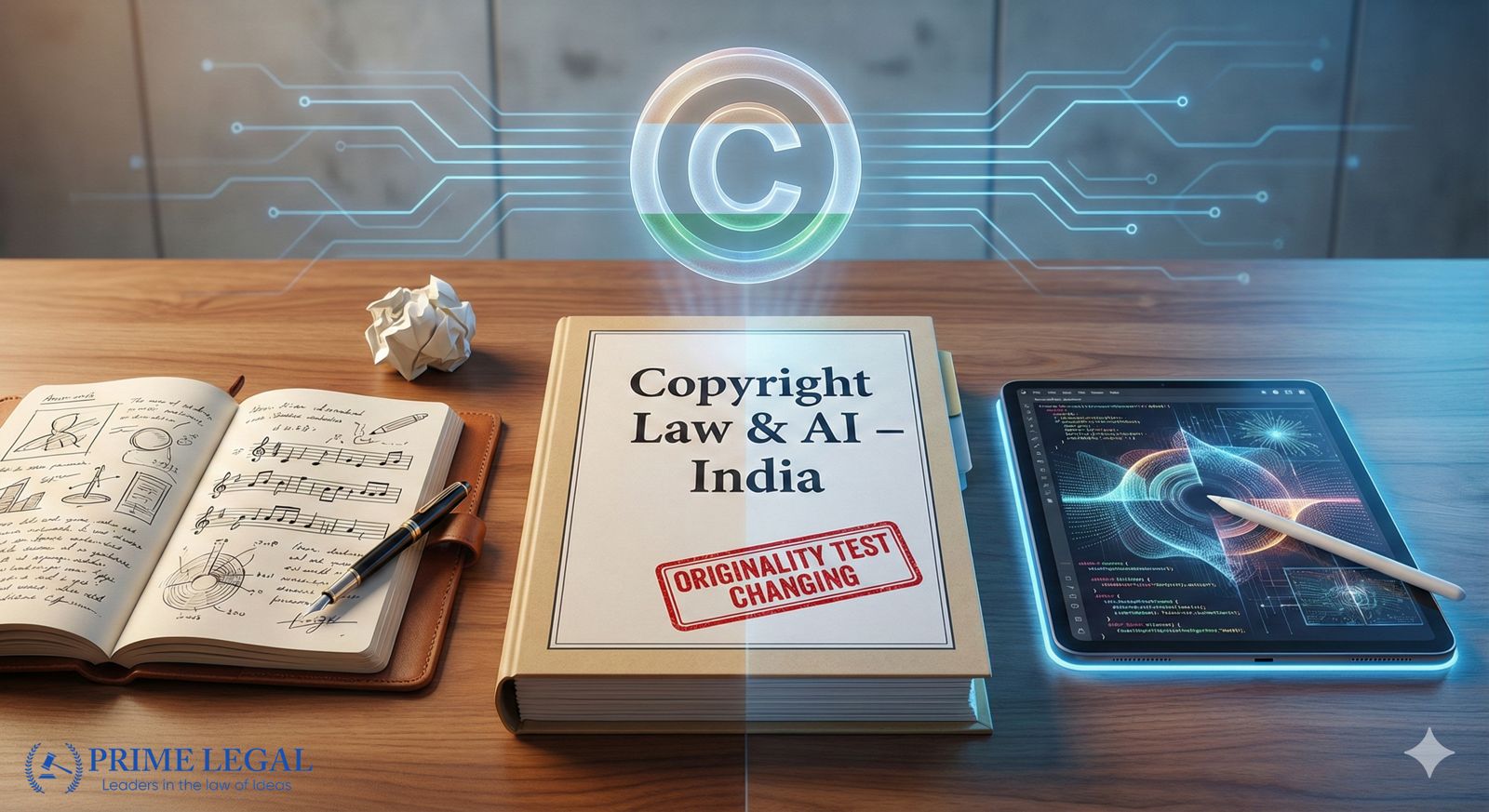
ABSTRACT
The world is moving towards AI (artificial intelligence). AI is now in every domain of life. However, the fundamental question would be on the ownership of an artistic work created with the help of AI or AI alone. As AI is gradually integrating into our daily lives, India needs to address the legal challenges surrounding copyright and AI. This article explores the existing Copyright Act of 1957, the shift in legal doctrines, and the recent developments regarding AI-generated works.
KEYWORDS
Artificial Intelligence, Copyright Act 1957, Sweat of the Brow, Modicum of Creativity, Suryast Case, Author Rights
INTRODUCTION
The world is moving towards AI (artificial intelligence). It spans from driverless cars to the field of medicine and the hospitality industry. AI is now in every domain of life. AI has been a part of our lives since the 1960s. However, it has become well known to the public after the introduction of an AI tool named ‘ChatGPT’ in the year 2022.
AI is a broad field of computer science. It focuses on processing larger databases to imitate human intelligence and perform tasks that would typically require human behavior. In the year 2022 Colorado State Fair Award was given to Jason M Allen as an emerging digital artist. Nevertheless, this was not well received by people as he had used AI. Therefore, the fundamental question would be on the ownership of an artistic work created with the help of AI or AI alone.
OVERVIEW OF COPYRIGHT ACT 1957 AND AI
In India, all the original artistic works are protected under the Copyrights Act of 1957. The act was intended to consolidate all the laws related to Copyright. It ensures public interest and protection of creators’ rights. Section 13 of the Act states the right to be granted to original literary, dramatic, musical, and artistic work. It incentivizes the creator/owner to produce several artistic works by giving them the exclusive right to the work created.
However, the law does not define the conditions to determine the term original, and it is left to be determined by the courts. The Indian courts, to determine the rights of the creator, were using the doctrine of ‘sweat of the brow’. Though section 13 of the acts calls for originality of the work, the doctrine of sweat of the brow protects work involving labour, skill, and effort rather than mere originality. This thus gave the creators the right over the data that was publicly available by just consolidation, i.e., if a person put in effort to combine the data, he/she could be awarded the right under the said Act. Consequently, this was a flaw of the ‘sweat of the brow’ principle.
SIGNIFICANT CHANGES AND DEVELOPMENTS IN AI COPYRIGHT
- Shift to Modicum of Creativity:
The flaw of the previous principle was noted down and was replaced by the doctrine of ‘modicum of creativity’ in the case of Eastern Book Company and Ors vs D B Modak and Anr (AIR 2008 SC 809). According to this, a minimum amount of creativity was required to term a work original. Thus, it granted the rights for the work involving a minimum level of creativity. The minimum level would be determined on a case-by-case basis. Traditionally, the work was solely created by humans; however, in the present era, it is also accommodated by AI. Ergo, the protection of rights to AI is in question.
- Arguments for Human-Directed Creativity:
Due to the doctrine of modicum of creativity, the Proponents advocating for the extension of copyright to AI-generated works emphasize the intellectual contribution of the human user through the crafting of input prompts. They state that directive prompts constitute the requisite original expression and skilled judgment, thereby classifying the resultant output as human-directed creativity, thereby asking for the grant of authorship.
- The Suryast Case Registration:
India’s position on AI-generated works was tested in the Suryast case [Registration of Suryast, No. A-135120/2020 (Copyright Office, Gov’t of India Nov. 2020)] wherein artist and lawyer Ankit Sahni sought copyright protection for an artwork created using an AI tool, RAGHAV (robust artificially intelligent graphics and art visualiser). The artwork was generated by an input of a digital photograph of a sunset, taken by Mr Sahni with an image of Vincent van Gogh’s The Starry Night. The AI tool, as per the prompt, integrated the base photograph with another prompt to reflect Van Gogh’s artistic style. Mr Sahni explained that he always had control over the extent of the style, thus mixing his original creation and the AI transformation. Subsequently, in November 2020, the Indian Copyright Office made the news for giving copyright registration to Suryast, becoming one of the first AI-created artworks to receive copyright. The prior application that only had the AI, RAGHAV, as the author was rejected, whereas the successive application that had a human, Ankit Sahni, and AI, RAGHAV, as co-authors was accepted. This was an important moment in Indian copyright law as AI was recognized as a co-author with a human for the first time ever.
CRITICAL APPRAISAL OF AI AUTHORSHIP
Conversely, critical scholars reject this attribution, citing that the mechanistic nature of the AI algorithm output is derived from existing large data sets, and as such is therefore considered non-original and thus does not meet the legal definition based on lack of independent creativity. However, a larger question on the grant of rights to AI in India shall be based on section 2(d)(iv) of the Act. It states the term ‘author’, which is meant as any natural person. This was stated in the case of Camlin Pvt Ltd v National Pencil Industries (AIR1986DELHI444 ). Accordingly, it can be construed that AI systems cannot be regarded as ‘authors’ or conferred with copyright protection. However, the question of AI as an author or co-author was not a part of the factual matrix in any such previous decisions.
However, many legal issues have come up with AI being accepted as a co-author.
CONCLUSION
As AI is gradually integrating into our daily lives, India needs to address the legal challenges surrounding it. The existing Copyright Act of 1957 does not recognise the work created by AI. This leaves uncertainty around who owns the rights to such content. Given the usage of AI tools in our day-to-day lives, a structured legal framework is necessary to prevent existing ambiguity. The initial step is to update the intellectual property laws to keep pace with technological advancements. Additionally, not only could the legislature create a separate legal category for AI-generated works, but it also needs to create a distinct category of a recognition module to differentiate AI work and human work. Thus, these steps would ensure the protection of human authorship while acknowledging the increasing role of AI in content creation.
“PRIME LEGAL is a full-service law firm that has won a National Award and has more than 20 years of experience in an array of sectors and practice areas. Prime legal falls into the category of best law firm, best lawyer, best family lawyer, best divorce lawyer, best divorce law firm, best criminal lawyer, best criminal law firm, best consumer lawyer, best civil lawyer.”
WRITTEN BY: SHARANYA M

