
INTRODUCTION
Intellectual Property is an intangible property. It fosters the protection of the inventiveness of the human mind by granting protection and adding value to poems, literature, symbols, etc., created by them. There are various laws under the intellectual properties, The Trademarks Act 1999, The Design Act 2000, The Copyright Act 1956, The Geographical Indications of Goods (Registration and Protection) Act 1999, Patent Act 1970, etc. All the said laws protect different intellectual properties, but all these acts largely work on a ground principle of the protection of creativity or the intangible effort put in by an individual, thereby fostering the creative mind.
TRADEMARKS ACT 1999
The Act protects the unique marks that help in the identification of goods and services from the rest of the population. In India, trademarks have been in practice since the Harappa and Mohenjo-Daro civilizations. The various seals and signs used by the kings and the merchants were known to be proprietary marks. It was operated to identify and distinguish their goods from the rest of the world. Later, the common law protected these marks in India, and the first trademark act in India came up in the year 1940, which was taken from the British Trade Mark Act of 1938 and was enacted in the year 1942.
This Act has undergone various amendments. The Act of 1942 was replaced by the Trade and Merchandise Act of 1958 to incorporate the Penal Laws and Sea Customs Act of 1958. This was replaced by the Trade Act of 1999 to enable the act to be in tune with TRIPS (Trade Related Aspects of Intellectual Property Rights), as India was its signatory. Subsequently, in the year 2010, the Act was amended to include international registration as per the Madrid protocol. Currently in India, the act is followed under the name of the Trade Union Act of 1999.
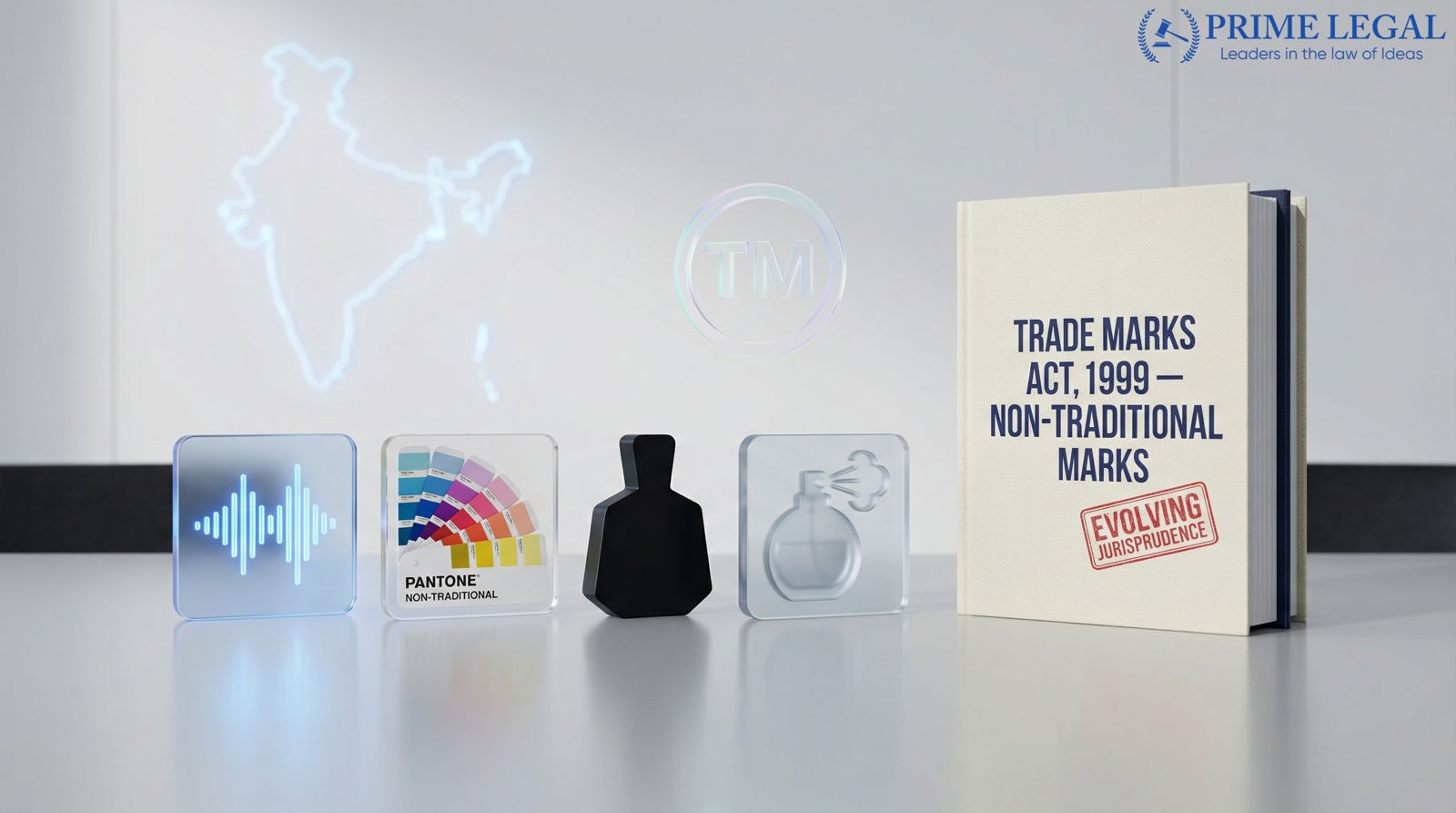
The definition of trademark, before the commencement of the Trade Mark Act of 1999, was any mark which pointed out the relationship between the goods and the person having the right as a proprietor. It was only after 1999 that words like color, shape, and packaging were added. These newly added terms, along with varied other evolving elements, are known as the non-conventional trademark. Thus, non-conventional trademarks are those that were not included in the earlier legislations.
THE NON-CONVENTIONAL TRADEMARK
The non-conventional Trademark is broadly of two categories
- Visual Trade Marks.
These are the marks that can be seen and understood via graphics and are further divided into
- a) Trade Dress.
It refers to the overall appearance of the good. It can include color, shape, or a combination of both. E.g., the shape of the product as seen in Toblerone, etc.
- b) Motion marks.
A moving mark that can be represented graphically by a set of snapshots, pictures, etc., is a motion mark. Motion marks were not recognized until 2017 in India. It was only after Rule 2(1)(k) motion marks were identified in the Indian context. E.g., Toshiba’s multimedia mark.
- c) Color Marks.
Granting the trademark to a single color may be difficult. It can only be granted when the color used is peculiar and is distinguished by the traders and the consumers. But usually an application for a single color is liable for an objection under section 9(1)(a) of the Trade Mark Act 1999, which grants ground for refusal of a mark if it is void of a distinct nature.
In the case of Christian Louboutin SAS vs. Abubaker and Ors. [2019 Delhi HC 11 (Apr. 11, 2019)] A single judge bench had refused to grant exclusive rights for a single color, i.e., a red sole for a shoe brand, highlighting the combination of colors as sine qua non. However, when this case was appealed, the divisional bench of the court emphasized that a registered trademark could not be dismissed before hearing the defendants.
- d) Hologram marks.
The holographic mark on a good can also be registered as a trademark. E.g., the holographic mark registered by the American Express card.
- e) Position Marks.
As the name suggests, the position of the mark on a product can also be registered in the country under the trademark law.
- Non-Visual Trade Marks.
The marks that are perceived by the senses other than the eyes follow under non-visual trademarks. These are further divided into
- a) Sound Mark.
Before the 2017 rule, there were no procedures established for the registration of sound. However, after the 2017 trademark rule, the proprietor has to send the music note in MP3 format, and the sound should not exceed more than 30 seconds, for registration. E.g. Airtel ringtone composed by A R Rahman, the ICICI jingle, etc.
- b) Olfactory Marks.
Another interesting variant of trademark is the smell/scent. This is allowed in various jurisdictions, such as South Korea, New Zealand, the United States of America, etc. However, in India, the law does not permit the use of olfactory marks as the marks cannot be represented graphically as per the laws of the country.
- c) Other Marks.
Various other marks like texture, taste, etc., are evolving in the domain of trademark. Texture as a trademark is one of the least used non-conventional modes of trademark in the USA under the United States Patent and Trademark Office. A wine bottle having velvet was registered as a trademark, as it served as a differentiating factor. Texture as a trademark is registrable in the Indian jurisdiction. E.g., Louis Vuitton was granted a trademark for its EPI STYLE pattern on handbags.
CURRENT STATUS OF NON-CONVENTIONAL TRADEMARK IN INDIA
India has recognised colour, texture, and sound as a trademark. Despite being included in 2017, in the Indian context, they have been beneficial in rendering a distinct nature to a product or service. This thereby serves the sine qua non of trademark and continues to grow and add value to the product or goods sold by the proprietor.
However, the registration of smell in India is not permissible as per the current laws in the country. In India, for the registration of a mark, it needs to be graphically represented, and a smell cannot be represented graphically; its description may vary from person to person and thus, might not serve the distinct category. The smell is classified as a mark in other jurisdictions due to varying distinctions in the registration. In the USA, smell is registered as a mark by submitting physical samples, scratch-and-sniff cards, or detailed olfactory descriptions, provided the smell being registered is not its functionality. This is not allowed in India, as the representation is strictly through graphical representation, except the sound. Thus, smell cannot be registered.
CONCLUSION
There is an impetus growth of trademarks in the country. Primarily, it focused only on word marks and symbols. However, by the inclusion of sound, motion marks, etc, the laws in the country showcased the changes that are required as per the needs of the society. Nevertheless, if smell is allowed to be registered in India, there needs to be a change in the mode of submission of the mark, as seen in the registration of the sounds in the year 2017.
“PRIME LEGAL is a full-service law firm that has won a National Award and has more than 20 years of experience in an array of sectors and practice areas. Prime legal falls into the category of best law firm, best lawyer, best family lawyer, best divorce lawyer, best divorce law firm, best criminal lawyer, best criminal law firm, best consumer lawyer, best civil lawyer.”
WRITTEN BY: SHARANYA M

