
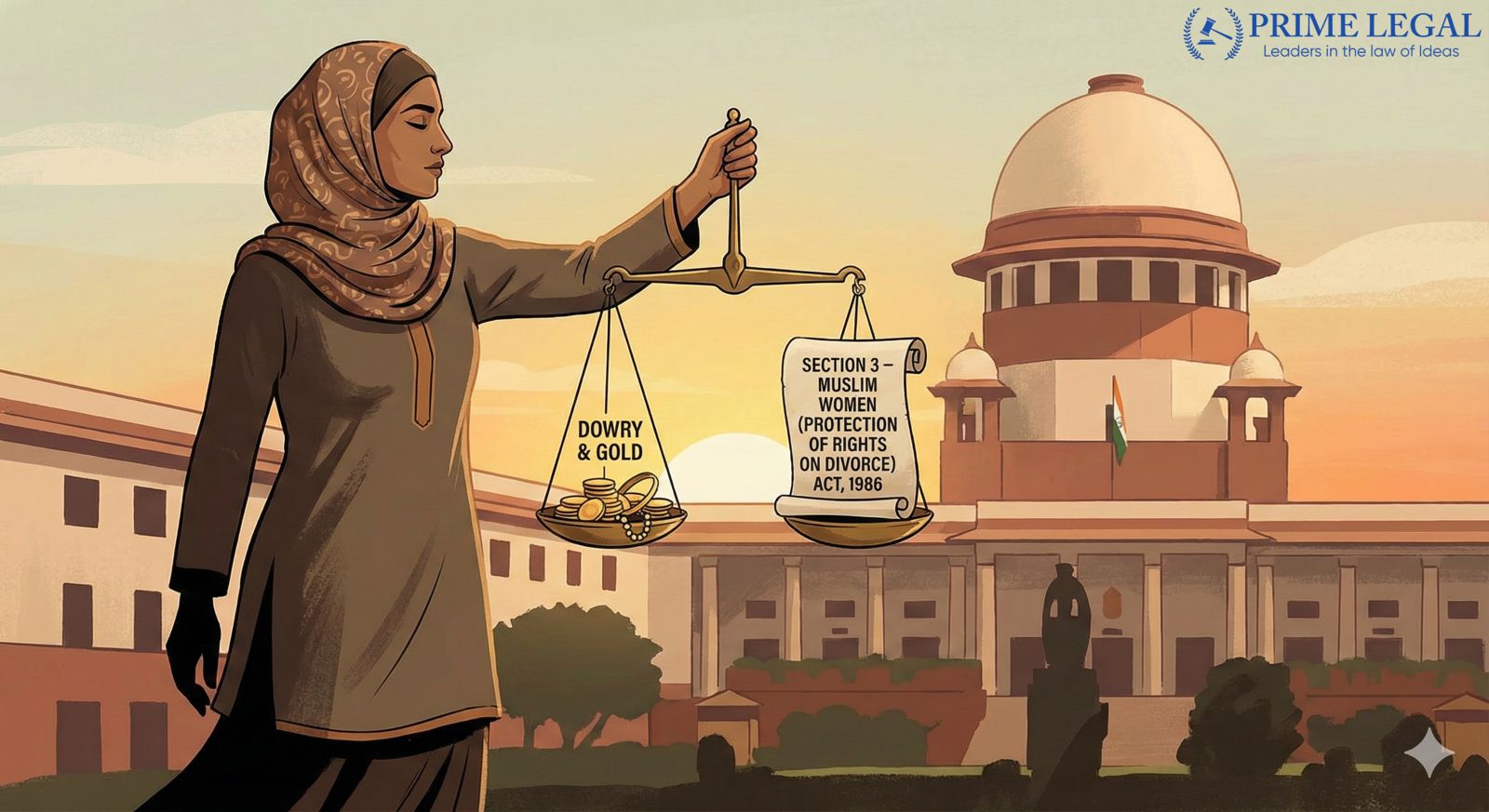
CASE NAME: Rousanara Begum VERSUS S.K. Salahuddin @ SK Salauddin & ANR.
CASE NUMBER: Criminal Appeal @ SLP (Crl.) D No.60854 of 2024
DATE: December 02, 2025
QUORUM: Hon’ble Mr. Justice Sanjay Karol and Hon’ble Mr. Justice Nongmeikapam Kotiswar Singh
FACTS
The present case is an appeal to the judgment of the Calcutta High Court dated 24th November 2022 and the order dated 31st January 2024, which had ruled against Appellant, Rousanara Begum.
The appellant married the respondent on 28 August 2005. Following a matrimonial discord, the appellant left her matrimonial home in 2009 and was subsequently divorced on 13 December 2011. The Appellant applied under Section 3 of The Muslim Women (Protection of Rights on Divorce) Act, 1986, seeking the return of cash, gold (30 bhori), and furniture, valued by the Appellant at Rs. 17.67 Lakhs. There were multiple rounds of litigation and remand in the Judicial Magistrate and the Sessions Court. ACJM (Additional Chief Judicial Magistrate) ordered the respondent (husband) to return 7 Lakhs and 30 bhori of gold to the appellant. Aggrieved by this decision, the respondent appealed the matter in the Calcutta High Court, where it set aside the ACJM’s order on the return of the valued amount. Thus, the wife filed an appeal in the Supreme Court.
ISSUES
- Whether goods given to a daughter or bridegroom at the time of marriage can be returned to the divorced daughter by application of law?
- Whether the “purposive construction” of the 1986 Act allow for the return of property despite technical discrepancies in documentary evidence?
LEGAL PROVISIONS
- Section 3(1) of the Muslim Women (Protection of Rights on Divorce) Act, 1986.
The section asks the former husband to pay a reasonable and fair amount of maintenance to the former wife. This includes all the properties given to the woman before or at the time of marriage by her friends or relatives. It shall also include the amount given to her by the husband’s friends or relatives.
- Article 227 of the Indian Constitution
This article gives the High Court the power to superintend over all the other courts within its jurisdiction. This article was allowed in the High Court as it gives the court the power to look into the abuse of process of the law, if any, and grant a decree to uphold justice. Thus, the High Court looked into the matters of the lower courts.
- Article 21 of the Indian Constitution.
The right to life and personal liberty was applied in this case with the lens of securing the dignity and financial protection of Muslim women,
ARGUMENTS
APPELLANT:
The appellant (wife) relied on the wording of section 3(1) of The Muslim Women (Protection of Rights on Divorce) Act, 1986. She stated the use of the word “all the properties” under the section and challenged the judgment of the High Court. She also heavily relied on Exhibit 8, which was the original marriage entry register stating 7 lakhs and 30 bohris of gold given to the son-in-law at the time of marriage, which needs to be returned after divorce.
RESPONDENT:
The respondent, unlike the appellant, produced Exhibit 7, i.e., the marriage certificate. The marriage certificate also stated the amount given, but it did not specify that it was given to the bridegroom. He argued that without specifications and discrepancies, he is not liable to pay the asked value as he would not be the custodian/guardian of the said amount.
ANALYSIS
The court held that the evidentiary value of the statement of the father in a concluded criminal trial could not outweigh the testimony of the Marriage Registrar, who had proved the overwriting and entry in the register.
The Court, relying on the Constitution Bench judgment in Daniel Latifi v. Union of India, AIR 2001 SUPREME COURT 3958, reiterated that Section 3 of the 1986 Act, carrying a non-obstante clause over other laws, was enacted to ensure fair provision and return of property to divorced women.
It distinguished “purposive construction” and said the 1986 Act seeks to secure the dignity and financial protection of Muslim women. This corroborates the meaning of Article 21 of the Constitution. Adjudication has to be informed by social justice and not merely by the technicalities of a civil dispute.
The Court found inherent patriarchal discrimination in smaller towns, which required it to interpret laws in the light of lived experiences by women.
JUDGEMENT
The Supreme Court overturned the judgment of the High Court and ordered the respondent to return the amount and the gold.
CONCLUSION
The judgment upholds the commitment to social justice adjudication over technical legalities in matrimonial disputes. By prioritizing the objective of the Muslim Women (Protection of Rights on Divorce) Act, 1986, the Court has ensured a divorced woman’s right to property and financial security.
“PRIME LEGAL is a full-service law firm that has won a National Award and has more than 20 years of experience in an array of sectors and practice areas. Prime legal falls into the category of best law firm, best lawyer, best family lawyer, best divorce lawyer, best divorce law firm, best criminal lawyer, best criminal law firm, best consumer lawyer, best civil lawyer.”
WRITTEN BY: SHARANYA M

