
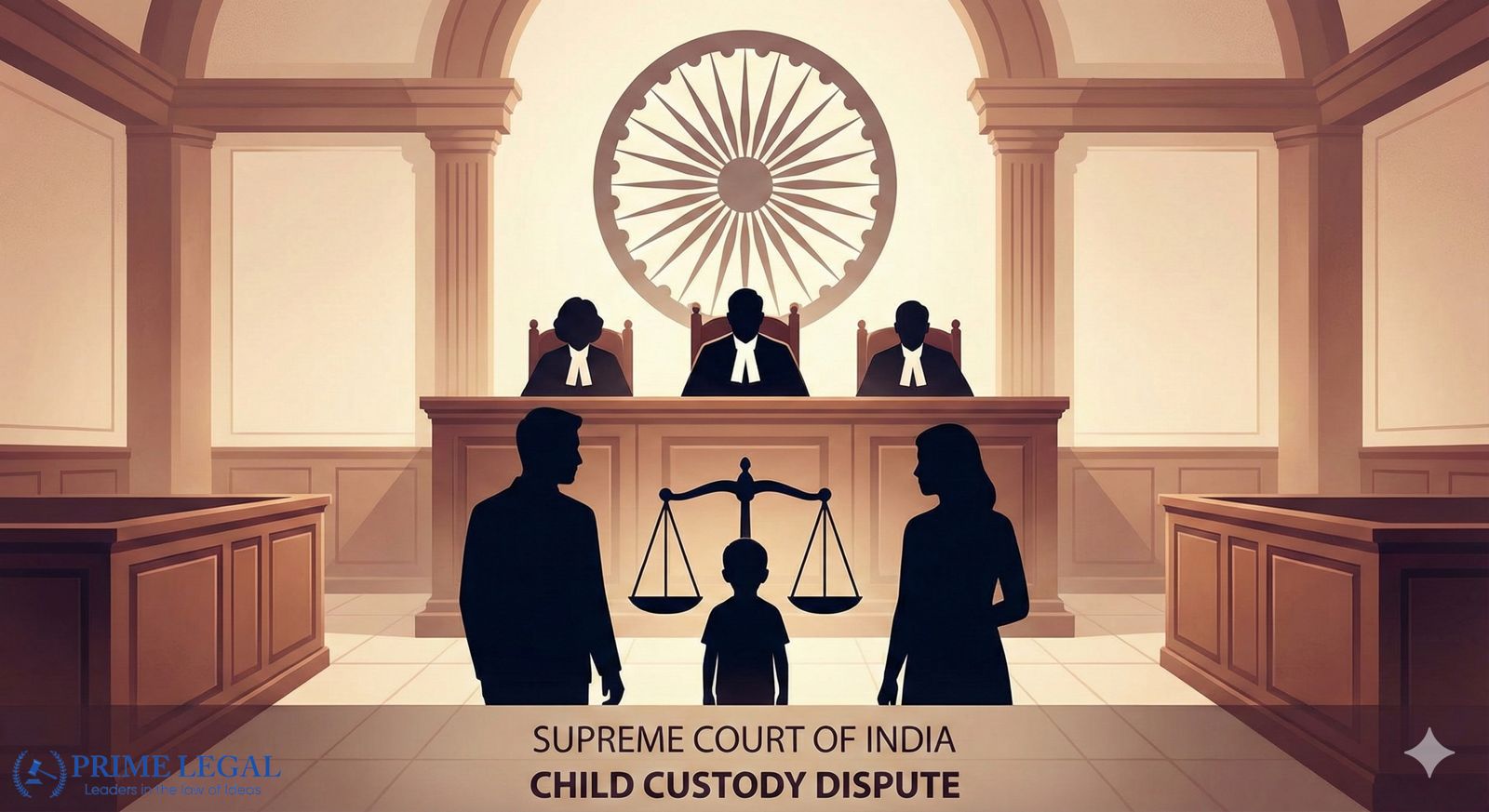
CASE NAME: Poonam Wadhwa v. Ajay Wadhwa & Ors.
CASE NUMBER: Criminal Appeal arising out of SLP (Crl.) No. 12458/2024
COURT: Supreme Court of India
DATE: 25 November 2025
QUORUM: Justice Manoj Misra, Justice Ujjal Bhuyan
FACTS
The appeal arose from a judgment of the Punjab and Haryana High Court which had set aside two lower-court orders granting custody of the minor child Arjun Wadhwa to his mother, the appellant. The High Court placed custody with the father and directed both parties to pursue appropriate remedies before the Family Court where related proceedings were pending.
When the custody issue was initially considered by the lower court, Arjun was below five years of age and was therefore placed with the mother. During the proceedings before the High Court, however, Arjun crossed the age of five. The child was produced before the Supreme Court on 21 August 2025, when the Court interacted with both children and their parents. In an earlier interim order, the Court had encouraged the parties to attempt reconciliation, stayed other pending inter se proceedings, and directed continued visitation as previously granted. By the time of the final hearing, the parties informed the Court that no settlement was possible. The appellant sought to challenge certain observations made by the High Court relating to working hours, distance from school, and past conduct during the Covid-19 period. The respondent supported the High Court’s reasoning and sought discharge of the visitation rights previously granted to the mother.
ISSUES
1.Whether the High Court was justified in placing the minor child, Arjun, in the custody of his father.
2.Whether factors like the parents’ work timings, the child’s travel distance to school, and the mother’s Covid-19–period travel were pertinent and properly evaluated in deciding custody.
3.Whether the mother’s previously granted visitation rights ought to remain in force or be withdrawn.
ARGUMENTS
APPELLANT
The appellant contended that the High Court’s reliance on her long working hours and the father’s work-from-home arrangement was misplaced, as she too could work from home. It was submitted that the High Court’s observations regarding distance to school were factually incorrect, since the travel time from the mother’s residence was comparable or even shorter. She also argued that the child’s clear desire to be with his sister — whose custody the father did not dispute — supported placing both children together with the mother.The appellant also disputed the High Court’s criticism of her travel abroad during the Covid-19 period, maintaining that she was fully vaccinated and had undertaken the trip for work-related reasons rather than out of irresponsibility.
RESPONDENT
The respondent supported the High Court’s decision and argued that moving the child back and forth between homes could affect his emotional stability. He therefore sought cancellation of the mother’s weekend visitation rights previously granted by the Supreme Court, contending that such frequent shifting was harmful to the child’s overall development.
ANALYSIS
The Supreme Court acknowledged that both parents were working and held that this factor alone could not determine the best interests of the child. The Court disagreed with the High Court’s reasoning that a parent working from home was inherently better suited to custody and clarified that modern family responsibilities often require both parents to work. The Court further observed that the appellant’s travel during the Covid-19 period, whether undertaken for work or even for a holiday, did not justify drawing any negative conclusions about her suitability as a parent.
At the same time, the Court emphasised the prevailing circumstances: Arjun was now older than five, remained enrolled in the same school without any disruption, enjoyed a supportive household environment with his father and other elder family members, and clearly did not wish to be separated from his father. The Court further observed that the High Court had not taken away the mother’s ability to seek custody before the appropriate statutory forum. Consequently, the Supreme Court found no basis to modify the current custody arrangement. At the same time, it refused the respondent’s prayer to cancel the mother’s visitation rights, affirming that such contact was important for the child.
JUDGEMENT
The Supreme Court dismissed the appeal and upheld the High Court’s order placing the custody of Arjun with his father. The Court declined the respondent’s request to discontinue the mother’s visitation rights, affirming that she would continue to meet the child as earlier permitted. It left both parties free to pursue their respective remedies before the competent courts. No order as to costs was made.
CONCLUSION
This judgment reinforces the principle that the welfare and present emotional comfort of the minor child must be the paramount consideration in custody matters. The Supreme Court acknowledged the High Court’s concerns but retained custody with the father, honoring the child’s preference and well-being, while maintaining the mother’s visitation rights.
“PRIME LEGAL is a full-service law firm that has won a National Award and has more than 20 years of experience in an array of sectors and practice areas. Prime legal falls into the category of best law firm, best lawyer, best family lawyer, best divorce lawyer, best divorce law firm, best criminal lawyer, best criminal law firm, best consumer lawyer, best civil lawyer.”
WRITTEN BY: ARCHITHA MANIKANTAN

